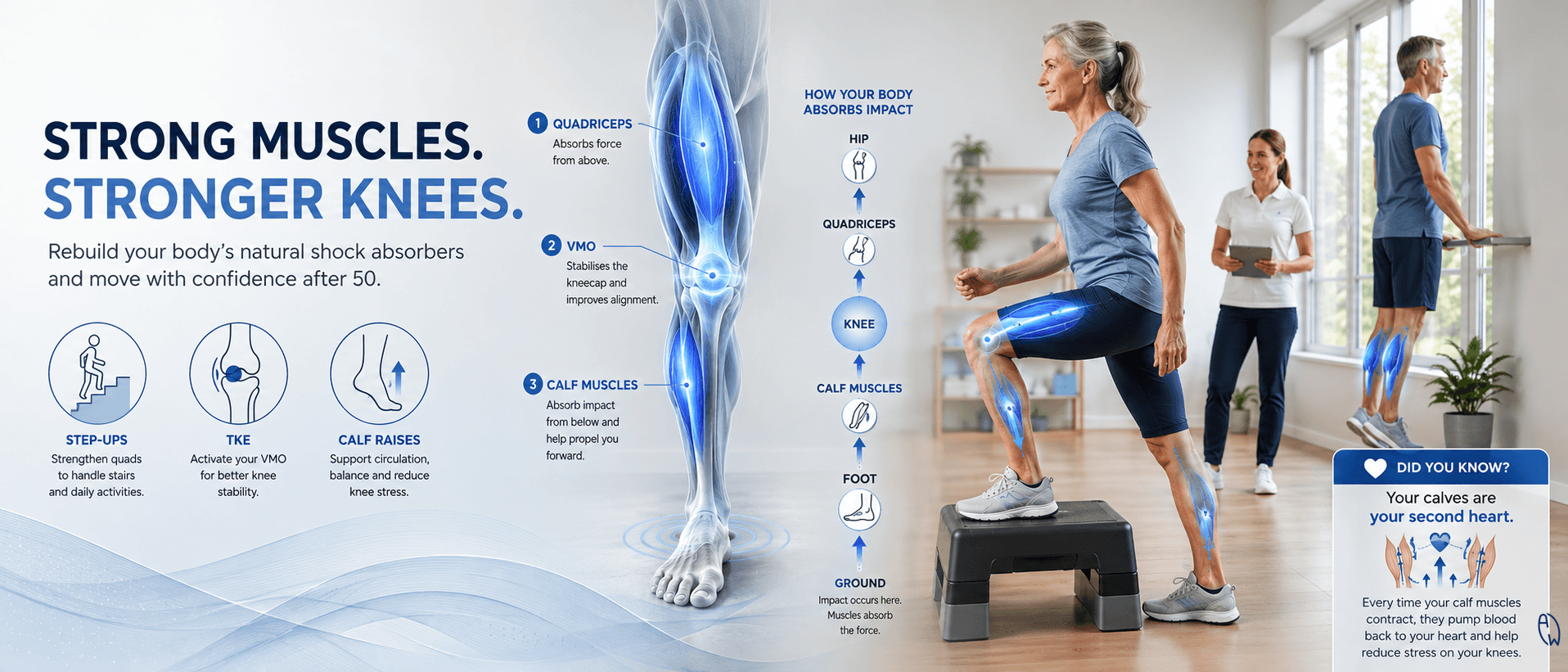
3 Exercises That Can Help Reduce Knee Pain After 50 (By Rebuilding Your Knee's Natural Shock Absorbers)
If you believe everything you read online, knee pain after 50 means it's time to:
❌ Give up squats.
❌ Buy a knee brace.
❌ Accept that surgery is inevitable.
Fortunately, that's not true for many people.
While some knee conditions do require medical treatment or surgery, many people develop knee pain because the muscles that normally protect the joint have gradually become weaker, less coordinated, or simply underused.
In other words...
Your knee may not be the real problem.
Instead, it may be doing a job that other muscles were designed to do.
The good news?
These muscles remain trainable at almost any age.
By strengthening three important "shock absorbers," you can often reduce unnecessary stress on your knees, improve your balance, and move with greater confidence.
Let's explore how.
Why Knee Pain Isn't Always a Knee Problem
Imagine driving a car with worn-out suspension.
Every bump in the road is transmitted directly into the chassis because the suspension can no longer absorb the impact.
Your body works in much the same way.
Every step creates forces that travel from the ground through your feet, ankles, knees, hips, pelvis, and spine.
Fortunately, your body has built-in shock absorbers.
Strong muscles don't simply move your joints—they absorb impact before it reaches the cartilage, ligaments, and bones.
When these muscles become weaker, the knee is forced to absorb more force with every step.
That's why activities such as:
-
Walking downstairs
-
Standing up from a chair
-
Hiking downhill
-
Carrying groceries
-
Getting out of the car
often become painful long before you notice problems during level walking.
The goal isn't simply to strengthen your legs.
The goal is to help your muscles take back the job they were designed to do.
Your Knee Depends on Three Natural Shock Absorbers
Your knee doesn't work in isolation.
It sits between your hip and your foot, meaning everything above and below it influences how much force passes through the joint.
Three muscle groups are especially important.
1. Your Quadriceps — The Front Shock Absorber
Your quadriceps control your body as you walk downstairs, lower into a chair, or climb stairs.
Without strong quadriceps, the knee joint absorbs significantly more force.
2. Your VMO — The Knee Stabiliser
The vastus medialis oblique (VMO) is the small inner portion of your quadriceps.
Although relatively small, it plays a vital role in helping the kneecap move smoothly during walking, climbing stairs, and standing up.
One of the first muscles to become less active after knee pain or prolonged rest is the VMO.
Reactivating it helps improve knee control and confidence during movement.
3. Your Calves — The Lower Shock Absorber
Most people don't associate calf strength with knee pain.
But every time your foot touches the ground, your calf muscles begin working before your knee does.
They help:
-
Absorb landing forces
-
Slow your body as you walk
-
Push you into your next step
-
Improve balance
-
Reduce the amount of force travelling upward into the knee
Weak calves quietly shift extra work to the joint above them.
Exercise 1: Step-Ups
Why It Works
Every time you walk downstairs, gravity pulls your body downward.
Your quadriceps must work hard to slow your body against gravity.
This is called eccentric muscle control, one of the most demanding jobs your knee performs every day.
If your quadriceps are weak, your knee absorbs more of that force.
Step-ups strengthen this exact movement pattern, allowing your muscles to do more of the work instead of your knee.
How to Perform Step-Ups
-
Use a stable step or low platform.
-
Place your entire foot on the step.
-
Push through your whole foot to stand.
-
Fully straighten your knee.
-
Lower yourself slowly with control.
Perform:
-
10 repetitions each leg
-
3 sets
-
3 times per week
Common Mistakes
-
Rushing the lowering phase
-
Letting the knee collapse inward
-
Pushing only through the toes
-
Using momentum instead of muscle control
Remember: the way down is just as important as the way up.
Exercise 2: Terminal Knee Extensions (TKE)
Why It Works
After knee pain, your brain naturally tries to protect the joint.
One of the first muscles to become "switched off" is the VMO.
Even after the pain settles, the muscle may still not activate properly.
Terminal Knee Extensions help reactivate this important stabilising muscle.
Improved activation can support smoother kneecap movement and better knee stability during everyday activities.
How to Perform
-
Secure a resistance band behind your knee.
-
Begin with a slight bend.
-
Straighten your knee fully.
-
Pause for one second.
-
Return slowly.
Perform:
-
12–15 repetitions
-
3 sets
-
3 times per week
Focus on squeezing the front of your thigh rather than simply moving your leg.
Exercise 3: Calf Raises
Why They Work
Your calf muscles begin absorbing force before your knee even starts to bend.
Every step you take relies on your calves to slow your body, stabilise your ankle, and help propel you forward.
If they're weak, more force is transferred upward into the knee.
Strong calves help make walking more efficient while reducing unnecessary stress on the joint.
How to Perform
-
Stand beside a wall or countertop.
-
Rise onto your toes as high as comfortable.
-
Pause briefly.
-
Lower slowly over 2–3 seconds.
Perform:
-
12–15 repetitions
-
3 sets
-
Daily
If single-leg calf raises are too difficult, begin using both legs.
💡 Did You Know?
Your calf muscles are often called your "second heart."
Every time they contract, they squeeze the deep veins in your legs, helping pump blood back toward your heart against gravity. Tiny one-way valves inside the veins prevent blood from flowing backward, making each calf contraction a natural circulation pump.
That's one reason regular walking is so good for your health.
But that's not all.
Your calves also act as one of your body's most important shock absorbers. Every time your foot lands, they help absorb impact before it reaches your knee.
Strong calves don't just support healthy circulation—they also reduce the workload on your knees with every step.
Something as simple as daily calf raises can benefit both your cardiovascular system and your joints.
The Best Exercise Might Already Be in Your Home
You don't need expensive equipment.
Simply walking up and down your stairs slowly can become an excellent strengthening exercise.
Take your time.
Use the handrail if needed.
As your strength improves, add a gentle calf raise at the top of each step.
Consistency is far more important than intensity.
Build Strength Into Your Daily Routine
The best exercise is the one you'll actually keep doing.
Try attaching these movements to habits you already have.
-
Do calf raises while brushing your teeth.
-
Walk one extra flight of stairs each day.
-
Perform step-ups during television commercial breaks.
-
Stand up from a chair without using your hands several times a day.
These small habits may seem insignificant, but performed consistently, they add up to meaningful improvements over time.
Pain Doesn't Always Mean More Damage
One of the biggest myths about knee pain is that pain always means your joint is getting worse.
In reality, pain is much more complex.
It can be influenced by:
-
Muscle strength
-
Balance
-
Previous injuries
-
Sleep quality
-
Stress
-
Confidence in movement
-
Joint sensitivity
This explains why two people with similar X-rays can experience very different levels of pain.
For many people, gradually rebuilding strength and confidence helps reduce pain and improve daily function.
Look Beyond the Knee
The knee rarely works alone.
Persistent knee pain may also be influenced by:
-
Weak hips
-
Limited ankle mobility
-
Poor foot mechanics
-
Reduced balance
-
Changes in posture
-
Altered walking patterns
At All Well Scoliosis Centre, we believe successful rehabilitation begins by understanding how the entire body moves together. Rather than focusing only on the painful joint, we assess posture, balance, muscle strength, mobility, and movement patterns to identify contributing factors.
This whole-body approach reflects the same principles we use in scoliosis rehabilitation through the CLEAR Protocol®, ScoliBalance®, and ScoliBrace®, recognising that lasting improvements often come from restoring healthy movement patterns throughout the body—not simply treating one painful area.
Frequently Asked Questions
Should I stop squatting if I have knee pain?
Not necessarily. Squats are not inherently bad for your knees. If deep squats are uncomfortable, reduce the depth, use a chair for support, or hold onto a stable surface while gradually rebuilding strength.
Is walking good for knee pain after 50?
For many people, yes. Walking encourages joint movement, strengthens muscles, improves circulation, and activates the calf muscle pump. Start with a comfortable distance and increase gradually.
Do I need a knee brace?
A knee brace may provide temporary support for some conditions, but it does not replace strengthening the muscles that naturally protect your knee. Always seek professional advice if you're unsure.
How long does it take before exercises help?
Many people notice improvements after several weeks of consistent exercise. Progress depends on the underlying cause of the pain, your overall health, and how regularly you perform the exercises.
When should I seek medical advice?
Arrange a professional assessment if you experience severe swelling, locking, instability, significant pain after an injury, or symptoms that continue despite appropriate exercise.
Final Thoughts
Your knees weren't designed to carry every step alone.
They rely on a team of muscles above and below the joint to absorb force, maintain balance, and keep you moving confidently throughout life.
If those muscles become weaker with age, the answer isn't always to move less.
More often, it's to move better.
By strengthening your quadriceps, reactivating your VMO, and building stronger calves, you're rebuilding your body's natural shock absorbers—helping your knees do the job they were designed to do.
Start small.
Stay consistent.
Your future self will thank you for every step.