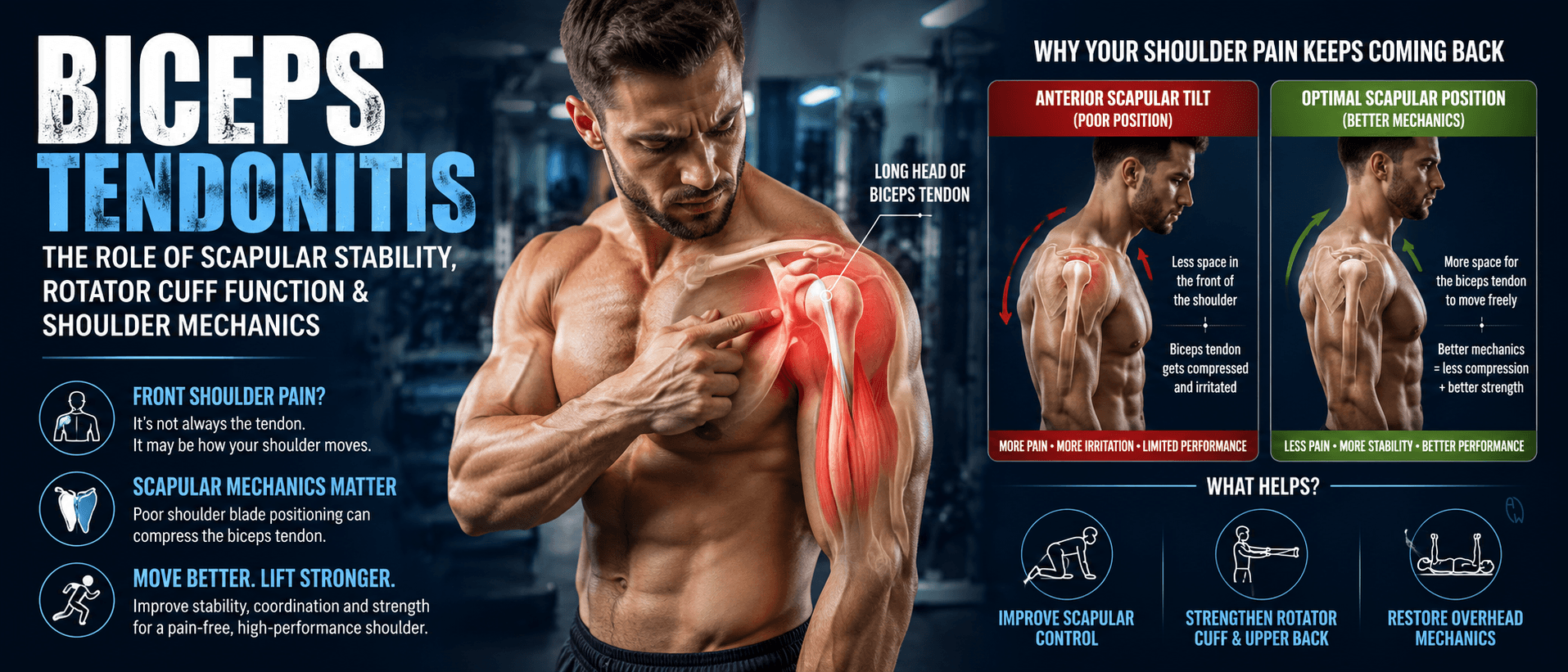
Biceps Tendonitis: The Hidden Shoulder Mechanics Behind Recurring Front Shoulder Pain
Why Does Biceps Tendonitis Keep Coming Back?
Most people feel pain at the front of their shoulder and immediately reach for the usual solutions:
-
Rest
-
Ice
-
Stretching
-
Massage
-
Foam rolling
These approaches may temporarily reduce discomfort, but many people notice that as soon as they return to the gym, sports, or daily activities, the pain returns.
Bench pressing hurts.
Pull-ups hurt.
Reaching overhead hurts.
Sleeping on the shoulder hurts.
The reason may be that the painful tendon is not the entire problem.
In many cases, the underlying issue involves how the shoulder blade moves, how the shoulder joint is positioned, and whether the shoulder has a stable foundation to move from.
Understanding these mechanics can help explain why some cases of biceps tendonitis become persistent and why treating symptoms alone often fails to create lasting improvement.
What Is Biceps Tendonitis?
Biceps tendonitis refers to irritation of the long head of the biceps tendon, one of the tendons that runs through the front of the shoulder before attaching into the shoulder joint.
This tendon plays an important role in:
-
Shoulder stability
-
Lifting movements
-
Pulling movements
-
Overhead activities
-
Deceleration during throwing and sporting actions
When the tendon becomes overloaded or repeatedly compressed, it may become painful and sensitive.
Common symptoms include:
-
Pain at the front of the shoulder
-
Pain when lifting the arm overhead
-
Pain during push-ups, bench press, or pull-ups
-
Tenderness in the front shoulder groove
-
Clicking or catching sensations
-
Weakness when lifting objects
-
Night pain when sleeping on the affected side
A Real Case: "I Woke Up and Couldn't Lift My Arm"
Recently, a lady in her late 40s came into the clinic asking whether I could help her.
She woke up one morning and suddenly found it difficult to lift her arm.
She could not comfortably reach overhead and every movement felt restricted.
Her immediate concern was that she had injured something while sleeping.
This is a common fear.
Many people assume that if movement suddenly becomes painful, there must be a torn muscle, damaged tendon, or serious injury.
While injuries can certainly occur, many shoulder problems are actually movement and positioning problems rather than purely tissue damage.
The question becomes:
Why can't the shoulder find a comfortable position to move in?
To answer that, we need to understand a concept called scapulohumeral rhythm.
What Is Scapulohumeral Rhythm?
Most people think the shoulder is a single joint.
In reality, lifting your arm is a coordinated movement involving several structures working together:
-
Shoulder blade (scapula)
-
Collarbone (clavicle)
-
Breastbone (sternum)
-
Upper arm bone (humerus)
-
Thoracic spine (upper back)
When these structures move efficiently together, the shoulder can achieve smooth, pain-free movement.
When one part stops contributing properly, the shoulder joint may be forced to compensate.
Think of it like a team carrying a heavy table.
If one person lets go, everyone else has to work harder.
The shoulder works exactly the same way.
The glenohumeral joint (the ball-and-socket shoulder joint) relies heavily on the shoulder blade and surrounding muscles to create the positioning needed for efficient movement.
Without that support, stress may be transferred to structures such as the biceps tendon.
Why Shoulder Stability Matters More Than Most People Realise
Many people chase mobility.
They stretch harder.
They foam roll longer.
They try to force more range of motion.
But mobility without stability is often temporary.
A useful definition of stability is:
The ability to resist unwanted movement while allowing desired movement.
Your shoulder can only move efficiently when nearby joints and muscles provide a stable platform.
If the shoulder blade cannot maintain its position, the shoulder joint may lose its optimal alignment.
The body often responds by creating protective stiffness, compensation patterns, or pain.
This means the sensation of "tightness" may not always come from muscles that need stretching.
Sometimes the body feels tight because it does not trust the movement.
Before asking:
"How do I get more shoulder mobility?"
A better question may be:
What needs to remain stable for my shoulder to move there safely?
Understanding the Shoulder Girdle: Your Foundation for Movement
The shoulder is attached to a structure known as the shoulder girdle.
The shoulder girdle consists of:
-
Scapula (shoulder blade)
-
Clavicle (collarbone)
-
Sternum (breastbone)
Together they create the foundation that allows the arm to move.
If this foundation becomes unstable due to:
-
Muscle weakness
-
Poor posture
-
Reduced upper back mobility
-
Fatigue
-
Poor movement habits
-
Lack of coordination
the shoulder joint may struggle to function efficiently.
This is why shoulder rehabilitation often extends far beyond the painful area itself.
The Rotator Cuff: The Steering System of the Shoulder
The rotator cuff consists of four muscles:
-
Supraspinatus
-
Infraspinatus
-
Teres Minor
-
Subscapularis
Each muscle has its own individual action, but together they perform one critical role:
They help keep the ball of the shoulder centred within the socket throughout movement.
Think of the rotator cuff as the steering system of the shoulder.
The larger muscles create force.
The rotator cuff controls where that force goes.
When the rotator cuff cannot perform this role effectively, the shoulder may drift into positions that increase stress on surrounding structures, including the long head of the biceps tendon.
How Poor Scapular Position Can Irritate the Biceps Tendon
The long head of the biceps tendon sits within a groove at the front of the shoulder.
When the shoulder blade remains tipped forward excessively—a position known as anterior scapular tilt—the available space around the tendon may decrease.
Over time, repetitive activities such as:
-
Bench pressing
-
Push-ups
-
Pull-ups
-
Overhead lifting
-
Throwing sports
-
Swimming
-
Rowing
may repeatedly compress or overload the tendon.
The result is irritation that keeps returning despite temporary symptom relief.
This is one reason many people experience recurring shoulder pain even after rest.
Nothing changed about the mechanics that created the stress in the first place.
Common Causes of Biceps Tendonitis
Several factors may contribute to biceps tendon irritation:
-
Poor scapular control
-
Rotator cuff weakness
-
Rounded shoulder posture
-
Excessive anterior shoulder loading
-
Reduced thoracic spine mobility
-
Training errors
-
Sudden increases in exercise volume
-
Repetitive overhead activities
-
Muscle imbalances
-
Poor movement awareness
-
Previous shoulder injuries
Often, multiple factors are involved simultaneously.
Exercises That May Help Improve Shoulder Mechanics
The goal is not simply to reduce pain.
The goal is to improve how the shoulder functions.
1. Quad Kneel Scapular Depressions
This exercise helps teach the shoulder blade to sit down and back against the ribcage instead of hanging forward.
Potential benefits include:
-
Improved scapular awareness
-
Better shoulder positioning
-
Reduced anterior shoulder stress
-
Improved shoulder stability
2. Banded Extension With External Rotation
This movement loads the shoulder in a more favourable position while encouraging improved chest and shoulder mechanics.
Potential benefits include:
-
Improved posterior shoulder activation
-
Better rotator cuff engagement
-
Improved posture awareness
-
Reduced stress at the front of the shoulder
3. Supine Banded Y's
This exercise helps strengthen the upper back and shoulder stabilisers during overhead movement.
Potential benefits include:
-
Improved upward rotation
-
Better overhead mechanics
-
Increased lower trapezius activation
-
Improved shoulder blade control
When Should You Seek Professional Help?
It is important to seek professional assessment if you experience:
-
Persistent shoulder pain
-
Significant weakness
-
Loss of shoulder function
-
Pain that disrupts sleep
-
Sudden inability to lift the arm
-
Progressive symptoms despite rest
A comprehensive assessment can help determine whether the issue involves:
-
Biceps tendon irritation
-
Rotator cuff dysfunction
-
Scapular control deficits
-
Mobility restrictions
-
Muscle imbalances
-
Shoulder impingement
-
Other shoulder conditions
Final Thoughts
Biceps tendonitis is often more than just an inflamed tendon.
The tendon may be the structure producing symptoms, but the reason it became overloaded may involve the entire shoulder system.
The shoulder blade, collarbone, breastbone, rotator cuff, upper back, and arm all need to work together through a coordinated process known as scapulohumeral rhythm.
When that coordination breaks down, the shoulder may struggle to find efficient positions during movement, leading to repeated irritation at the front of the shoulder.
Instead of only asking how to reduce pain, consider asking:
What needs to remain stable for my shoulder to move well?
Because when the foundation improves, the shoulder often follows.
Improving stability, coordination, strength, and movement quality may be the key to helping the shoulder function better for the long term rather than simply managing symptoms temporarily.