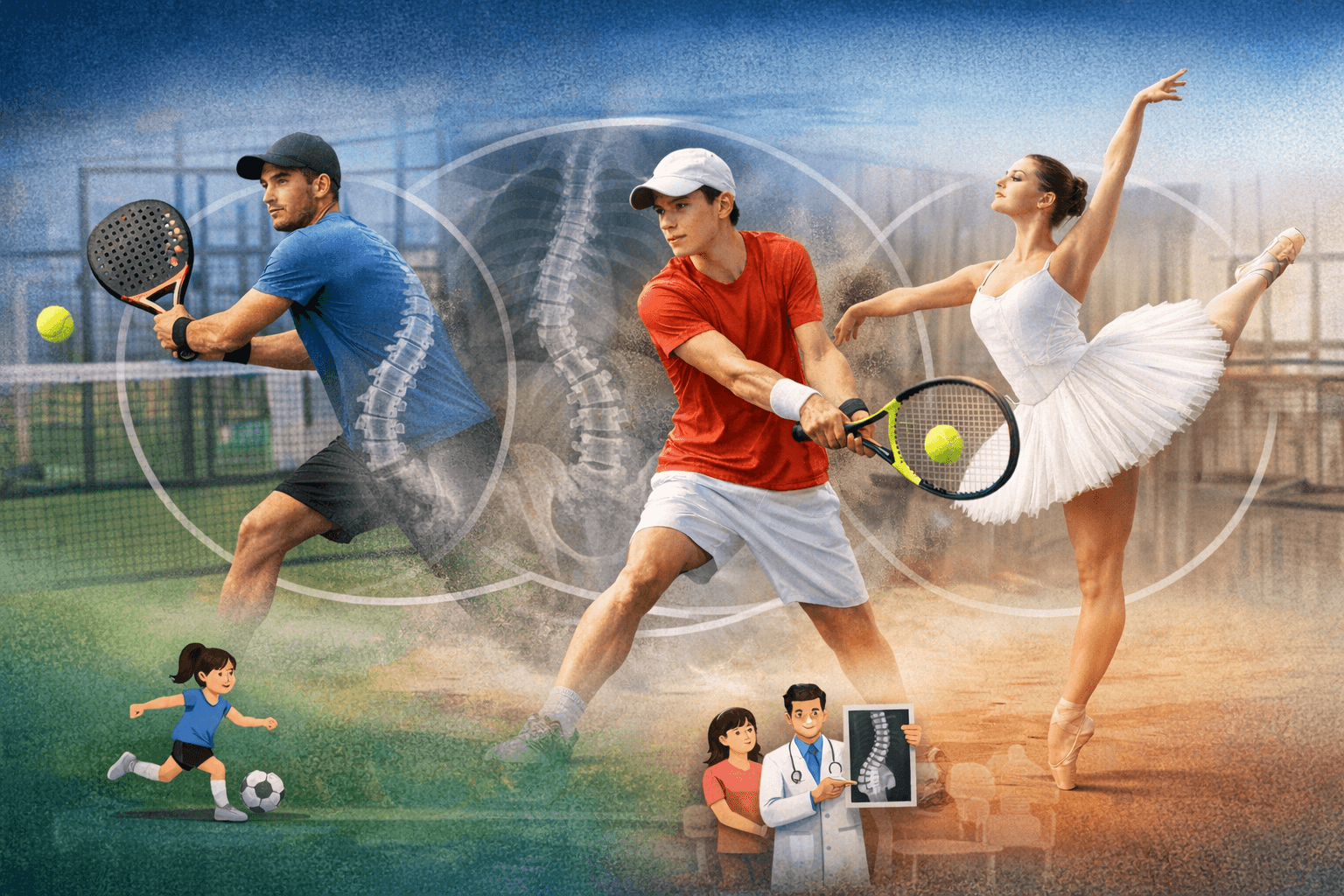
Can Playing Padel Cause Scoliosis?
Short answer:
No. Current scientific evidence does not show that padel causes scoliosis.
Scoliosis — especially idiopathic scoliosis — is a complex, three-dimensional spinal condition influenced primarily by genetics, growth, and neuromuscular factors, not by a single sport. While some sports involve asymmetrical movement, asymmetry alone has not been proven to cause structural scoliosis.
This is an important clarification for parents, athletes, and adults who worry that certain activities may “damage” the spine.
Understanding Idiopathic Scoliosis
Idiopathic scoliosis (IS) accounts for 80–90% of scoliosis cases and has no single identifiable cause. It is diagnosed using X-ray imaging and Cobb angle measurements, not posture alone.
Key distinction:
Muscle imbalance or uneven posture ≠ structural scoliosis.
Many sports can create temporary postural adaptations — but structural scoliosis involves changes in spinal alignment and vertebral rotation, which are not caused simply by movement patterns.
Padel, Tennis & Racket Sports
Padel and tennis are often questioned because they involve repetitive unilateral movements.
What sports science shows:
-
Studies on tennis players, a comparable asymmetric racket sport, found no increased prevalence of scoliosis or spinal deformity compared to non-athletes.
-
Reviews on padel injuries focus mainly on shoulder, elbow, and lower back strain, not scoliosis.
-
No peer-reviewed study currently identifies padel as a risk factor for scoliosis development.
External reference (sports science):
-
PubMed – Spinal adaptations in adolescent tennis players
Conclusion:
Playing padel or tennis does not cause scoliosis, even though the sport is asymmetric.
Ballet and Dance: Why Are They Often Mentioned?
Ballet is one of the few activities consistently associated with higher scoliosis prevalence in research.
What the research suggests:
-
Ballet dancers show higher rates of idiopathic scoliosis compared to non-dancers.
-
This is likely influenced by:
-
Early specialization
-
High training volume
-
Joint hypermobility
-
Selection bias (children with flexible bodies being drawn into dance)
-
❗ Important:
Association does not equal causation. There is no proof that ballet causes scoliosis — only that scoliosis appears more frequently in this population.
External reference:
-
Journal of Dance Medicine & Science – Prevalence of scoliosis in ballet dancers
Other Asymmetric or High-Load Sports
Gymnastics
-
Similar to ballet, artistic gymnastics shows higher scoliosis prevalence, especially at elite levels.
-
Likely influenced by growth, flexibility, and training intensity, not movement asymmetry alone.
Swimming
- Surprisingly, some studies report scoliosis presence among swimmers — but this is believed to reflect referral bias, not causation.
Team Sports (Football, Basketball, Handball)
-
Generally show no increased scoliosis risk
-
Some studies suggest lower prevalence, possibly due to balanced movement patterns.
External systematic review:
-
Idiopathic scoliosis and sports participation (Life, MDPI)
[https://www.mdpi.com/2075-1729/13/5/1180]
What Large Reviews & Meta-Analyses Say
Across thousands of athletes:
-
No sport has been proven to cause idiopathic scoliosis
-
General physical activity may reduce scoliosis risk
-
Ballet and gymnastics show association — but direction of causality remains unclear
External reference:
-
Systematic review – Scoliosis prevalence in athletes
[https://pubmed.ncbi.nlm.nih.gov/35999823/]
Why This Matters for Parents & Athletes
✔ Sports do not cause scoliosis
✔ Asymmetric movement alone is not dangerous
✔ Avoiding sports out of fear can limit healthy growth and confidence
✔ Early screening and monitoring matter more than sport restriction
Should Children with Scoliosis Stop Playing Sports?
No. In most cases:
-
Physical activity is encouraged
-
Sports support bone health, coordination, and mental wellbeing
-
Training should be balanced and supervised, especially during growth spurts
Frequently Asked Questions
Can asymmetric sports worsen scoliosis?
They do not cause scoliosis, but unbalanced training without conditioning may contribute to muscle tightness or discomfort. Monitoring and corrective exercise help.
Is ballet bad for the spine?
No. Ballet does not damage the spine, but screening and load management are important for young dancers.
Is padel safe for someone with scoliosis?
Yes — when combined with:
-
Good technique
-
Strength training
-
Regular spinal monitoring
Final Takeaway
There is no scientific evidence that padel, tennis, or most asymmetric sports cause scoliosis. Ballet and gymnastics show higher scoliosis prevalence, but causation has not been established.
The spine thrives on movement, not fear — and informed, balanced activity remains one of the best supports for long-term spinal health.