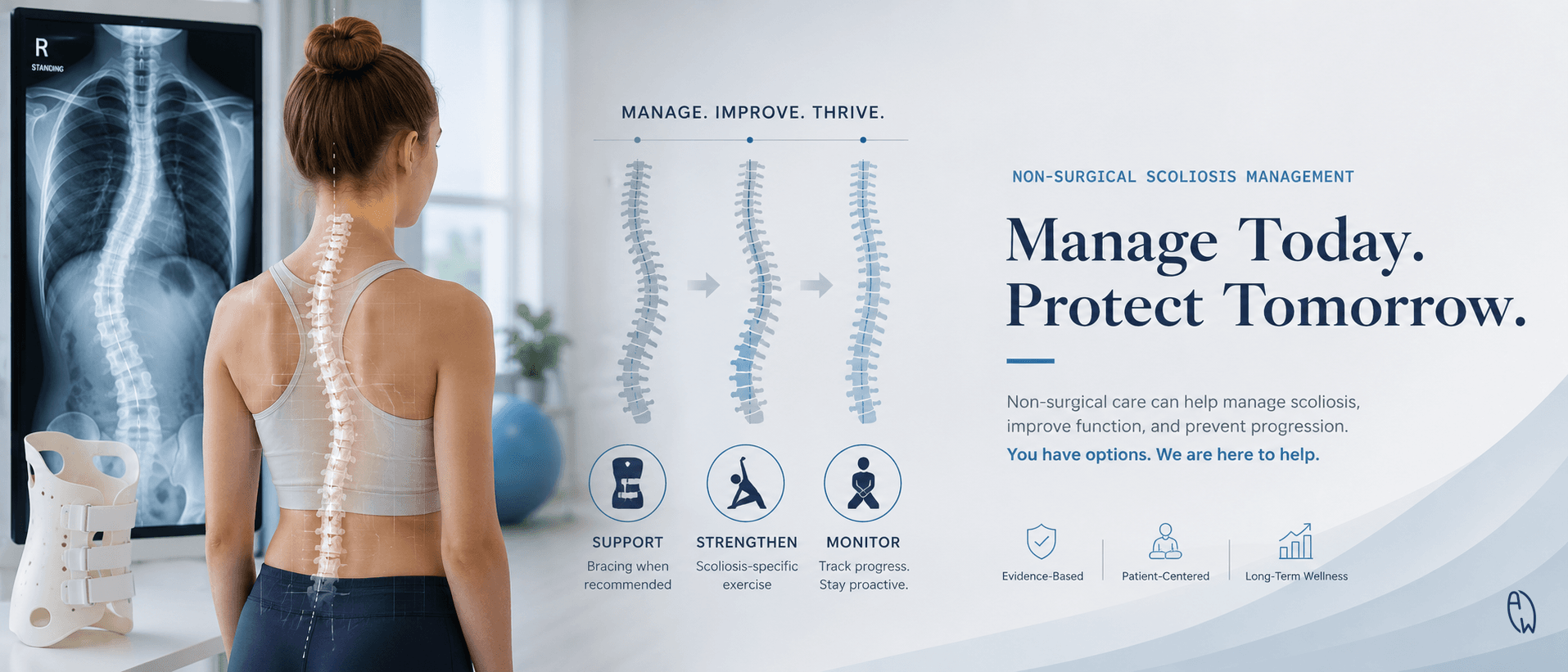
Can Scoliosis Be Corrected Without Surgery? What Non-Surgical Treatment Can and Cannot Do
Scoliosis does not always require surgery. Learn what bracing, scoliosis-specific exercise, rehabilitation and monitoring can realistically achieve—and where non-surgical treatment has limits.
Can scoliosis be corrected without surgery?
Yes, scoliosis can often be managed successfully without surgery—but “corrected” does not always mean making the spine completely straight.
Scoliosis is a three-dimensional structural condition involving sideways curvature, vertebral rotation and changes in spinal alignment.
It is not something that needs to be “cured” in the traditional sense.
The goal is to understand the curve, monitor its behavior, reduce the risk of progression when possible, improve alignment and movement, and help the person remain strong and functional.
For some people, non-surgical treatment can produce measurable improvement in posture or even the Cobb angle. For others, the most important achievement may be preventing the curve from getting worse.
And that can be a major success.
Quick Answer
Can scoliosis be corrected without surgery?
Many people with scoliosis can be managed without surgery. Depending on age, Cobb angle, skeletal maturity, curve flexibility and progression risk, treatment may include observation, scoliosis-specific exercise, bracing and rehabilitation. These approaches can help control progression and improve posture, strength, movement and function. Some patients may also experience measurable curve improvement. However, no non-surgical treatment can guarantee that every structural scoliosis curve will completely straighten.
That distinction is important because:
Manage ≠ cure
Stabilize ≠ straighten
Improve ≠ erase
Non-surgical ≠ do nothing
What Does “Correcting Scoliosis” Actually Mean?
When someone searches for “Can scoliosis be corrected without surgery?”, they may actually be asking several different questions:
-
Can the curve become smaller?
-
Can scoliosis stop getting worse?
-
Can a brace correct the spine?
-
Can exercise improve scoliosis?
-
Can posture improve?
-
Can surgery be avoided?
-
Can adults improve scoliosis?
-
What happens if scoliosis is not treated?
These questions do not all have the same answer.
A realistic treatment plan should distinguish between progression control, functional improvement and structural correction.
Can Non-Surgical Treatment Stop Scoliosis From Getting Worse?
In appropriately selected patients, particularly growing adolescents, yes—this is one of the most important goals of non-surgical treatment.
A child with a 30° curve that remains around 30° through the remainder of growth may have achieved an excellent outcome, even though the spine has not become completely straight.
Why?
Because some scoliosis curves progress during growth.
Preventing a moderate curve from becoming significantly larger can reduce future treatment challenges and may reduce the likelihood of reaching a surgical range.
The Scoliosis Research Society recommends observation for many smaller curves and bracing for appropriately selected growing patients with larger curves.
For parents, this is an important change in perspective:
Success does not always mean making the curve disappear. Sometimes success means keeping it from progressing.
Can a Scoliosis Curve Actually Become Smaller Without Surgery?
Sometimes—but this should never be guaranteed.
Some curves retain meaningful flexibility. Younger patients may also respond differently from adults with rigid structural curves.
Scoliosis-specific rehabilitation and corrective bracing can sometimes produce measurable changes in alignment.
However, the Cobb angle is not a perfect measurement.
Differences in positioning, imaging technique and measurement can influence the result. Your 🔗 Cobb angle is therefore best interpreted as part of a larger clinical picture rather than as the only measure of treatment success.
This means:
A smaller Cobb angle can be a positive outcome, but scoliosis treatment should not be judged by one number alone.
Posture, function, symptoms, skeletal maturity, curve progression and treatment adherence all matter.
What Can Non-Surgical Scoliosis Treatment Do?
Non-surgical scoliosis treatment is not one single therapy.
Depending on the patient, it may include:
-
observation and monitoring
-
scoliosis-specific exercise
-
bracing
-
rehabilitation
-
postural and movement retraining
-
strengthening
-
breathing and mobility exercises
-
activity guidance
-
pain management
-
regular imaging
The right combination depends on the individual.
1. Observation: Sometimes the Best Treatment Is Monitoring
Not every scoliosis curve requires immediate intervention.
For smaller curves, especially in people who have completed growth and have stable curves, observation may be appropriate.
Observation does not mean ignoring scoliosis.
It means:
Assess → measure → monitor → reassess → intervene when appropriate.
The Scoliosis Research Society recommends observation for many curves below approximately 25–30° and for people who have stopped growing with stable, non-problematic curves.
For growing children, follow-up may be more frequent because the curve can change during periods of rapid growth.
For more on this, see our article on 🔗 growth spurts and scoliosis progression.
Monitoring is not fear-based.
It is information-based.
2. Bracing: One of the Strongest Non-Surgical Tools for Growing Adolescents
For appropriately selected growing adolescents, bracing is one of the best-supported non-surgical treatments for reducing scoliosis progression.
The primary purpose of a scoliosis brace is to slow or stop curve progression during growth.
It is not simply about making the X-ray look straighter while the brace is being worn.
The larger objective is to influence the curve's trajectory while the child continues growing.
The Scoliosis Research Society generally recommends bracing for growing patients with curves larger than about 25° but below approximately 45–50°, depending on the clinical situation.
Does a scoliosis brace work?
The landmark BrAIST trial found treatment success in 72% of patients assigned to bracing compared with 48% with observation. In the randomized cohort, success was 75% with bracing versus 42% with observation. The study also found that greater brace-wear time was associated with greater treatment success.
In simple terms:
A brace can only help if it is actually worn.
Compliance matters.
Timing matters.
Growth remaining matters.
And the individual curve matters.
You can learn more about 🔗 bracing for scoliosis in our detailed guide.
Can a scoliosis brace permanently straighten the spine?
That should not be the promise.
A brace can produce significant correction while it is being worn, and successful bracing can reduce progression during growth.
But the primary objective is long-term curve control, not a guaranteed permanent cure.
3. Scoliosis-Specific Exercise Can Improve Posture, Control and Function
Exercise is another important part of conservative scoliosis care.
But there is an important difference between:
general exercise
and
physiotherapeutic scoliosis-specific exercise (PSSE).
PSSE programs are designed around the individual's curve pattern and may include:
-
three-dimensional self-correction
-
postural awareness
-
stabilization
-
breathing strategies
-
muscle activation
-
movement retraining
-
functional integration
Our guide to 🔗 scoliosis-specific exercise explains how PSSE differs from ordinary strengthening and how individualized rehabilitation can support scoliosis management.
Can exercise straighten scoliosis?
This is where responsible communication matters.
Exercise can help improve:
-
posture
-
strength
-
muscular control
-
balance
-
movement quality
-
physical function
-
body awareness
-
quality of life
However, current evidence does not justify promising that exercise alone will reliably straighten structural scoliosis.
A 2024 Cochrane review found that evidence for therapeutic exercise in adolescent idiopathic scoliosis remains limited and heterogeneous. It also found that exercises may provide some benefits in combination with bracing, but more robust research is needed.
So the responsible answer is:
Scoliosis-specific exercise can be an important part of treatment, but it should not be presented as a guaranteed replacement for bracing or surgery when those treatments are medically indicated.
4. Why Combining Bracing and Exercise Can Make Sense
The question does not always have to be:
Brace OR exercise?
For some patients, the better approach may be:
Brace + scoliosis-specific exercise + monitoring.
The brace provides an external corrective influence.
Exercise helps the patient develop the strength, awareness and motor control needed to work with that correction.
This can help patients learn to:
-
maintain improved alignment
-
activate appropriate muscles
-
control movement
-
develop postural awareness
-
improve endurance
-
carry corrective strategies into daily activities
The objective is not simply to place someone into a corrected position.
It is to help the person develop control of that position.
5. Rehabilitation Can Improve Posture Even When the Curve Remains
This is one of the most important concepts in scoliosis care.
A person can have a persistent Cobb angle and still experience meaningful improvement in how they stand, move and function.
Treatment may improve:
-
shoulder balance
-
trunk alignment
-
pelvic positioning
-
rib prominence
-
head position
-
muscular symmetry
-
movement patterns
-
physical confidence
This is why scoliosis should not be judged by the Cobb angle alone.
The X-ray tells part of the story.
The person tells the rest.
For patients interested in strength and conditioning, our article on 🔗 muscle balance and core strength in scoliosis provides another useful perspective.
6. What Can Non-Surgical Treatment Do for Adults With Scoliosis?
Adult scoliosis is different from adolescent scoliosis.
Once skeletal growth is complete, the objectives often shift.
For adults, non-surgical treatment may focus on:
-
pain management
-
strength
-
mobility
-
balance
-
posture
-
physical function
-
maintaining independence
-
managing neurological symptoms
-
quality of life
Our guide to 🔗 adult scoliosis treatment explores how conservative care can support mobility, pain management and long-term spinal function.
A particularly important point is that structural correction is less predictable after skeletal maturity, especially when a curve has become rigid or degenerative.
However, adult scoliosis is not automatically “untreatable.”
Some adults retain meaningful spinal flexibility and may show measurable changes with appropriate rehabilitation.
Our 🔗 real adult scoliosis X-ray journey shows an example of why individual assessment matters. That case should be viewed as an individual outcome—not a promise that every adult curve will respond in the same way.
What Happens If Scoliosis Is Left Untreated?
This is one of the questions parents ask most often.
The answer is not that every scoliosis curve will eventually “collapse.”
That would be inaccurate.
Some curves remain stable.
Others progress.
Progression risk depends on factors including:
-
Cobb angle
-
age
-
skeletal maturity
-
curve pattern
-
remaining growth
-
previous progression
-
vertebral rotation
-
degenerative changes in adults
Larger curves and curves in patients with substantial growth remaining generally have greater progression risk.
This is why:
“Observe it carefully” ≠ “ignore it.”
Observation is an active clinical decision.
Ignoring a significant or progressing curve means losing the opportunity to identify change and reconsider treatment when appropriate.
Is Scoliosis Life-Threatening?
Most scoliosis is not life-threatening.
Most people with scoliosis live active and productive lives.
However, severe or progressive scoliosis can have a significant effect on physical function.
In very severe curves, particularly severe thoracic curves, spinal deformity can affect chest mechanics and breathing.
Scoliosis can also be associated with:
-
chronic pain
-
reduced mobility
-
muscular fatigue
-
balance problems
-
functional limitations
-
changes in body appearance
-
psychological or social impact
The message should therefore not be:
“Scoliosis is dangerous.”
A more accurate message is:
Scoliosis deserves attention because progression and increasing structural changes can make the condition more difficult to manage.
That is a message of awareness, not fear.
What Non-Surgical Treatment Cannot Reliably Do
Responsible scoliosis care requires knowing the limits of conservative treatment.
It cannot guarantee a perfectly straight spine
Structural scoliosis is too individual and unpredictable for anyone to guarantee complete correction without surgery.
Exercise cannot guarantee that scoliosis will stop progressing
Exercise can improve strength, posture, movement and function.
But exercise alone should not be presented as a guaranteed way to stop progression in a high-risk growing adolescent. Current evidence remains limited.
A brace cannot guarantee permanent correction
Bracing is primarily designed to control progression during growth.
It is not a guaranteed cure.
Passive treatment cannot permanently reshape every structural curve
Hands-on treatment, mobility work and other supportive therapies may help symptoms or movement limitations.
But symptom improvement should not automatically be described as structural correction.
A credible treatment plan should distinguish between:
- symptom improvement
- functional improvement
- postural improvement
- structural correction
They are related—but they are not the same thing.
When Might Surgery Become Necessary?
Non-surgical treatment should never become an excuse to delay a necessary surgical evaluation.
The Scoliosis Research Society generally describes surgery as an option for curves usually greater than approximately 45–50°, particularly when there is a high risk of continued worsening after growth. The decision also depends on symptoms, function, age and the individual clinical picture.
Surgery may be considered when there is:
-
significant progression
-
severe deformity
-
disabling pain
-
neurological involvement
-
substantial functional limitation
-
severe respiratory compromise in selected cases
-
failure of appropriate conservative treatment
The decision is individualized.
Surgery is not a failure of conservative care.
Sometimes the most responsible treatment decision is knowing when conservative treatment has reached its limits.
Likewise, avoiding surgery at all costs is not necessarily the safest approach.
How Do You Know If Non-Surgical Scoliosis Treatment Is Working?
Treatment success should not be judged from one photograph or one X-ray.
A proper follow-up looks at several factors.
1. Cobb angle
Is the curve:
-
progressing?
-
stable?
-
improving?
Learn more about 🔗 Cobb angle measurement and scoliosis severity.
2. Skeletal maturity
How much growth remains?
This is particularly important in adolescents because growth strongly influences progression risk.
3. Clinical posture
Has there been improvement in:
-
shoulder balance?
-
trunk shift?
-
waist asymmetry?
-
pelvic alignment?
-
rib prominence?
4. Function
Can the patient:
-
move more comfortably?
-
exercise more effectively?
-
maintain posture longer?
-
perform daily activities more easily?
5. Symptoms
Has pain improved?
Has fatigue decreased?
Has physical tolerance improved?
6. Treatment adherence
Is the patient:
-
wearing the brace as prescribed?
-
performing the recommended exercises?
-
attending follow-up?
-
maintaining appropriate activity?
A scientifically sound treatment plan can still fail if it is not followed consistently.
Why X-Rays Still Matter
It is tempting to judge scoliosis only by appearance.
That can be misleading.
Someone may look straighter but still have a significant structural curve.
Conversely, a small Cobb-angle change may occur while posture, muscular control and function improve substantially.
Standing spinal X-rays therefore remain an important tool for assessing structural alignment and monitoring progression.
When comparing X-rays, it is important to use reasonably comparable imaging conditions whenever possible because positioning and measurement can influence the Cobb angle.
Our 🔗 Cobb angle guide explains why small changes between X-rays should be interpreted carefully rather than automatically labelled as progression or correction.
The goal is to follow the trend—not chase a number.
A meaningful scoliosis assessment combines:
X-ray + physical examination + posture + function + symptoms + growth or age + treatment adherence.
Can a 40-Degree Scoliosis Be Treated Without Surgery?
Sometimes, yes.
A 40° curve does not automatically mean that surgery is required immediately.
For a growing adolescent, bracing may still be considered depending on skeletal maturity, curve characteristics and progression risk. The Scoliosis Research Society generally places bracing within the treatment range for growing patients with curves above 25° and below about 45–50°.
For an adult, the treatment goals may be different.
The important question is not simply:
“Is the curve 40°?”
It is:
“Who has the 40° curve, how flexible is it, is it progressing, how much growth remains, and what is happening clinically?”
The same Cobb angle can mean very different things in different people.
Can Scoliosis Get Better Naturally?
Some curves remain stable, while others progress.
A person should not assume that a curve is improving simply because they have no pain.
This is especially important because pain is not a reliable indicator of whether scoliosis is progressing.
A teenager can feel perfectly well while a curve changes during growth.
That is why appropriate monitoring matters.
What Is the Best Non-Surgical Treatment for Scoliosis?
There is no single treatment that is best for every patient.
Depending on the individual, non-surgical care may include:
Observation
Scoliosis-specific exercise
Bracing
Rehabilitation
Strength and movement training
Activity guidance
Regular monitoring
For some patients, the best approach is a combination.
Treatment should match the person's:
-
age
-
skeletal maturity
-
Cobb angle
-
curve pattern
-
flexibility
-
progression history
-
symptoms
-
goals
-
ability to adhere to treatment
The Earlier Scoliosis Is Understood, the More Options May Be Available
Timing matters.
A growing child with a moderate and relatively flexible curve may have several non-surgical treatment options.
A much larger and rigid curve after skeletal maturity may have fewer opportunities for meaningful structural improvement.
This does not mean every scoliosis curve needs aggressive treatment.
It means early assessment gives you information—and information gives you choices.
For parents, our article on 🔗 growth spurts and scoliosis progression explains why monitoring becomes especially important during periods of rapid growth.
The goal is not to create fear.
The goal is to avoid discovering years later that a curve has progressed significantly without anyone noticing.
You Do Not Have to “Cure” Scoliosis to Successfully Manage It
This may be the most important message for anyone living with scoliosis.
Scoliosis is not something that always needs to be “cured.”
It is a structural condition that can often be managed over time.
The goals may include:
stabilizing the curve
reducing progression risk
improving alignment
building strength
improving movement
reducing symptoms
maintaining function
protecting quality of life
And sometimes, measurable structural improvement is possible too.
But there is no need to promise perfection.
The Goal Is Not Simply to Avoid Surgery
Non-surgical scoliosis care should not be viewed as a battle against surgery.
There is a large space between:
“Ignore it.”
and
“Have surgery.”
That space includes:
observation → exercise → bracing → rehabilitation → monitoring → reassessment
The appropriate path depends on the person.
For one patient, observation may be enough.
For another, bracing may be critical during growth.
For another, scoliosis-specific exercise and rehabilitation may be the priority.
And for someone with severe, progressive or symptomatic scoliosis, surgical consultation may eventually be the appropriate next step.
The goal is not to avoid surgery at all costs.
The goal is to use the least invasive approach that can realistically achieve the best long-term outcome.
Final Thoughts: Scoliosis Can Be Managed—Not Promised Away
There is no honest way to promise that every scoliosis curve can be straightened without surgery.
But there is also no reason to believe that the only meaningful treatment is surgery.
Non-surgical scoliosis treatment can make a real difference.
It can help control progression in appropriately selected patients, improve posture and movement, build strength, manage symptoms and preserve function.
For growing adolescents, bracing and scoliosis-specific exercise may play an important role in changing the trajectory of the curve.
For adults, treatment often focuses more on strength, mobility, pain management and maintaining quality of life.
And for some patients, non-surgical care may not be enough.
That is not failure.
It is simply the reality that every spine is different.
The goal is not a perfect promise.
The goal is a better trajectory.
Understand the curve.
Monitor the change.
Improve what can be improved.
Protect what can be protected.
And keep every appropriate treatment option open.
Because with scoliosis, doing something does not always mean surgery—and doing nothing does not always mean the curve will stay the same.
Frequently Asked Questions About Non-Surgical Scoliosis Treatment
Can scoliosis be corrected without surgery?
Some people can achieve meaningful improvement in posture, function and sometimes Cobb angle without surgery. However, complete permanent correction of structural scoliosis cannot be guaranteed through non-surgical treatment.
Can scoliosis be treated without surgery?
Yes. Depending on age, curve size, skeletal maturity and progression risk, treatment may include observation, scoliosis-specific exercise, bracing, rehabilitation and regular monitoring.
Can exercise straighten scoliosis?
Scoliosis-specific exercises can improve posture, muscular control, movement and function. However, current evidence does not support promising that exercise alone will permanently straighten structural scoliosis.
Can a brace correct scoliosis?
A brace can produce meaningful correction while worn and, most importantly, can reduce progression risk in appropriately selected growing adolescents. Its primary purpose is curve control during growth rather than guaranteeing permanent correction.
Can a 40-degree scoliosis be treated without surgery?
Sometimes. A 40° curve does not automatically require immediate surgery. Age, skeletal maturity, flexibility, progression history, symptoms and curve characteristics all influence the treatment decision.
What happens if scoliosis is left untreated?
Some curves remain stable, while others progress. Progression is more likely in certain growing patients and with larger curves. Monitoring helps determine whether a curve is stable or changing.
Is scoliosis life-threatening?
Most scoliosis is not life-threatening. Severe curves can, however, affect physical function and, in selected cases, breathing mechanics. Significant or progressive scoliosis should therefore be appropriately assessed and monitored.
Can adults improve scoliosis without surgery?
Adults can often manage scoliosis without surgery, particularly when symptoms are manageable. Exercise and rehabilitation can help strength, mobility, pain and function. Structural correction is less predictable after skeletal maturity, although some flexible curves may show measurable improvement.
What is the best treatment for scoliosis without surgery?
There is no single best treatment for everyone. The appropriate approach may include observation, scoliosis-specific exercise, bracing, rehabilitation or a combination based on the individual's curve, age, growth status and goals.
Can scoliosis get better naturally?
Some curves remain stable, while others progress. A person feeling well does not necessarily mean the curve is stable, which is why appropriate monitoring is important.
A Note About Scoliosis Treatment
This article is for educational purposes and does not replace an individual assessment by a qualified healthcare professional.
Scoliosis treatment should be based on appropriate clinical examination, imaging, skeletal maturity, progression risk, symptoms and individual goals.
Non-surgical treatment should never be about promising a perfect spine. It should be about giving each person the best realistic opportunity to maintain stability, improve function and protect long-term quality of life.
Evidence and References
-
Scoliosis Research Society — Observation and Bracing
-
Weinstein SL et al. Effects of Bracing in Adolescents with Idiopathic Scoliosis, New England Journal of Medicine
-
SOSORT guidelines for conservative scoliosis management
-
Romano M et al. Therapeutic exercises for idiopathic scoliosis in adolescents, Cochrane Database of Systematic Reviews
-
Research on Cobb-angle measurement variability