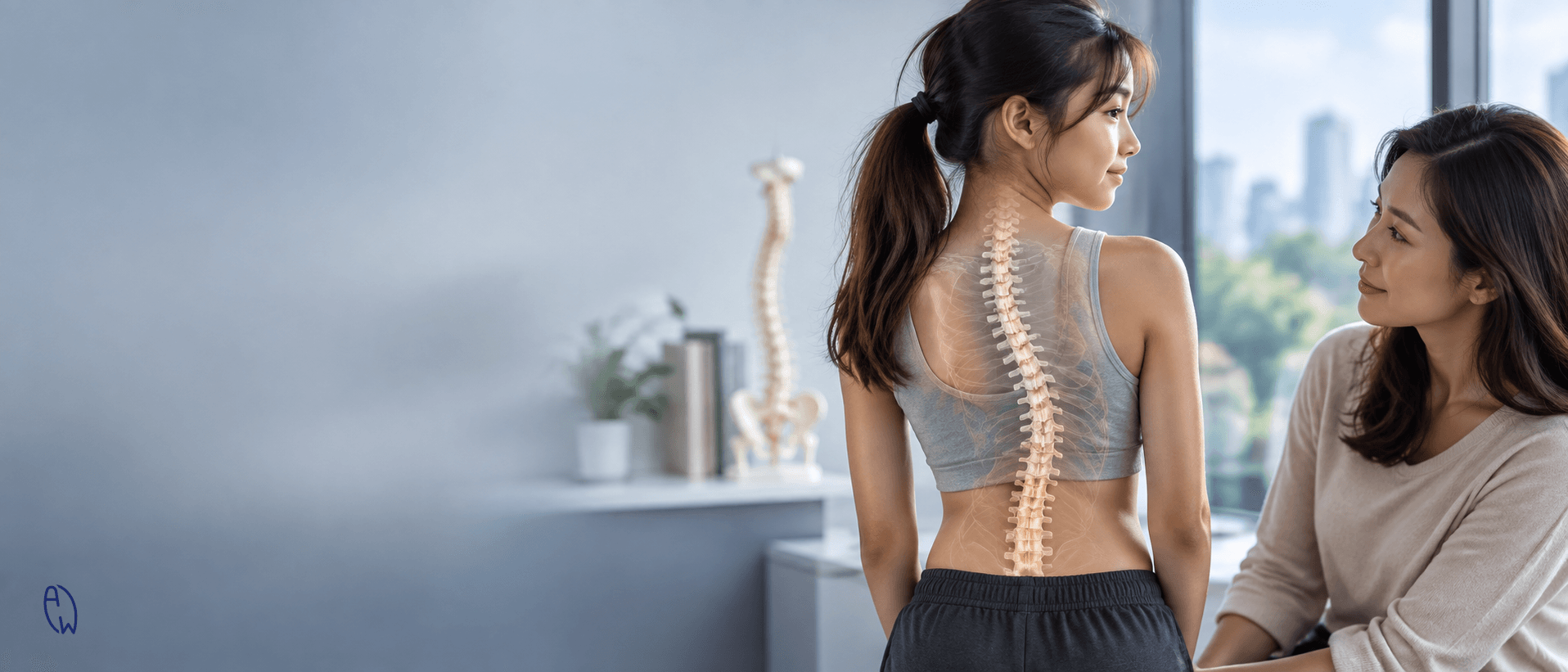
Can Scoliosis Get Worse During Puberty? What Parents Should Know
Puberty is an important time to understand scoliosis. A child's spinal curve can progress during rapid growth, but puberty does not automatically mean the curve will suddenly become severe—or that surgery is inevitable.
For many parents, the first scoliosis diagnosis comes with a lot of questions.
Sometimes it happens after a school screening. Your child is referred for further assessment, you see an orthopaedic specialist, an X-ray is taken, and suddenly you are introduced to a whole new vocabulary:
Cobb angle. Growth potential. Skeletal maturity. Progression. Bracing. Surgery.
And then someone tells you:
“Your child is entering puberty, so we need to watch the curve carefully.”
That can be frightening.
Parents naturally begin wondering:
How quickly can this get worse?
What happens when my child has a growth spurt?
Should we start treatment immediately?
What if we wait and the curve becomes too large?
And perhaps the most frightening question of all:
Does puberty mean my child is heading toward surgery?
The answer is more nuanced than many parents realise.
Puberty is an important period because children can grow very quickly during adolescence. That growth can increase the risk of scoliosis progression, particularly when substantial growth remains.
But puberty itself does not determine what will happen to your child's spine.
To understand the risk, we need to look at the child—not just the calendar.
Why Can Scoliosis Get Worse During Puberty?
The simplest answer is rapid growth.
During adolescence, the skeleton can change considerably within a relatively short period.
Your child is getting taller. The vertebrae are growing. Body proportions are changing. Muscles are adapting. The centre of mass is shifting. The nervous system is continually adjusting to a body that seems to change almost month by month.
The spine has to adapt to all of this.
If a child already has scoliosis, a period of rapid growth can be accompanied by an increase in the spinal curve.
Research in girls with untreated adolescent idiopathic scoliosis found that progression was closely related to growth velocity, with greater progression occurring during periods of faster growth and in children with larger curves at the initial assessment.
That is why doctors pay close attention to children with scoliosis while they are growing.
But there is an important distinction:
Rapid growth can increase the risk of progression. It does not guarantee that progression will occur.
Puberty Is Not a Scoliosis Emergency
A child entering puberty does not automatically need urgent treatment.
Two children can be the same age, have a similar Cobb angle and still have very different situations.
Consider two 12-year-olds, both with a 30° curve.
One may have just entered a rapid growth phase and have several years of growth ahead.
The other may already be approaching skeletal maturity.
The number on the X-ray is the same.
The circumstances are not.
That is why scoliosis should never be interpreted from the Cobb angle alone.
Our detailed Cobb Angle in Scoliosis: Measurement, Severity & Treatment explains how the measurement is made and why the number needs to be considered alongside age, growth, symptoms and the overall clinical picture.
How Much Growth Does My Child Have Left?
For a parent, this may be one of the most useful questions to ask.
Not:
“How old is my child?”
But:
“How much growth does my child have remaining?”
Chronological age gives us one piece of information.
Growth potential gives us another.
Clinicians may look at factors such as:
-
height changes
-
growth velocity
-
pubertal development
-
menstrual status
-
skeletal maturity
-
Risser stage
-
other radiographic indicators
These help provide a picture of where the child is in the growth process.
A child who is still growing rapidly may have a different progression risk from someone who is almost skeletally mature.
This is one reason scoliosis management during adolescence is so closely connected to timing.
Growth Velocity Matters More Than Many Parents Realise
Growth velocity simply means how quickly a child is growing.
Imagine your child grew 2 centimetres over an entire year.
Now imagine another child grew 8 centimetres over that same period.
Both children are growing.
But they are not going through the same biological phase.
Research has found a clear relationship between growth velocity and scoliosis progression. In one study of 535 girls with untreated adolescent idiopathic scoliosis, progression was particularly notable during periods of faster growth and around the years preceding menarche.
This is why a parent may hear the word “growth spurt” quite often after a scoliosis diagnosis.
It isn't because every growth spurt makes scoliosis worse.
It is because rapid growth is a period when an existing curve deserves closer attention.
Our article Growth Spurts, Curve Changes & What Every Parent Must Monitor goes deeper into this relationship between growth and curve changes.
When Does Scoliosis Progress the Fastest?
There isn't one age that applies to every child.
Puberty begins at different times. Growth spurts occur at different times. And scoliosis behaves differently from one child to another.
In the study mentioned above, progression was particularly notable during periods of growth velocity of at least 2 cm per year and approximately 0.5–2 years before menarche in the girls studied.
That doesn't mean every girl will follow the same timeline.
It simply shows why growth stage matters.
Think of puberty as a period rather than a single birthday or milestone.
The spine is growing.
The body is changing.
And the curve needs to be followed over time.
What Happens After a Girl Gets Her First Period?
This is another question we hear from parents.
Some assume that once menstruation begins, the major growth phase is immediately over.
It isn't.
Growth usually slows after menarche, but it does not stop overnight. The amount of remaining growth varies between individuals.
So the first period can provide useful information about where a girl is in her development, but it shouldn't be treated as a magic switch that turns scoliosis progression on or off.
What matters is the bigger picture:
How much growth remains?
What is the skeletal maturity?
What has happened to the curve over time?
Why Is Scoliosis More Common in Girls?
This is one of the questions researchers have been trying to answer for decades.
Adolescent idiopathic scoliosis occurs in both boys and girls, but girls are disproportionately represented, particularly among larger curves.
The reason is not completely understood.
Researchers have investigated possible contributions from:
-
genetics
-
skeletal growth
-
biomechanics
-
neuromuscular development
-
endocrine pathways
-
differences in growth patterns
It is tempting to look for one explanation.
The biology probably isn't that simple.
What About Hormones?
Puberty obviously involves major hormonal changes.
That makes hormones an interesting area of scoliosis research.
Researchers have studied possible relationships between adolescent idiopathic scoliosis and several endocrine factors, including estrogen, melatonin, growth-related hormones and other metabolic pathways.
There is evidence that endocrine signalling may be involved in the biology of adolescent idiopathic scoliosis, but the mechanisms are still being investigated.
That distinction matters.
Interesting research is not the same as an established treatment.
We should be careful about turning:
“Researchers are studying the relationship between hormones and scoliosis”
into:
“Your child has a hormone imbalance causing scoliosis.”
Those are very different statements.
There is currently no established “hormone-balancing” treatment for adolescent idiopathic scoliosis.
So if someone tells you that scoliosis can be explained by one simple hormonal imbalance, it is reasonable to ask:
What evidence supports that claim?
The Spine Doesn't Exist by Itself
A child's spine is part of a much larger system.
It interacts with:
-
muscles
-
joints
-
bones
-
balance
-
proprioception
-
movement
-
breathing
-
the nervous system
-
growth
-
physical activity
That doesn't mean every one of these factors causes scoliosis.
It means the child is more than the curve seen on an X-ray.
This is also why scoliosis isn't simply a sideways bend.
Our article Why Scoliosis Is Three-Dimensional explains how scoliosis involves the coronal, sagittal and rotational dimensions of the spine.
For parents, this can change the way you think about treatment.
You are not simply trying to chase a smaller number on an X-ray.
You are also considering how your child moves, controls posture and develops physically while growing.
Does a Larger Curve Automatically Mean Surgery?
No.
This is probably one of the most important things for parents to understand.
A larger curve can carry a greater risk of progression, particularly during growth. But surgery is not determined by puberty alone.
Treatment decisions consider the individual situation, including:
-
Cobb angle
-
progression over time
-
skeletal maturity
-
growth remaining
-
curve pattern
-
symptoms
-
function
-
overall clinical circumstances
Depending on those factors, management may include observation, scoliosis-specific exercise, bracing or surgery.
For some children, surgery may eventually be the appropriate option.
For others, conservative management may be appropriate.
The point is not to decide the treatment before understanding the child.
“Wait and See” Doesn't Mean “Do Nothing”
This phrase can be difficult for parents.
You finally get a diagnosis and ask:
“What can we do?”
Then you hear:
“Let's monitor it.”
It can feel like doing nothing.
But observation is a form of management.
It may involve:
-
monitoring growth
-
clinical reassessment
-
tracking the Cobb angle
-
assessing skeletal maturity
-
repeating imaging when clinically appropriate
-
watching for documented progression
The purpose is to understand what the curve is actually doing.
Not what we fear it might do.
Our article Growth Spurts, Curve Changes & What Every Parent Must Monitor explains why monitoring during periods of growth can be important.
What If the Curve Is Progressing?
This is where parents often begin looking for additional options.
For appropriately selected growing children, conservative management can include different approaches.
Observation
For curves and clinical situations where monitoring is appropriate.
Scoliosis-specific exercise
Structured exercise designed around the child's curve, posture and movement pattern.
Bracing
For appropriately selected growing adolescents, bracing can help reduce the risk of curve progression.
Surgery
For some children with severe or progressive curves, surgery may be an appropriate treatment.
These options aren't interchangeable.
They serve different purposes and are appropriate for different clinical situations.
Can Scoliosis-Specific Exercise Help During Puberty?
Yes, it can have a role in conservative management for appropriately selected patients.
But let's be precise about what that means.
Scoliosis-specific exercise is not simply:
“Do more core exercises.”
Physiotherapeutic Scoliosis-Specific Exercises (PSSE) are individualized around the patient's curve pattern, posture, movement and treatment goals.
Potential goals can include:
-
improving postural awareness
-
developing active self-correction
-
improving movement control
-
supporting muscular endurance
-
improving balance
-
improving body awareness
-
supporting function
Our Scoliosis-Specific Exercises (PSSE): Evidence-Based Rehabilitation for Scoliosis explains this approach in more detail.
But exercise shouldn't be sold as a guaranteed cure.
For a growing child at meaningful risk of progression, exercise may be one part of a broader management strategy. It does not automatically replace bracing or surgical evaluation when those are clinically indicated.
What About Bracing?
Bracing is particularly relevant during growth because its purpose is to help manage the risk of curve progression while the child is still developing.
That is an important distinction.
A brace is not necessarily intended to make a child's spine permanently straight while it is being worn.
Rather, for appropriately selected adolescents, the goal is generally to reduce the likelihood of significant progression during the growth period.
That is why timing matters.
Our article When Can You Stop Wearing a Scoliosis Brace? A Guide to Brace Weaning discusses why skeletal maturity and remaining growth matter when determining when brace treatment can end.
Exercise and Bracing Can Have Different Roles
Parents sometimes ask:
“Should my child exercise or wear a brace?”
It doesn't always have to be one or the other.
A brace provides external support and corrective forces.
Scoliosis-specific exercise allows the child to actively develop movement and postural control.
Depending on the individual case, the two may be used together.
The important thing is to understand what each treatment is trying to achieve.
Our article Can Scoliosis Be Corrected Without Surgery? What Non-Surgical Treatment Can and Cannot Do discusses observation, exercise, bracing and the realistic limits of non-surgical treatment.
That last part matters.
Realistic expectations are part of good care.
No responsible practitioner should promise that every scoliosis curve can be completely straightened without surgery.
What If a Doctor Has Already Recommended Surgery?
First, take a breath.
A recommendation for surgery can be overwhelming, particularly when the patient is your child.
But asking questions does not mean you are rejecting the recommendation.
It means you are trying to understand it.
You can ask:
About the curve
What is my child's Cobb angle?
Has it changed since the previous X-ray?
How many degrees has it changed?
Over what period?
About growth
How much growth does my child have remaining?
How are you assessing skeletal maturity?
Is my child approaching peak growth velocity?
About progression
What makes this curve likely to progress?
What has the curve actually done so far?
What would happen if we monitored it for a period of time?
About other options
Is observation appropriate?
Is bracing appropriate?
Would scoliosis-specific exercise be appropriate?
What would each option realistically achieve?
About surgery
Why is surgery being recommended now?
What are the expected benefits?
What are the risks?
What alternatives should we consider?
Would another qualified opinion help us understand the situation?
These are reasonable questions.
You don't need to be anti-surgery to ask them.
If Your Child Was Referred After a School Screening
This is especially relevant for families in Singapore.
A school screening can identify a child who may have a spinal asymmetry or scoliosis and needs further assessment.
That is useful.
But a screening result is not the same thing as a final treatment decision.
A typical pathway may involve:
Screening
↓
Further clinical assessment
↓
Standing spinal X-ray when appropriate
↓
Cobb angle and curve assessment
↓
Growth and skeletal maturity assessment
↓
Discussion of management options
The next step depends on the individual child.
For one child, monitoring may be appropriate.
For another, bracing may be discussed.
Another family may seek scoliosis-specific exercise.
And for some children with severe or progressive curves, surgical consultation may be appropriate.
The important thing is not to assume that one pathway applies to every child.
Our ABCD of Scoliosis: Simple Early Detection Guide for Parents provides a parent-friendly explanation of early signs and assessment.
You Are Allowed to Ask Questions
This is something I wish more parents felt comfortable with.
When you hear that your child may need surgery, it is completely normal to feel overwhelmed.
You may be looking at an X-ray you don't understand.
You may be hearing unfamiliar terminology.
You may be trying to make a decision that feels enormous.
Asking questions doesn't mean you don't trust your doctor.
It means you want to understand.
You can ask why surgery is being recommended now.
You can ask how much growth your child has left.
You can ask whether the curve has actually progressed.
You can ask what conservative options are appropriate.
And if you still don't feel comfortable with the information you have, it is reasonable to seek another qualified opinion.
Good healthcare should leave parents better informed—not simply more frightened.
Medicine Doesn't Have to Be a One-Way Street
Different healthcare professionals may look at scoliosis from different perspectives.
An orthopaedic surgeon may focus heavily on:
curve magnitude, progression and surgical indications.
A rehabilitation professional may focus on:
movement, strength and function.
A scoliosis-specific exercise practitioner may focus on:
active self-correction, posture and movement strategies.
A brace specialist may focus on:
orthotic design, correction and fit.
These perspectives don't necessarily need to compete.
Sometimes they complement each other.
The better question isn't:
“Which professional should I believe?”
It is:
“What is each professional assessing, what evidence supports the recommendation, and how does it fit into my child's overall situation?”
Families also have different circumstances.
Some are comfortable with surgery.
Some want to explore conservative care first.
Some want another opinion.
Some have financial or practical limitations.
Some simply need more time to understand what they have been told.
Those differences deserve respect.
There isn't one emotional response that every family is supposed to have.
At All Well, We Take a Conservative Approach
At All Well Scoliosis Centre, our approach is non-surgical and conservative.
That doesn't mean we believe surgery is always wrong.
It means that our role is to help families understand and explore conservative options when those options are appropriate.
Some families come to us after a school screening.
Others have already seen an orthopaedic specialist.
Some have been advised to monitor the curve.
Others have been told that surgery may eventually be necessary and want to understand what else can reasonably be considered.
We don't believe every child should receive exactly the same treatment.
We look at the individual child, including factors such as:
-
spinal curve
-
Cobb angle
-
growth stage
-
posture
-
movement
-
muscle control
-
balance
-
body awareness
-
previous treatment
-
family goals
Where appropriate, conservative care may include scoliosis-specific exercise, corrective bracing and postural or movement retraining.
We also believe in objective monitoring.
If an intervention is being used to manage a structural spinal condition, parents deserve to understand how its progress will be evaluated.
That might involve clinical assessment, functional changes and, when appropriate, repeat imaging.
The goal isn't to promise an outcome.
It is to provide a structured process for understanding what is happening.
Puberty Should Not Become Something Your Child Fears
Puberty is normal.
Growth is normal.
Your child should still be able to:
-
go to school
-
play
-
exercise appropriately
-
spend time with friends
-
develop confidence
-
discover what they enjoy
-
simply be a child
A scoliosis diagnosis deserves attention.
But it doesn't need to become your child's identity.
For parents, the challenge is finding the balance between being proactive and being frightened.
Don't ignore a changing curve.
But don't assume the worst before you have the information.
Monitor.
Ask questions.
Understand the options.
Then make the decision that is appropriate for your child and your family.
The Bottom Line
Can scoliosis get worse during puberty?
Yes, it can.
Rapid growth is an important period for scoliosis progression, particularly when a child has substantial growth remaining. Research has demonstrated a relationship between growth velocity and curve progression in adolescent idiopathic scoliosis.
But that doesn't mean every child will experience significant progression.
Puberty does not automatically mean scoliosis will suddenly become severe.
Puberty does not automatically mean surgery.
A Cobb angle needs to be interpreted alongside growth and skeletal maturity.
Hormones may be involved in the biology of scoliosis, but a simple hormonal imbalance has not been established as the cause.
Observation can be active management, not simply doing nothing.
Bracing and scoliosis-specific exercise can have roles in conservative care for appropriately selected patients.
And perhaps the most useful question for a parent isn't:
“Will my child's scoliosis get worse?”
It is:
“What is my child's risk, how much growth remains, and what can we do to monitor and manage that risk appropriately?”
You don't have to reject medical advice.
You don't have to rush into a decision because you're frightened.
And you don't have to choose a treatment simply because someone else chose it for their child.
Ask. Understand. Monitor. Consider your options. Then decide.
Your child is more than an X-ray.
And good scoliosis care should recognise that.
Frequently Asked Questions
Does scoliosis always get worse during puberty?
No. Scoliosis can progress during rapid growth, but puberty does not guarantee progression. Risk varies according to factors such as curve magnitude, growth remaining, skeletal maturity and previous progression.
When does scoliosis progress the fastest?
Progression is generally associated with periods of rapid growth. The exact timing varies between children. Research has found particularly notable progression during periods of higher growth velocity and around the years preceding menarche in girls.
Does scoliosis stop getting worse after a girl's first period?
Not immediately. Growth generally slows after menarche, but it does not stop overnight. Remaining growth varies between individuals.
Why is scoliosis more common in girls?
Adolescent idiopathic scoliosis occurs in both sexes, but girls are disproportionately represented, particularly among larger curves. The reasons are not completely understood.
Do hormones cause scoliosis?
Hormonal and endocrine pathways are being investigated as part of the biology of adolescent idiopathic scoliosis. However, no single hormone or simple hormonal imbalance has been established as the cause.
Does puberty mean my child will need surgery?
No. Puberty alone is not an indication for surgery. Treatment depends on the individual curve, progression, growth remaining, skeletal maturity and other clinical factors.
Can scoliosis-specific exercise help during puberty?
PSSE may form part of conservative management for appropriately selected patients. It can target posture, active self-correction, movement control and function, but it should not be presented as a guaranteed cure.
Does my child need a scoliosis brace?
Not every child does. Bracing is generally considered for appropriately selected growing adolescents based on factors such as curve magnitude, skeletal maturity and progression risk.
Should I get a second opinion if surgery has been recommended?
If you remain uncertain about the diagnosis, progression risk or recommended treatment, asking another appropriately qualified healthcare professional to review the case can help you understand the available options.
Medical Disclaimer
This article is for educational purposes and does not replace an individualized medical assessment. Adolescent idiopathic scoliosis is a multifactorial condition, and progression risk varies between children. Treatment decisions should consider the child's clinical examination, imaging, Cobb angle, curve pattern, growth potential, skeletal maturity and overall circumstances.
If surgery has been recommended, discuss the rationale, alternatives, expected benefits and risks with the treating specialist. A second appropriately qualified opinion may be considered when a family remains uncertain.
Further Reading
-
My Child Has Scoliosis—What Should I Do Next? A Parent's Guide
-
Growth Spurts, Curve Changes & What Every Parent Must Monitor
-
Scoliosis-Specific Exercises (PSSE): Evidence-Based Rehabilitation for Scoliosis
-
When Can You Stop Wearing a Scoliosis Brace? A Guide to Brace Weaning
-
Can Scoliosis Be Corrected Without Surgery? What Non-Surgical Treatment Can and Cannot Do
-
Spinal Fusion Surgery for Scoliosis: Benefits, Risks & Long-Term Effects
References
-
Scoliosis Research Society. Adolescent Idiopathic Scoliosis.
-
Dimeglio A, Canavese F. Growth and progression of adolescent idiopathic scoliosis in girls. Journal of Pediatric Orthopaedics B.
-
Liang ZT, et al. The role of endocrine hormones in the pathogenesis of adolescent idiopathic scoliosis. FASEB Journal. 2021.
-
Horne JP, Flannery R, Usman S. Epidemiology of adolescent idiopathic scoliosis.
-
Recent longitudinal research examining scoliosis progression in relation to menarche and skeletal maturity.