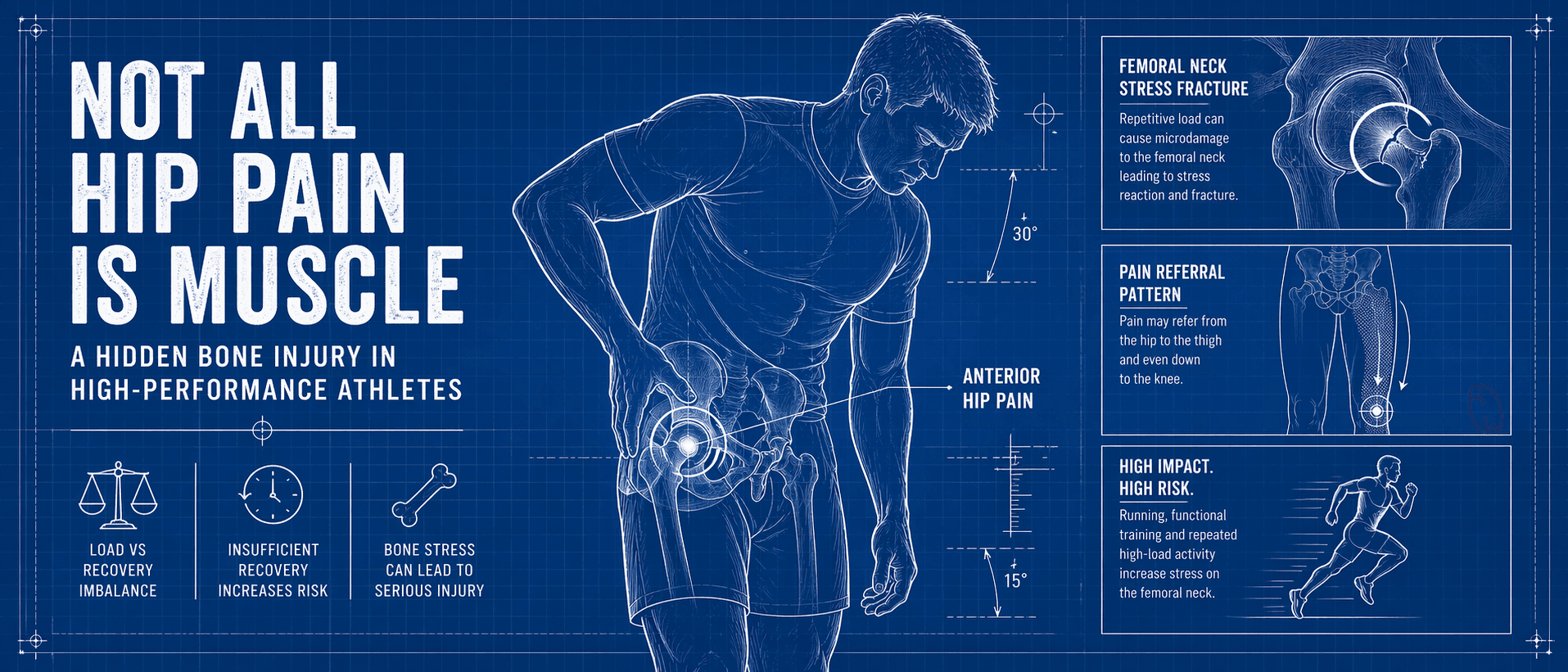
Anterior Hip Pain in Hybrid Athletes: When It’s NOT Just a Hip Flexor Problem
Case Study: High-Performance Athlete With Escalating Hip Pain
A 35-year-old male hybrid athlete presents with progressive anterior hip pain.
-
Training history:
-
Running for 2.5 years
-
Completed 4 marathons + 1 triathlon in the past 12 months
-
3 years of CrossFit experience
-
-
Currently preparing for HYROX Helsinki
-
Training load: 7 days per week (sometimes twice daily)
-
Occupation: Full-time auditor in a Big 4 accounting firm
What Changed?
-
Pain developed gradually over 3 weeks
-
Progressed to the point he had to stop running
-
Night pain waking him up
-
Pain is poorly localized — hip, thigh, sometimes down to the knee
-
Limping into clinic
-
Tried 1 week of rest → no improvement
A common assumption from peers:
“Probably just a tight hip flexor.”
That assumption can delay the right diagnosis.
Why This Is NOT Just a Hip Flexor Injury
Typical hip flexor issues:
-
Improve with rest
-
Are localized and reproducible
-
Rarely cause night pain
-
Do not cause limping at rest
This case presents multiple red flags that point away from muscle and toward bone injury.
The Real Diagnosis: Femoral Neck Stress Fracture (Grade 4)
This presentation is highly concerning for a:
Grade 4 Femoral Neck Stress Fracture
A serious overuse injury involving the neck of the femur, where repetitive load overwhelms the bone’s ability to recover.
What Is a Femoral Neck Stress Fracture?
A stress fracture is a progressive failure of bone, not a sudden traumatic break.
With high-performance athletes:
-
Training creates micro-damage in bone
-
Recovery allows bone to remodel and strengthen
When load exceeds recovery:
Microdamage accumulates → bone weakens → stress reaction → stress fracture → complete fracture
Why This Athlete Is High Risk
1. Extreme Training Load
Endurance events combined with CrossFit and HYROX-style training create repeated high-impact and high-load stress on the hip.
2. No Recovery Window
Training 7 days per week, sometimes twice daily, leaves little room for bone adaptation.
3. Hybrid Athlete Load Overlap
Running plus strength circuits means the hip is never truly unloaded.
4. Occupational Stress
Long hours as a Big 4 auditor, mostly sedentary, can impair recovery despite high physical output.
Red Flags You Should NEVER Ignore
-
Pain worsening despite rest
-
Night pain
-
Deep, vague hip or groin pain
-
Pain radiating to thigh or knee
-
Limping
-
Sudden drop in performance
These are classic indicators of bone stress injury, not soft tissue strain.
Imaging Matters: Do Not Guess This Diagnosis
This is where many cases go wrong.
You may hear different opinions from various practitioners. While clinical experience is valuable, a condition of this severity should not be managed on assumption alone.
Gold Standard: MRI
-
Detects early stress reactions and fractures
-
Identifies severity (grading 1–4)
-
Guides safe management decisions
X-ray: Useful but Limited
-
Often normal in early stages
-
May only show changes when the injury is already advanced
Important Advice
Do not rely solely on reassurance such as:
-
“It’s just muscle tightness”
-
“Give it more time”
-
“Continue light training”
Even if suggested by a physiotherapist or TCM practitioner, these symptoms justify proper medical imaging.
When red flags are present, the priority is clear:
Confirm the diagnosis with imaging before continuing any training.
Why This Injury Is Serious
A Grade 4 femoral neck stress fracture is the most severe stage.
If missed or ignored:
-
Can progress to a complete fracture
-
Risk of bone displacement
-
May require surgical fixation
-
Potential for long-term hip damage or early arthritis
Immediate Management
1. Stop Training Immediately
Continuing to load the hip risks worsening the fracture.
2. Offload the Hip
Crutches or reduced weight-bearing may be required.
3. Seek Medical Evaluation
-
Sports physician or orthopaedic specialist
-
Arrange MRI imaging
4. Address Root Causes
-
Training structure
-
Recovery and sleep
-
Nutrition and energy availability
The Bigger Lesson for Hybrid Athletes
This is a common pattern:
Your cardiovascular fitness and strength improve faster than your bone capacity.
You feel capable, but structurally, your body is under strain.
Prevention Strategies
Respect Recovery
At least one true rest day per week is essential.
Plan Training Load
Avoid stacking high-impact running with heavy lower body strength sessions repeatedly.
Monitor Symptoms Early
Deep hip pain that alters your gait is not something to push through.
Support Bone Health
Adequate nutrition, especially total energy intake, plays a key role in bone resilience.
Final Takeaway
If you are training for HYROX or high-intensity hybrid events and develop:
-
Persistent anterior hip pain
-
Night pain
-
Limping
Do not assume it is a minor issue.
This may be a femoral neck stress fracture, and the safest next step is proper imaging, not guesswork.
Need Help Navigating Hip Pain Safely?
Early and accurate diagnosis can be the difference between:
-
A short recovery period
and
-
A long-term setback involving surgery
If you are unsure, it is worth getting clarity early and managing it properly.