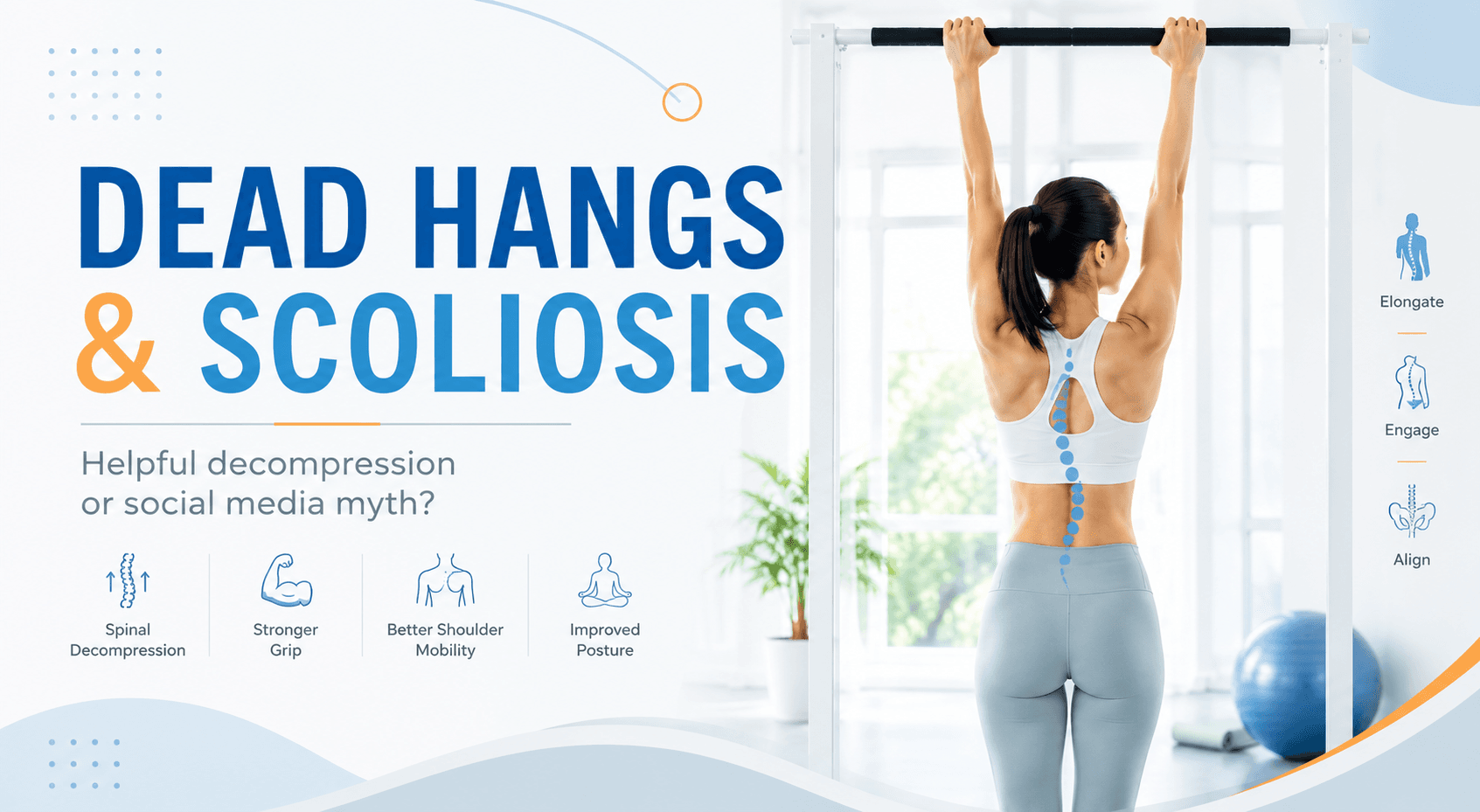
Dead Hangs for Scoliosis: Helpful Decompression or Social Media Hype?
Social media is filled with videos claiming that dead hangs can “fix” scoliosis, decompress your spine, or instantly improve posture. While dead hangs can feel good and may temporarily relieve tension, there is an important truth most videos leave out:
Dead hangs do not reduce a scoliosis curve.
As someone who has worked with scoliosis patients for more than 20 years — and also trains in CrossFit — I understand why dead hangs are appealing. They look simple, natural, and satisfying. But scoliosis is far more complex than just “stretching the spine longer.”
If fixing scoliosis was as easy as hanging like a monkey from a pull-up bar, life would honestly be much easier for everyone.
Why Dead Hangs Became Popular for Scoliosis
Dead hangs are exactly what they sound like: hanging from a pull-up bar while allowing your body weight to create traction through the spine.
People often report:
-
A temporary feeling of decompression
-
Reduced tightness in the back
-
Better shoulder mobility
-
Relief after sitting long hours
-
Improved grip strength
And yes — there is some truth behind it.
Humans were built to climb, swing, and hang. Think about primates swinging through trees. Our shoulders are naturally designed for overhead movement when done correctly.
Dead hangs can absolutely be beneficial for:
-
Shoulder mobility
-
Grip strength
-
Upper body endurance
-
Spinal decompression
-
Athletic performance
If you want to progress further, many athletes even use a hang board — commonly used in rock climbing — with different grip positions and hold sizes to challenge stability and strength.
But scoliosis changes the conversation.
The Problem With Dead Hangs for Scoliosis
What many people do not realize is that a passive dead hang can sometimes create more instability in a scoliosis body.
During a passive hang:
-
Your shoulders elevate toward your ears
-
Your body relaxes into the stretch
-
Your spine traction increases without muscular control
-
Stabilizing muscles may “switch off”
For someone with scoliosis — especially if they already lack muscular support and spinal control — this can overload tissues instead of helping them.
The biggest issue is this:
The “Rebound Effect”
When you overstretch muscles passively, the body often reacts defensively afterward.
Instead of staying relaxed, the muscles tighten up again to protect the spine.
This is known as a rebound effect:
-
Temporary relief during the hang
-
Increased tightness afterward
-
More tension later in the day
-
Possible aggravation of pain
This is why some scoliosis patients say:
“It felt good at first… then my back became tighter later.”
That response is very real.
What Muscles Actually Work During a Dead Hang?
Many people think dead hangs are “just stretching.” They are not.
Several major muscle groups are heavily involved:
Forearms & Hand Flexors
These are the primary load-bearers. Your grip muscles work continuously to keep you attached to the bar.
Shoulders (Deltoids & Rotator Cuff)
Your shoulder stabilizers protect the joint while supporting your body weight overhead.
Upper Back (Lats & Traps)
The latissimus dorsi and trapezius help stabilize your shoulder girdle and maintain alignment.
Core (Abs & Obliques)
Your abdominal muscles engage to reduce swinging and keep your trunk controlled.
For healthy individuals with good stability, this can be excellent training.
But for scoliosis patients without adequate muscular activation and control, the load may exceed what the body can properly manage.
Why Dead Hangs Are NOT a Scoliosis Correction Exercise
This is where social media often becomes misleading.
Spinal decompression does not equal scoliosis correction.
Scoliosis involves:
-
Rotation of the spine
-
Muscular asymmetry
-
Rib cage changes
-
Pelvic imbalance
-
Neuromuscular control issues
Simply pulling the spine longer does not address these components.
A temporary stretch may create relief, but it does not “straighten” the spine permanently.
Be careful of:
-
“Instant scoliosis fix” videos
-
Before-and-after posture clips
-
Viral traction hacks
-
Overpromised decompression claims
Real scoliosis care takes:
-
Consistency
-
Strength
-
Breathing control
-
Stability training
-
Individualized correction strategies
Nothing instant.
Better Alternatives Than Passive Dead Hangs
For many scoliosis patients, controlled elongation works better than passive traction.
Active or Supported Hangs
Instead of completely relaxing:
-
Keep the core engaged
-
Maintain shoulder control
-
Avoid collapsing into the joints
-
Use partial body weight if needed
Sometimes support from a Swiss ball or assisted positioning can help reduce excessive strain.
Wall Elongations
This is often a safer starting point for scoliosis patients.
Wall elongation exercises allow you to:
-
Lengthen the spine with control
-
Maintain muscular activation
-
Improve posture awareness
-
Reduce instability
-
Avoid rebound tightening
You gain decompression without the body fighting back afterward.
Semi-Hanging & Wall Bar Exercises
Exercises such as “semi-hangs” or “The Circle” performed on wall bars can help:
-
Improve pelvic alignment
-
Create controlled traction
-
Encourage better spinal organization
-
Reduce asymmetrical loading
These are generally more controlled compared to a full passive dead hang.
The Schroth Method
Methods like the Schroth Method focus on:
-
Rotational breathing
-
Muscle activation
-
Postural correction
-
Three-dimensional scoliosis management
This is often far more effective than simply hanging from a pull-up bar.
The Schroth Method is excellent for posture awareness, breathing, and spinal positioning. My only critique is that scoliosis rehab should also place more emphasis on strength training — not just stretching and elongation.
If the muscles are not strong enough to support the correction, the body often falls back into old patterns. That is why scoliosis care should include:
-
core strength
-
glute activation
-
scapular stability
-
spinal endurance
You cannot stretch your way into long-term stability.
So… Should You Do Dead Hangs If You Have Scoliosis?
Maybe — but with caution.
Dead hangs are not “bad.”
They simply are not the miracle solution social media makes them seem to be.
They may help:
-
Grip strength
-
Shoulder mobility
-
Athletic conditioning
-
Temporary decompression
But they may also:
-
Increase instability
-
Trigger rebound tightness
-
Overload weak stabilizers
-
Cause more discomfort if done passively
What works for someone online may not work for your spine.
Every scoliosis pattern is different.
Final Thoughts
Do not follow social media blindly.
A movement that feels amazing for one person may aggravate another person’s scoliosis completely.
If you are considering dead hangs:
-
Start conservatively
-
Focus on control, not duration
-
Avoid collapsing passively
-
Pay attention to symptoms afterward
-
Speak with your scoliosis provider first
After working with scoliosis patients for more than two decades — and training as a CrossFitter myself — one thing remains true:
There are no instant fixes.
Real scoliosis management is about building a body that is stronger, more aware, and more supported over time. Modern scoliosis systems like CLEAR and ScoliBalance recognize that long-term scoliosis management requires muscular support, spinal stability, and active strengthening — not passive stretching alone.
Not just hanging from a bar and hoping gravity solves everything.