Fascia Hydrodissection for Myofascial Pain Syndrome in the Latissimus Dorsi: Is Injection Enough, or Does the Body Need Retraining?
Introduction: When Muscle Pain Is Not Just a Muscle Problem
Many people experience persistent tightness, aching, or “knots” around the upper back, shoulder blade, ribs, or lower back area. Sometimes stretching, massage, and strengthening exercises only provide temporary relief.
One possible reason is Myofascial Pain Syndrome (MPS) — a condition involving sensitive trigger points and dysfunction within the muscle and surrounding connective tissue called fascia.
One muscle that is commonly overlooked is the latissimus dorsi — one of the largest muscles in the body, connecting the shoulder, spine, ribs, and pelvis.
Recently, fascia hydrodissection has gained attention as a treatment option for myofascial pain. But how does it work? And is it enough to solve the problem?
Understanding the Latissimus Dorsi: More Than a Back Muscle
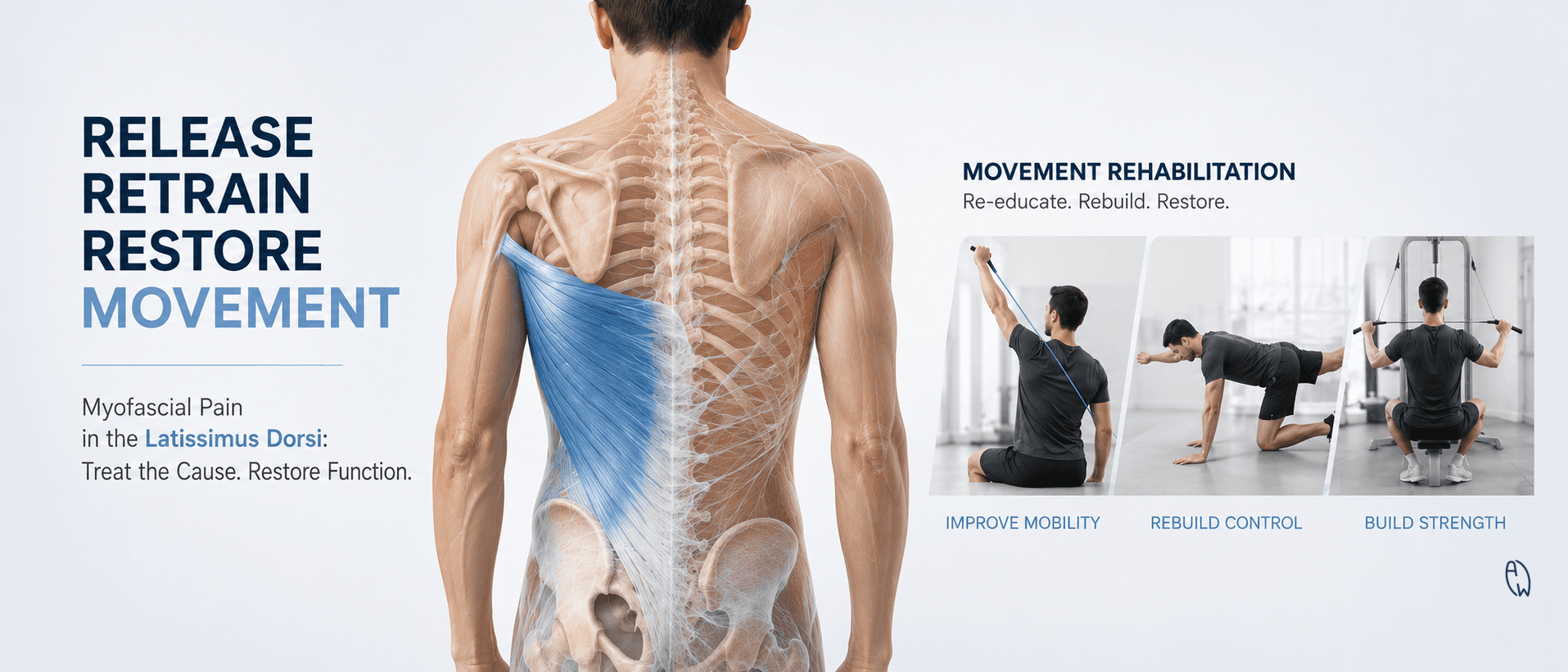
The latissimus dorsi (“lat”) is a large, fan-shaped muscle that extends from:
-
Lower thoracic spine
-
Lower back fascia (thoracolumbar fascia)
-
Pelvis
-
Ribs
-
Shoulder bone (humerus)
Because of these connections, dysfunction in the latissimus dorsi may contribute to:
✓ Shoulder stiffness
✓ Pain around the shoulder blade
✓ Mid-back tightness
✓ Lower back discomfort
✓ Limited overhead movement
✓ Feeling “stuck” when rotating the body
The latissimus dorsi does not work alone — it is part of a larger movement system involving fascia, joints, nerves, and the brain.
What Is Myofascial Pain Syndrome?
Myofascial Pain Syndrome occurs when muscles and fascia develop areas of increased sensitivity commonly called trigger points.
Symptoms may include:
-
Deep aching pain
-
Muscle tightness
-
Tender points
-
Referred pain to another area
-
Restricted movement
-
A feeling that stretching never fully releases the muscle
Unlike a simple muscle strain, chronic myofascial pain often involves changes in how the nervous system controls and protects movement.
The muscle may not only be “tight” — it may be guarding.
What Is Fascia Hydrodissection?
Fascia hydrodissection is a minimally invasive procedure where fluid is injected into specific tissue layers to separate restricted fascial planes.
The goal is to improve the ability of tissues to glide and move.
A doctor may use ultrasound guidance to identify the targeted area and carefully place fluid between tissue layers.
Potential goals include:
✓ Reducing mechanical restriction
✓ Improving fascial movement
✓ Decreasing irritation around sensitive tissues
✓ Supporting pain reduction
For some patients with persistent myofascial pain, hydrodissection may help create an opportunity for better movement.
However, releasing tissue is only one part of recovery.
Why Pain May Return After Injection Alone
Imagine a rusty door hinge.
Adding lubricant may help the hinge move better — but if the door frame is misaligned or the same stress keeps happening, the problem can return.
The human body works similarly.
If the latissimus dorsi became overactive because of:
-
Poor movement patterns
-
Limited spinal mobility
-
Shoulder compensation
-
Weak stabilizing muscles
-
Long-term protective guarding
then reducing tissue restriction alone may not address why the problem developed.
The body needs to relearn how to move.
What Treatment Should Be Done After Fascia Hydrodissection?
1. Restore Proper Movement
After pain decreases, the next goal is improving movement quality.
This may include:
-
Shoulder mobility exercises
-
Thoracic spine mobility work
-
Controlled breathing patterns
-
Gentle range-of-motion training
The goal is not simply flexibility.
The goal is teaching the nervous system that movement is safe again.
2. Improve Fascia and Muscle Coordination
Fascia responds to movement, loading, and repetition.
Rehabilitation may include:
-
Slow controlled movements
-
Multi-directional stretching
-
Functional movement training
-
Progressive strengthening
Because the latissimus dorsi connects multiple body regions, isolated treatment may not be enough.
The shoulder, spine, pelvis, and core need to work together.
3. Address Posture and Biomechanics
Many chronic pain problems develop because certain muscles repeatedly compensate.
Assessment may include:
-
Spinal alignment
-
Shoulder position
-
Rib cage movement
-
Breathing mechanics
-
Muscle imbalance
Finding why the latissimus dorsi became overloaded is important for long-term improvement.
4. Strengthen Without Creating More Guarding
Many people try to strengthen their way out of pain.
But if the nervous system is still protective, aggressive strengthening may reinforce tension.
Rehabilitation should progress from:
Awareness → Control → Mobility → Strength → Function
The goal is efficient movement, not simply stronger muscles.
Fascia Hydrodissection + Rehabilitation: A Combined Approach
Fascia hydrodissection may help reduce restrictions, but lasting improvement often requires addressing the whole movement system.
A comprehensive approach may include:
✓ Medical assessment
✓ Pain management when appropriate
✓ Movement rehabilitation
✓ Postural correction
✓ Strength retraining
✓ Lifestyle and ergonomic changes
The question is not only:
“How do we release the tight muscle?”
A better question is:
“Why did this muscle need to become tight in the first place?”
Final Thoughts
Myofascial Pain Syndrome of the latissimus dorsi can be frustrating because the painful area is often only part of the story.
Fascia hydrodissection may help improve tissue mobility and reduce symptoms in selected cases. However, long-term improvement usually comes from restoring how the muscles, fascia, joints, and nervous system work together.
Pain relief creates the opportunity.
Movement retraining creates the change.