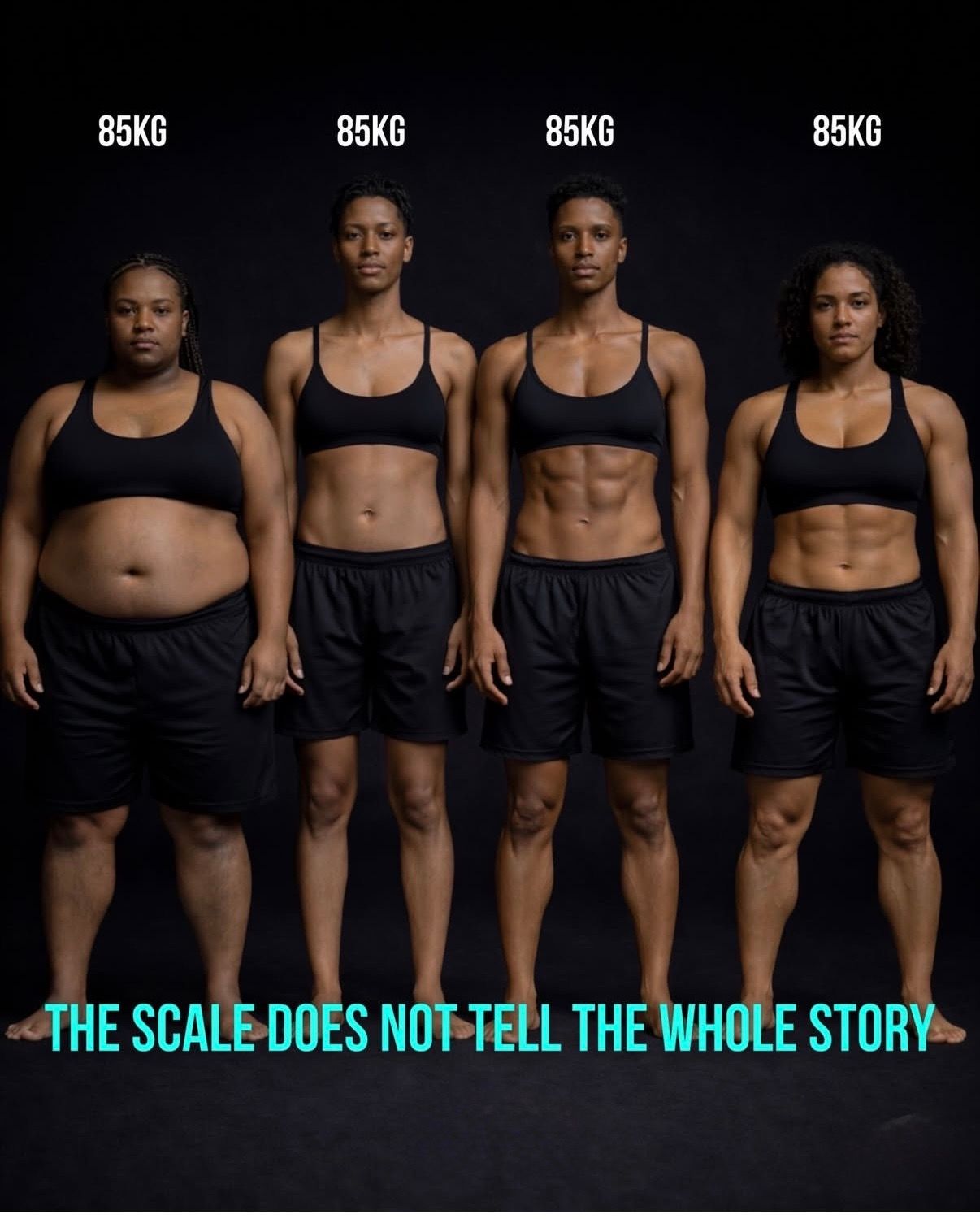
Body Weight vs Body Composition: Why It Matters for Scoliosis
Many people with scoliosis focus heavily on the number on the weighing scale. But when it comes to spinal health and scoliosis management, body composition matters far more than body weight alone.
If you look at a group of people who all weigh the same, you will quickly notice something interesting:
Even though the number on the scale is identical, each person looks different. Some appear taller, some leaner, some more muscular, and some softer.
This is because weight alone does not reflect body composition.

All weigh 85 kg, but one may have higher muscle mass while the other has higher body fat. The structure, posture, and how their body supports the spine can be completely different.
For individuals with scoliosis, this distinction becomes even more important.
Why Body Composition Matters for Scoliosis
Scoliosis is not simply a sideways curve of the spine. It is a three-dimensional condition involving spinal curvature, rotation, and muscular imbalance.
Because of this, the muscles around the spine often develop unevenly. Certain muscles become overactive and tight, while others become weak or underused.
If fitness training is done without understanding the curve pattern, the body may reinforce existing imbalances rather than correct them.
However, when training is guided by knowledge of the specific spinal curve, muscle development can actually become a powerful tool to support the spine.
Proper conditioning allows you to:
-
Strengthen muscles that stabilize the spine
-
Improve postural awareness
-
Support spinal alignment
-
Reduce strain on joints and discs
-
Build a body that helps maintain correction
In other words, muscle becomes structural support for the spine.
Muscle Training Can Support Your Curve
Every scoliosis curve pattern is different. Some people have thoracic curves, others lumbar curves, and many have a combination of both.
Because of this, exercise programs should never be completely generic.
When your curve pattern is understood through proper assessment and imaging, training can be structured to:
-
Build muscle where spinal support is needed
-
Improve asymmetrical muscle activation
-
Enhance neuromuscular coordination
-
Promote better posture and movement control
Instead of training randomly, you begin training with purpose.
This is especially important for individuals who enjoy fitness, sports, or strength training. With the right approach, scoliosis does not need to limit your goals.
It simply requires a more intelligent and personalized approach to conditioning.
Conditioning Training: The Missing Piece
One of the most important components of scoliosis management is conditioning training.
Conditioning teaches the body how to maintain the posture and alignment you are trying to build.
Without conditioning, even if adjustments, braces, or corrective exercises are performed, the body may gradually return to its previous patterns.
Conditioning helps the body retain the structural changes you are working toward.
It trains your brain and muscles to communicate more effectively so that improved posture becomes natural, not forced.
The Best Place to Start: Core Training
For most people beginning their fitness journey with scoliosis, core training is the safest and most effective starting point.
However, the core is often misunderstood.
Many people think core muscles are only the abdominal muscles in the stomach area.
In reality, the core includes a much larger support system:
-
Deep abdominal muscles
-
Spinal stabilizers
-
Back extensors
-
Pelvic stabilizers
-
Diaphragm and breathing muscles
Together, these muscles form a natural support corset for the spine.
Strengthening both the front and back of the core helps stabilize the spine and reduce unnecessary stress on the curved segments.
When done correctly, core training can:
-
Improve spinal stability
-
Enhance posture
-
Support corrective scoliosis exercises
-
Reduce fatigue in the back muscles
-
Help maintain better alignment during daily activities
Why Knowing Your Curve Matters
If you are serious about building strength while managing scoliosis, the first step is understanding your curve pattern.
This cannot be accurately determined by posture observation alone.
A proper spinal X-ray provides essential information, including:
-
Curve location
-
Curve magnitude (Cobb angle)
-
Rotation of the vertebrae
-
Structural balance of the spine
With this information, exercise and conditioning programs can be customized according to your body type and spinal structure.
This allows your fitness training to support your spine rather than unknowingly stress it.
Your Body Is the Only Vessel You Control
Your body is the only vessel you truly have control over in this life.
The decisions you make today about movement, strength, and posture will influence how your spine functions for years to come.
Scoliosis does not mean you cannot pursue fitness goals. In fact, with the right guidance and understanding, training can become one of the most powerful tools to support your spine.
The key is to move forward with knowledge, awareness, and the right structure.
If you are planning to start or improve your fitness journey while managing scoliosis, begin by understanding your spine.
Getting a proper spinal X-ray and professional evaluation allows us to guide your conditioning and exercise strategy based on your unique curve and body composition.
Make the right decision for your health.
Research Journals
1. Core Strength and Cobb Angle Improvement
A randomized controlled study found that 10 weeks of core strengthening exercises significantly reduced Cobb angle and improved back muscle strength in people with functional scoliosis. https://pubmed.ncbi.nlm.nih.gov/27102321/
Citation
Park YH, Park YS, Lee YT, et al.
The effect of a core exercise program on Cobb angle and back muscle activity in functional scoliosis.
Journal of International Medical Research, 2016.
Key finding
-
Core strengthening improved spinal muscle activity
-
Cobb angle decreased after training https://pubmed.ncbi.nlm.nih.gov/27102321/
2. Core Stabilization Exercise
A 2025 systematic review found that core stabilization exercise improves Cobb angle, trunk rotation, and quality of life in adolescents with scoliosis.
Citation
Liu X, Wang Y, Liu M, et al.
The efficacy of core stabilization exercise in mild and moderate adolescent idiopathic scoliosis.
Journal of Orthopaedic Surgery and Research, 2025.
Key findings
-
Reduced Cobb angle
-
Reduced trunk rotation
-
Improved quality of life scores
https://pubmed.ncbi.nlm.nih.gov/40016756/
3. Core Stabilization Improves Respiratory and Spine Function
A 12-week training study found that core stabilization exercise improved spinal curvature measures and respiratory muscle strength in scoliosis patients.
Citation
Effects of Core Stabilization Training on the Cobb Angle and Pulmonary Function in Adolescent Idiopathic Scoliosis.
Journal of Environmental and Public Health, 2022. https://pubmed.ncbi.nlm.nih.gov/35958375/
Key findings
-
Improved Cobb angle
-
Improved lung capacity
-
Stronger respiratory muscles
4. Muscle Imbalance in Scoliosis
MRI studies show that paraspinal muscle imbalance is strongly associated with scoliosis curve development and progression. https://pubmed.ncbi.nlm.nih.gov/40311801/
Citation
Gao Y et al.
Evaluation of thoracic paraspinal muscle imbalance in adolescent idiopathic scoliosis.
World Neurosurgery, 2025.
Key finding
- Asymmetry of spinal muscles contributes to curve progression
5. Importance of Muscle Forces in Curve Correction
Biomechanical models show that muscle forces play a critical role in stabilizing or correcting spinal curves when combined with rehabilitation or bracing.
Citation
Biomechanical analysis of scoliosis correction under muscular and external forces.
Journal of Clinical Neuroscience, 2024.
Key finding
- Balanced muscular force improves scoliosis correction outcomes https://www.sciencedirect.com/science/article/abs/pii/S0967586824005307?
Medical Disclaimer
This article is for educational purposes only and does not constitute medical advice.
Scoliosis varies significantly between individuals. Always consult a qualified healthcare professional before starting any new sport or exercise program, especially if you have scoliosis, spinal conditions, pain, or previous injuries. Participation in sports should be guided by individual assessment and professional recommendation.
The image is shared for educational purposes with patient consent. Individual outcomes vary. Structural correction does not automatically restore full respiratory function. Clinical assessment is required.
Copyright & Content Protection Notice
© 2026 All Well Scoliosis Centre. All rights reserved.
This content is original and protected by copyright law.
No part of this article may be reproduced, distributed, copied, or reused in any form without prior written permission. Unauthorized use, duplication, or content scraping is strictly prohibited.