Progress Is Progress: An Ongoing Cervical Rehabilitation Case Study
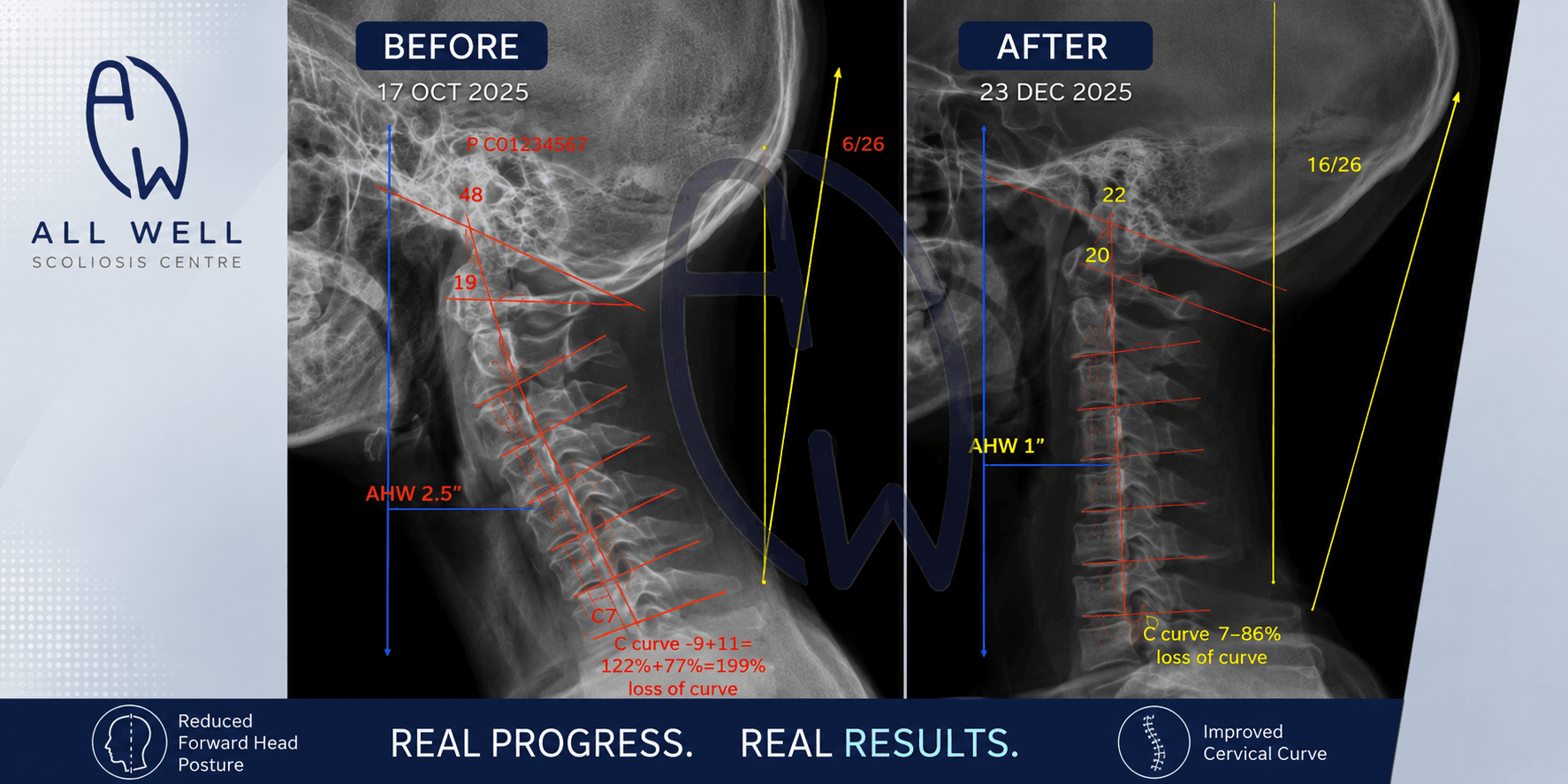
A Real Cervical X-Ray Comparison Showing Improvement in Forward Head Posture
In a world where many people spend hours each day looking at computers, tablets, and smartphones, forward head posture has become one of the most common postural problems we encounter.
Often referred to as Tech Neck or Text Neck, forward head posture occurs when the head drifts in front of the shoulders, placing excessive strain on the muscles, joints, ligaments, and discs of the cervical spine.
Many patients assume neck stiffness, shoulder tension, headaches, and postural fatigue are simply part of modern life. However, in some cases, these symptoms may be associated with measurable changes in cervical alignment.
This article shares the journey of one of our patients currently undergoing rehabilitation at All Well Scoliosis Centre. The purpose of this case study is not to present a final outcome or claim complete correction.
Instead, we want to highlight something equally important:
Progress Is Progress
The patient is still actively undergoing treatment, and additional follow-up imaging is planned. However, the changes seen so far are encouraging and demonstrate that positive improvements can occur when rehabilitation is approached consistently.
When Neck Tension Becomes More Than "Just Stress"
Like many working adults, this patient spent long hours sitting at a desk and frequently using digital devices throughout the day.
Over time, she began noticing:
-
Tight shoulders and upper back tension
-
Fatigue after prolonged sitting
-
Frequent stretching throughout the day
-
Difficulty maintaining upright posture
-
Discomfort after looking down at her phone
-
General postural fatigue by the end of the workday
Initially, she believed these symptoms were simply caused by stress, workload, or aging.
However, symptoms only tell part of the story.
To better understand the structural condition of the cervical spine, a lateral cervical X-ray was performed.
Initial X-Ray Findings
Date: 17 October 2025
The initial X-ray revealed significant postural changes within the cervical spine.
Key Findings
-
Forward head posture measuring approximately 2.5 inches
-
Significant loss of the normal cervical curve
-
Altered cervical biomechanics
-
Increased mechanical stress on the cervical spine
-
Poor load distribution throughout the neck
The patient's head was positioned substantially forward relative to her shoulders.
While this may seem like a minor postural issue, even small changes in head position can significantly increase the forces acting on the cervical spine.
The "Bowling Ball" Effect
Many people underestimate how much work the neck performs every day.
When properly aligned, the average adult head weighs approximately 10 to 12 pounds (4.5 to 5.5 kilograms).
However, as the head moves forward, the effective load on the cervical spine increases dramatically.
Imagine holding a bowling ball close to your chest.
Now imagine holding that same bowling ball at arm's length.
The weight itself has not changed, but the effort required to support it increases significantly.
The same principle applies to forward head posture.
As the head moves further away from its ideal position, the muscles of the neck and upper back must work harder to support it.
Over time, this increased stress may contribute to:
-
Neck pain
-
Muscle tension
-
Headaches
-
Shoulder discomfort
-
Reduced mobility
-
Disc degeneration
-
Loss of cervical lordosis
Why the Cervical Curve Matters
The cervical spine is naturally designed with a gentle backward "C-shaped" curve known as cervical lordosis.
This curve helps the body:
-
Support the weight of the head
-
Absorb shock during movement
-
Reduce stress on spinal discs
-
Improve movement efficiency
-
Protect nerves and surrounding structures
When this curve becomes flattened, the spine becomes less efficient at managing daily loads.
The body often compensates by recruiting additional muscles, creating tension and fatigue throughout the neck and upper back.
Forward head posture can also create a chain reaction throughout the body, contributing to:
-
Rounded shoulders
-
Increased thoracic kyphosis
-
Tight chest muscles
-
Weak deep neck flexors
-
Reduced postural endurance
The Rehabilitation Plan
Following a comprehensive assessment, a personalized rehabilitation program was developed.
The treatment plan included:
Cervigard Therapy
Designed to support restoration of cervical alignment and encourage healthier cervical biomechanics.
Corrective Rehabilitation Exercises
The exercise program focused on:
-
Deep neck flexor activation
-
Postural muscle strengthening
-
Scapular stabilization
-
Cervical mobility
-
Functional movement retraining
Postural Retraining
Patients often return to poor postural habits without realizing it.
Postural retraining focused on improving awareness during:
-
Computer work
-
Smartphone use
-
Reading
-
Daily activities
Ergonomic Recommendations
Specific recommendations were provided regarding:
-
Monitor height
-
Workstation setup
-
Sitting posture
-
Smartphone positioning
-
Movement breaks throughout the day
Home Exercise Program
Consistency outside the clinic is often one of the most important factors in long-term success.
The patient was provided with a structured home program designed to reinforce the changes being made during rehabilitation.
Follow-Up X-Ray: Encouraging Progress
Date: 23 December 2025
Approximately two months after beginning rehabilitation, a follow-up cervical X-ray was obtained.
What Changed?
Forward Head Posture Improved
Forward head posture improved from approximately 2.5 inches to 1 inch.
This represents a substantial reduction in mechanical stress acting on the cervical spine.
Improved Head Position
The head was positioned closer to its ideal location over the shoulders, creating a more balanced posture.
Improved Cervical Curve
The cervical spine demonstrated encouraging improvement compared to the initial X-ray.
Better Overall Biomechanics
As alignment improved, the spine became better positioned to distribute loads more efficiently throughout daily activities.
Why We Are Sharing This Case Before Treatment Is Finished
Many healthcare articles focus exclusively on dramatic before-and-after transformations.
However, real rehabilitation rarely happens overnight.
Meaningful improvements often occur gradually through repetition, consistency, and time.
This patient has not completed treatment.
She remains actively engaged in her rehabilitation program and continues to work toward further improvements.
The reason we are sharing this case now is because we believe it is important for patients to understand that every positive step matters.
A reduction in forward head posture from 2.5 inches to 1 inch may not represent the final destination, but it is meaningful progress worth acknowledging.
Why We Use X-Rays to Monitor Progress
At All Well Scoliosis Centre Singapore, we believe objective measurements matter.
Posture photographs can be useful, but they cannot show what is happening within the spine itself.
Likewise, symptoms alone do not always reflect structural changes.
Some individuals experience significant symptoms despite relatively minor structural findings.
Others may have substantial postural changes while experiencing little discomfort.
X-rays allow us to:
-
Measure forward head posture
-
Assess cervical lordosis
-
Monitor structural changes over time
-
Evaluate rehabilitation progress
-
Make more informed clinical decisions
Without imaging, many of these changes would be difficult to quantify accurately.
The Journey Continues
It is important to emphasize that this is an ongoing case study.
The patient continues to follow her prescribed treatment plan and remains committed to her rehabilitation journey.
Additional follow-up X-rays are planned in the coming months to evaluate whether further improvements in cervical alignment and posture can be achieved.
When future imaging becomes available, we look forward to sharing updates on her progress.
Progress Is Progress
One of the most valuable lessons in rehabilitation is that improvement rarely occurs all at once.
The body adapts to poor posture over many years.
Correcting those patterns requires patience, consistency, and commitment.
Every degree of improvement matters.
Every reduction in forward head posture matters.
Every positive change seen on an X-ray matters.
This ongoing case demonstrates that measurable improvements can occur when rehabilitation is approached systematically and consistently.
While the journey is not yet complete, we are encouraged by the progress achieved so far and look forward to documenting future milestones.
Because sometimes the most important result is not perfection.