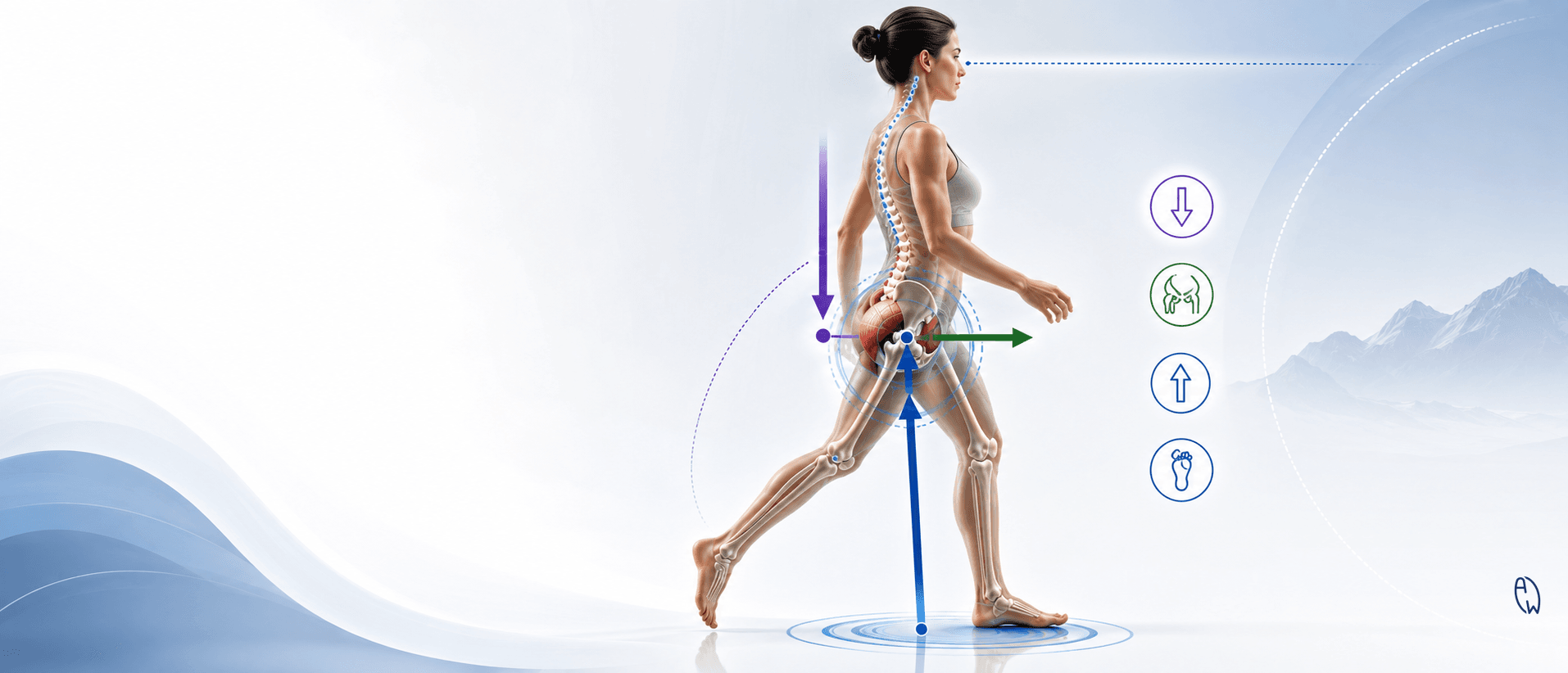
Hip Joint Biomechanics During Single-Leg Stance: Why Standing and Walking Feel More Difficult for People with Scoliosis
Most people never think about what it takes to stand on one leg.
Yet every step you take requires your body to balance on a single limb for a brief moment. During this phase, your hip experiences some of the highest mechanical loads found in normal human movement. Your muscles, joints, and nervous system must work together continuously to keep you upright against gravity.
For most healthy individuals, this happens automatically.
For people living with scoliosis—or those who have undergone spinal fusion surgery—this seemingly simple task often requires considerably more effort.
Many of our patients tell us:
"I can only stand for about 20 to 30 minutes before I need to sit down."
"Walking through a shopping mall is exhausting."
"People think I'm standing normally, but my muscles feel like they're working all the time."
These experiences are real, and they can often be explained through biomechanics.
Walking Is Actually a Series of Single-Leg Balances
Walking is not simply moving one foot in front of the other.
Every step contains a phase called single-leg stance, where one leg supports almost the entire body while the opposite leg swings forward.
This occurs thousands of times every day while you:
-
Walk
-
Climb stairs
-
Run
-
Exercise
-
Shop
-
Stand in a queue
Although each single-leg stance lasts only a fraction of a second, it places tremendous demands on the hip and pelvis.
The Four Forces That Keep You Balanced
During single-leg stance, four important forces work together to maintain stability.
1. Body Weight
Gravity continuously pulls your body downward through its center of mass.
Because your body's center of gravity lies slightly toward the opposite side of the supporting hip, gravity naturally creates an adduction moment, causing the pelvis to want to drop toward the unsupported side.
Without muscular control, you would immediately lose balance.
2. Ground Reaction Force
Whenever your foot contacts the ground, the ground pushes back with an equal and opposite force known as the Ground Reaction Force (GRF).
This force travels upward through the:
-
Foot
-
Ankle
-
Knee
-
Hip
-
Pelvis
Since the GRF usually passes slightly medial to the hip joint, it further increases the tendency for the pelvis to tilt.
3. Hip Abductor Muscles
Fortunately, the body has an elegant solution.
The gluteus medius, gluteus minimus, and tensor fasciae latae contract to generate an opposing abduction moment, preventing the pelvis from collapsing.
These muscles may appear relatively small, but because they attach close to the hip joint, they have a short lever arm.
To compensate for this mechanical disadvantage, they often generate forces two to three times your body weight during normal walking.
4. Joint Reaction Force
The combined effect of body weight and powerful muscle contraction creates the Joint Reaction Force (JRF).
This force compresses the femoral head into the acetabulum, allowing the hip joint to remain stable while transmitting force through the lower limb.
During:
-
Normal walking: 2.5–3× body weight
-
Stair climbing: 3–4× body weight
-
Running: 5–6× body weight
-
Jumping: 6–8× body weight or more
These loads are completely normal for a healthy hip.
Why Hip Muscle Weakness Changes Everything
The hip abductors are the primary stabilizers of the pelvis.
When these muscles become weak, they cannot generate enough force to counteract gravity.
The pelvis begins to drop toward the unsupported side—a finding known as the Trendelenburg sign.
Many people unconsciously compensate by leaning their trunk over the standing leg, creating a Trendelenburg gait.
Although this reduces the immediate demand on the weakened muscles, it transfers abnormal loads throughout the body.
Over time, these altered mechanics may contribute to:
-
Hip pain
-
Lower back pain
-
Knee valgus
-
Poor balance
-
Reduced walking efficiency
-
Overuse injuries
Now Imagine Living With Scoliosis
Now imagine beginning every step with a spine that is permanently curved.
Unlike someone with a symmetrical spine, individuals with scoliosis often start from an asymmetrical position. Their center of mass shifts, the pelvis may not be level, and the muscles surrounding the spine, pelvis, and hips must work continuously to maintain balance.
One remarkable feature of the human body is that the brain constantly tries to keep the head level with the horizon.
Using information from the eyes, vestibular system, muscles, and joints, the nervous system makes countless small adjustments every second so that vision remains stable and balance is preserved.
As a result, many people with scoliosis feel as though they are standing straight—even though their muscles may be working much harder than those of someone without spinal asymmetry.
Why Standing Becomes So Exhausting
This is one of the most common complaints we hear in the clinic.
Many patients can stand comfortably for only 20 to 30 minutes before they begin looking for somewhere to sit.
Others notice increasing fatigue while cooking, shopping, walking through an airport, or waiting in line.
This fatigue is not simply a matter of "poor fitness."
The muscles surrounding the spine, pelvis, and hips are constantly making thousands of tiny adjustments to counteract the uneven forces created by the spinal curve.
Unlike muscles working in a more balanced system, these stabilizers often have fewer opportunities to fully relax during standing and walking.
As muscle endurance declines:
-
Maintaining posture becomes more difficult.
-
Walking becomes less efficient.
-
Joint loading increases.
-
The back, hips, and legs begin to ache.
-
Sitting or lying down often provides immediate relief because it reduces the mechanical demand placed on the stabilizing muscles.
This does not necessarily mean the scoliosis has worsened.
More often, it means the muscles responsible for maintaining posture have reached their endurance limit.
What About Patients Who Have Undergone Spinal Fusion?
Now imagine adding another layer of complexity.
Many people who undergo scoliosis surgery have titanium rods and screws permanently attached to part of their spine.
Spinal fusion can successfully stop curve progression and improve alignment, but it also changes how movement is distributed throughout the body.
The fused segments no longer move independently. As a result, the muscles surrounding the spine, together with the hips, pelvis, and the mobile segments above and below the fusion, often take on greater responsibility during standing and walking.
One of the most common experiences we hear from post-fusion patients is not necessarily severe pain, but persistent muscular fatigue.
Many describe feeling as though they must constantly "hold themselves upright."
Even though they appear to be standing tall, their muscles may remain highly active to maintain balance and compensate for reduced spinal mobility. Over time, this sustained effort can contribute to stiffness, fatigue, and aching during prolonged standing or walking.
There is also an important neurological component.
The brain continuously integrates information from the eyes, inner ear, muscles, and joints to maintain balance while trying to minimize discomfort. Persistent pain or muscular tension can increase the nervous system's sensitivity, making everyday activities feel mentally and physically demanding.
Many patients tell us:
"I can stand straight, but I feel exhausted."
"My X-ray looks much better, but my muscles never seem to switch off."
"I feel like I'm using willpower just to keep standing."
These experiences do not necessarily mean the surgery has failed.
Rather, they reflect the body's ongoing adaptation to a new mechanical environment.
Rehabilitation Is About Teaching the Body to Move Efficiently
Whether someone has scoliosis, hip weakness, or has undergone spinal fusion, the goal of rehabilitation should extend beyond simply changing an X-ray.
It should focus on improving how the body manages gravity.
At All Well Scoliosis Centre, we believe successful rehabilitation involves strengthening the entire movement system, including:
-
Hip stability
-
Pelvic control
-
Core endurance
-
Balance
-
Proprioception
-
Walking mechanics
-
Breathing coordination
-
Muscle endurance
-
Neuromuscular control
As these systems become stronger and more coordinated, the body requires less energy to perform everyday tasks.
Patients often notice they can stand longer, walk farther, and move with greater confidence—not because gravity has changed, but because their body has become more efficient at responding to it.
The Bottom Line
Standing on one leg may appear effortless, but it is one of the most demanding mechanical tasks your body performs.
Every step requires powerful hip muscles, precise joint mechanics, and continuous communication between the muscles and nervous system to keep you balanced.
For people with scoliosis, the challenge is even greater. The body is constantly adapting to asymmetrical forces while trying to keep the head level and movement efficient. Over time, this increased muscular demand can lead to fatigue, discomfort, and reduced endurance—even during ordinary activities such as standing, walking, or shopping.
For individuals who have undergone spinal fusion, the body must also adapt to a different mechanical environment. Although the spine may be straighter and more stable, the muscles and nervous system still need to learn how to move efficiently within the limits of the fused segments.
This is why rehabilitation is about much more than making the spine straighter.
It is about helping the entire body become stronger, more coordinated, and more energy-efficient.
Because when your body spends less energy fighting gravity, it has more energy to enjoy life.
Frequently Asked Questions
Why do I get tired after standing for only 20 to 30 minutes?
This often reflects muscular endurance rather than muscle strength. In scoliosis, the muscles supporting the spine, pelvis, and hips work continuously to maintain balance, leading to fatigue during prolonged standing.
Can scoliosis cause hip pain?
Yes. A spinal curve can shift body weight unevenly, increasing demands on the hip muscles and altering walking mechanics. Over time, this may contribute to hip pain and muscle fatigue.
Why do some spinal fusion patients still experience fatigue?
Although spinal fusion stabilizes the spine, it also changes movement patterns. The surrounding muscles and nervous system must adapt to these changes, and some patients experience increased muscular effort during standing and walking.
Can rehabilitation help after spinal fusion?
Yes. Rehabilitation focuses on improving muscle endurance, balance, hip stability, posture, and movement efficiency, helping many patients reduce fatigue and improve function.
Why is hip strength important for scoliosis?
Very! Strong hip muscles help stabilize the pelvis during walking, distribute forces more evenly, and reduce unnecessary stress on the spine and lower limbs.