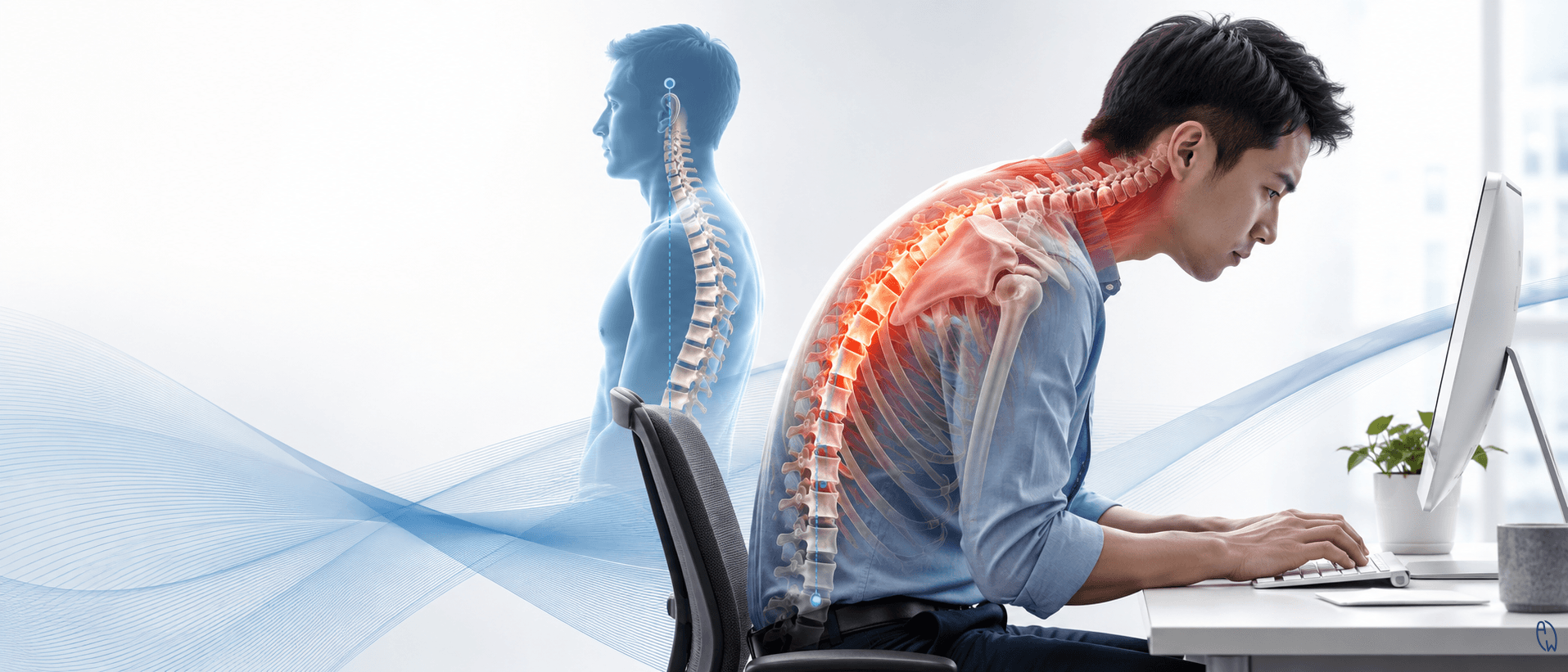
Hunchback Posture: Why It Happens and Why Stretching Alone Isn't Enough
Every Day, Millions of People Stretch the Wrong Thing
Every morning, you remind yourself to stand up straighter.
You stretch your upper back.
You roll your shoulders.
Maybe you use a foam roller, massage gun, or ask someone to massage the muscles between your shoulder blades.
For a few minutes, you feel better.
Then by lunchtime, you're slouching again.
Your neck feels heavy.
Your shoulders roll forward.
The tightness between your shoulder blades returns.
So you stretch again.
If this sounds familiar, you're not alone.
Every day, millions of office workers, students, drivers, healthcare professionals, gamers, and smartphone users experience the same frustrating cycle. They assume their upper back is simply "too tight," so they continue stretching the area that hurts.
But what if the tightness isn't actually the problem?
What if your body is trying to protect itself?
For many people, a rounded upper back—commonly called a hunchback posture—isn't caused by one tight muscle. Instead, it develops gradually as your spine, muscles, joints, and nervous system adapt to years of sitting, looking down at screens, and moving less.
The medical term for an exaggerated curve of the upper back is hyperkyphosis. Although some thoracic curvature is completely normal, excessive rounding can change how your body balances, breathes, and distributes force throughout the spine.
Stretching may temporarily reduce muscle tension, but lasting improvement often requires understanding why your posture changed in the first place.
Is Your Hunchback Posture Getting Worse?
Most people don't search for "hyperkyphosis."
Instead, they search for questions like:
-
Why is my upper back always tight?
-
Why do I keep slouching?
-
How do I fix a hunchback?
-
Why does my neck hurt after sitting?
-
Why won't my posture improve?
-
Why do my shoulders keep rolling forward?
A rounded upper back usually develops slowly over months or years. The early warning signs often appear long before a visible hunchback becomes obvious.
You may recognize some of these symptoms:
-
Your upper back constantly feels tight, even after stretching.
-
Foam rolling or massage only provides temporary relief.
-
Your shoulders naturally round forward.
-
Your head seems to sit in front of your shoulders.
-
Your neck becomes sore after working on a computer.
-
You frequently experience headaches at the base of your skull.
-
Standing up straight feels tiring.
-
You struggle to take a full, deep breath.
-
Your posture looks worse at the end of the day.
-
Friends or family often remind you to "stand up straight."
If several of these symptoms sound familiar, your body may already be adapting to changes in the way your spine manages gravity.
Why We See This So Often Today
At All Well Scoliosis Centre, rounded upper back posture is one of the most common concerns we hear during postural assessments.
Many people tell us:
"I've been stretching every day, but my upper back always gets tight again."
Others have already tried massage therapy, foam rolling, posture braces, ergonomic chairs, or posture correctors. While these approaches may temporarily reduce discomfort, many people become frustrated because the symptoms continue to return.
This is understandable.
Muscles respond to how the body is being loaded throughout the day. If the underlying movement patterns and posture remain unchanged, the muscles are often asked to perform the same compensations over and over again.
Rather than asking only, "Which muscle is tight?" we find it more helpful to ask, "Why is that muscle working so hard in the first place?"
That shift in thinking often changes the entire rehabilitation approach.
What Is a Hunchback Posture?
A hunchback posture refers to excessive rounding of the upper back caused by an increased curve of the thoracic spine.
Healthcare professionals call this hyperkyphosis when the thoracic curve exceeds the normal range.
Not every rounded upper back is the same.
Some people develop postural hyperkyphosis, where the spine remains flexible and posture improves when they consciously straighten up.
Others develop structural hyperkyphosis, where the shape of the spine itself has changed. This may occur with conditions such as Scheuermann's disease, osteoporosis, vertebral compression fractures, or age-related degenerative changes.
Understanding the difference is important because treatment should always match the underlying cause.
This is one reason why a comprehensive assessment is often more valuable than simply following generic posture exercises found online.
Your Spine Is Designed to Share the Load
Imagine a suspension bridge.
Every cable, support beam, and anchor works together to distribute weight evenly.
If one section weakens, the remaining structures must work harder to keep the bridge standing.
Your spine works in much the same way.
The natural curves of the neck, upper back, and lower back are carefully balanced to distribute the forces created by gravity, movement, and daily activities.
When the thoracic spine gradually rounds forward, your body's centre of gravity also shifts forward.
To prevent you from falling, the rest of your body immediately begins compensating.
Your head moves forward so your eyes remain level.
Your neck extends backward to keep you looking ahead.
Your shoulders roll inward.
Your chest muscles shorten.
Your upper back muscles tighten.
Your lower back may increase its curve.
Even your breathing mechanics begin to change because the rib cage cannot expand as efficiently.
These adaptations don't happen because your body is "broken."
They happen because your nervous system is remarkably good at keeping you balanced.
Unfortunately, those same adaptations can also increase stress on the spine over time.
The Postural Collapse Chain
A rounded upper back is rarely an isolated problem.
Instead, it often creates a chain reaction throughout the body.
As the thoracic spine rounds forward, the head migrates in front of the shoulders, increasing the workload placed on the neck muscles.
The shoulders rotate inward, placing the chest muscles in a shortened position while weakening the muscles that normally help stabilize the shoulder blades.
The upper trapezius and levator scapulae become overworked as they try to support the increasing weight of the head.
The rib cage loses some of its normal mobility, making deep breathing less efficient.
Over months or years, these compensations can contribute to:
-
Persistent neck pain
-
Upper back stiffness
-
Shoulder tension
-
Tension headaches
-
Muscle fatigue
-
Reduced thoracic mobility
-
Poor posture endurance
-
Difficulty maintaining an upright posture
Many people focus on the area that hurts.
However, the area that hurts is not always the area causing the problem.
Understanding the entire "postural collapse chain" helps explain why simply stretching the upper back often provides only temporary relief.
In the next section, we'll explore why your upper back feels so tight, why stretching alone rarely solves the problem, and what a more comprehensive treatment approach looks like.