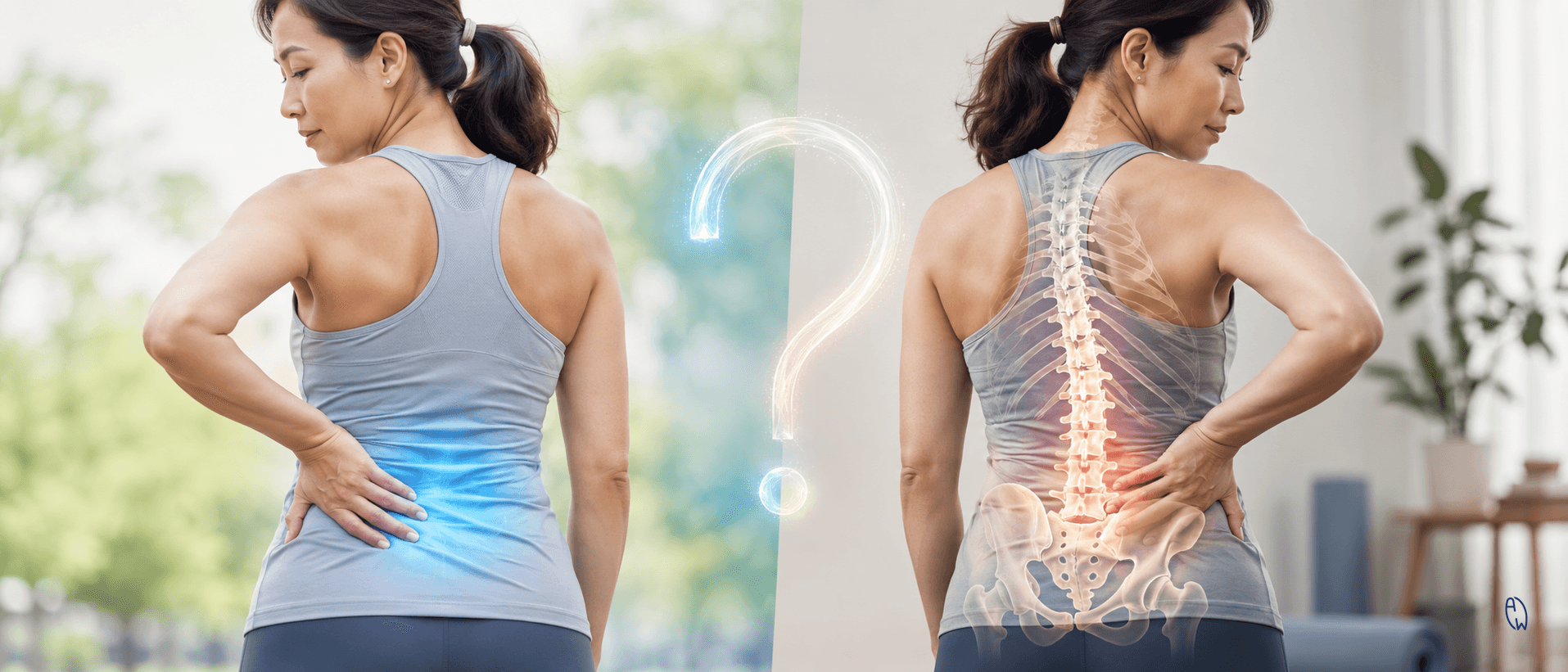
Why Your Back Pain Won't Go Away: Could It Be Your Bones, Not Your Muscles?
A Silent Problem More Women Over 35 Need to Know About
"I've Tried Everything... Why Does My Back Still Hurt?"
This is something we hear surprisingly often.
A woman in her late 30s, 40s, or 50s walks into our clinic frustrated.
She has lived with persistent back pain, hip pain, or knee pain for months—or sometimes years.
She has done everything she was told.
-
Physiotherapy
-
Dry needling
-
Pilates
-
Swimming
-
Running
-
Massage therapy
-
Stretching
-
Strength training
-
Pain medication
-
Traditional Chinese Medicine (TCM)
Some treatments helped for a few days.
Some reduced the pain temporarily.
But the discomfort always came back.
Eventually, after recommending further investigations, several of these patients underwent a Bone Mineral Density (BMD/DEXA) scan.
To their surprise, the scan revealed osteopenia—or in some cases, osteoporosis.
Their muscles were never the whole story.
Their bones also needed attention.
We Often Focus on Muscles and Forget About Bone Health
When we experience pain, our first thought is usually:
"I must have pulled a muscle."
And very often, that is true.
Muscle strains, tendon injuries, ligament sprains, and joint irritation are all common causes of pain.
However, bones are living tissue too.
They are constantly breaking down old bone and building new bone throughout life. When this balance changes and bone mass gradually decreases, bones become weaker and less able to tolerate everyday loading.
Unlike muscles, bones do not regenerate quickly after repeated stress. Over time, reduced bone density may contribute to persistent aching or make someone more susceptible to stress injuries and fragility fractures.
Importantly, osteoporosis itself is often called a "silent disease" because it usually causes no symptoms until a fracture occurs. However, persistent deep aching, repeated stress injuries, or pain following relatively minor trauma should prompt a thorough assessment rather than assuming the problem is only muscular.
The key message is simple:
Not every long-term ache is a muscle problem.
Is It Muscle Pain or Bone Pain?
Although only a healthcare professional can determine the exact cause, patients often describe muscle and bone-related pain differently.
Muscle Pain Often Feels Like
-
Close to the surface
-
Easy to locate with your fingers
-
Tight, sore or cramping
-
Tender when pressed
-
Sometimes swollen
-
Occasionally bruised or bluish after injury
-
Comes and goes with activity
-
Usually improves with movement and rehabilitation
Muscle-related conditions often respond well to:
-
Physiotherapy
-
Active rehabilitation
-
Pilates
-
Massage
-
Exercise therapy
-
Appropriate TCM treatment
-
Temporary activity modification
Bone-Related Pain May Feel Like
-
Deeper inside the body
-
Difficult to pinpoint
-
Dull or persistent
-
Worse during weight-bearing activities
-
Present most days
-
Returns repeatedly despite treatment
-
May occur after repeated falls, bumps, or stress on the same area
-
Does not seem to completely settle despite adequate rehabilitation
These features do not automatically mean osteoporosis, but they do suggest that further medical assessment may be worthwhile.
Persistent pain deserves an explanation—not simply repeated treatment.
Women Over 35: Why Awareness Matters
Many women believe osteoporosis only affects the elderly.
Unfortunately, this is not always true.
Bone mass naturally peaks during early adulthood.
After around the mid-30s, bone remodeling gradually changes. For many women, bone loss accelerates during perimenopause and menopause as estrogen levels decline.
However, some women begin losing bone density much earlier because of genetics, medical conditions, medications, nutritional deficiencies, or low body weight.
By the time osteoporosis is diagnosed after a fracture, bone loss may already be significant.
Early awareness is therefore extremely valuable.
Could You Be at Higher Risk?
1. Low Body Weight
One of the biggest overlooked risk factors is simply being too light.
Women with:
-
BMI below approximately 21 kg/m²
-
Small body frame
-
Low body weight
often have less bone reserve.
Being slim is not unhealthy by itself, but maintaining a healthy body weight helps support healthy bone mass.
2. Family History
Genetics strongly influence bone density.
Your risk increases if close relatives have experienced:
-
Osteoporosis
-
Hip fractures
-
Vertebral compression fractures
-
Fragility fractures after relatively minor falls
3. Medical Conditions
Certain health conditions reduce bone formation or interfere with nutrient absorption.
Examples include:
-
Rheumatoid arthritis
-
Lupus
-
Other autoimmune diseases
-
Coeliac disease
-
Crohn's disease
-
Ulcerative colitis
-
Chronic inflammatory bowel disease
-
Hyperthyroidism
-
Hyperparathyroidism
-
Chronic kidney disease
-
Conditions causing poor calcium or vitamin D absorption
4. Certain Medications
Long-term use of certain medications can weaken bones.
Examples include:
-
Corticosteroids (such as prednisolone)
-
Anti-epileptic medications including phenytoin
-
Aromatase inhibitors used for some breast cancers
-
Some hormone-related treatments
If you take these medications, speak with your doctor about whether bone health monitoring is appropriate.
5. Vitamin D and Calcium Deficiency
Healthy bones require more than exercise.
Without adequate calcium, bones cannot maintain their mineral content.
Without sufficient vitamin D, your body cannot efficiently absorb calcium.
Even in sunny countries like Singapore, vitamin D deficiency is not uncommon due to indoor lifestyles, sun avoidance, sunscreen use, or certain medical conditions.
Low dietary calcium intake, restrictive diets, and poor nutrition may further increase the risk of bone loss over time.
6. Lifestyle Factors
Additional risk factors include:
-
Smoking
-
Excessive alcohol intake
-
Repeated crash dieting
-
Eating disorders
-
Sedentary lifestyle
-
Limited resistance or weight-bearing exercise
"But I Exercise Every Week..."
Exercise is one of the best ways to maintain healthy bones.
Weight-bearing exercise and resistance training stimulate bone remodeling and help preserve bone strength.
However, exercise alone cannot completely offset bone loss caused by hormonal changes, chronic disease, certain medications, nutritional deficiencies, or genetics.
This explains why some women continue running, swimming, attending Pilates classes, or going to the gym regularly—and still develop osteopenia.
Bone health is influenced by many factors working together.
When Should You Consider a Bone Density (BMD/DEXA) Scan?
Discuss a Bone Mineral Density scan with your healthcare provider if you:
-
Have persistent back pain lasting several months
-
Experience recurring hip or knee pain without a clear explanation
-
Have completed multiple rehabilitation programmes without lasting improvement
-
Have a BMI below 21
-
Have a family history of osteoporosis
-
Take long-term steroids or medications known to affect bone health
-
Have autoimmune or gastrointestinal conditions affecting nutrient absorption
-
Have experienced fractures after relatively minor falls or bumps
-
Are entering perimenopause or menopause and have additional risk factors
A BMD (DEXA) scan is painless, quick, and remains the gold standard for measuring bone density and assessing fracture risk.
Listen to What Your Body Is Trying to Tell You
Pain is not something to fear—but it is something to respect.
Sometimes it comes from muscles.
Sometimes from joints.
Sometimes from nerves.
Sometimes from tendons.
And sometimes, the bones themselves deserve a closer look.
The goal is not to assume every persistent ache means osteoporosis.
The goal is also not to assume every persistent ache is "just muscle."
A thoughtful assessment considers the whole person—their lifestyle, medical history, nutrition, biomechanics, activity level, and bone health.
That is how we move beyond simply treating symptoms and toward understanding why the pain is there.
The Earlier You Detect Bone Loss, the More You Can Do
Osteopenia and osteoporosis do not have to define your future.
When detected early, many people can slow bone loss and reduce their risk of fractures through appropriate nutrition, resistance exercise, weight-bearing activity, vitamin D and calcium optimisation, lifestyle changes, and medical treatment when indicated.
You do not have to wait for a fracture to start caring for your bones.
If your back, hips, or knees have been aching for months—or even years—despite trying multiple treatments, perhaps it is time to ask a different question:
"Could my bones be part of the story?"
Because sometimes the answer isn't found by changing another therapy.
Sometimes it's found by looking a little deeper.
Key Takeaways
-
Persistent back, hip, or knee pain is not always caused by muscles.
-
Osteoporosis is often a silent condition until a fracture occurs, but persistent or unexplained pain warrants proper assessment.
-
Women over 35 should be aware of risk factors such as low BMI, family history, chronic diseases, long-term steroid or phenytoin use, and nutritional deficiencies.
-
Vitamin D and calcium play essential roles in maintaining bone health.
-
A Bone Mineral Density (BMD/DEXA) scan can identify osteopenia or osteoporosis before a major fracture occurs.
-
Understanding whether pain arises from muscles, joints, nerves, or bones allows for more appropriate treatment rather than repeated symptom management.