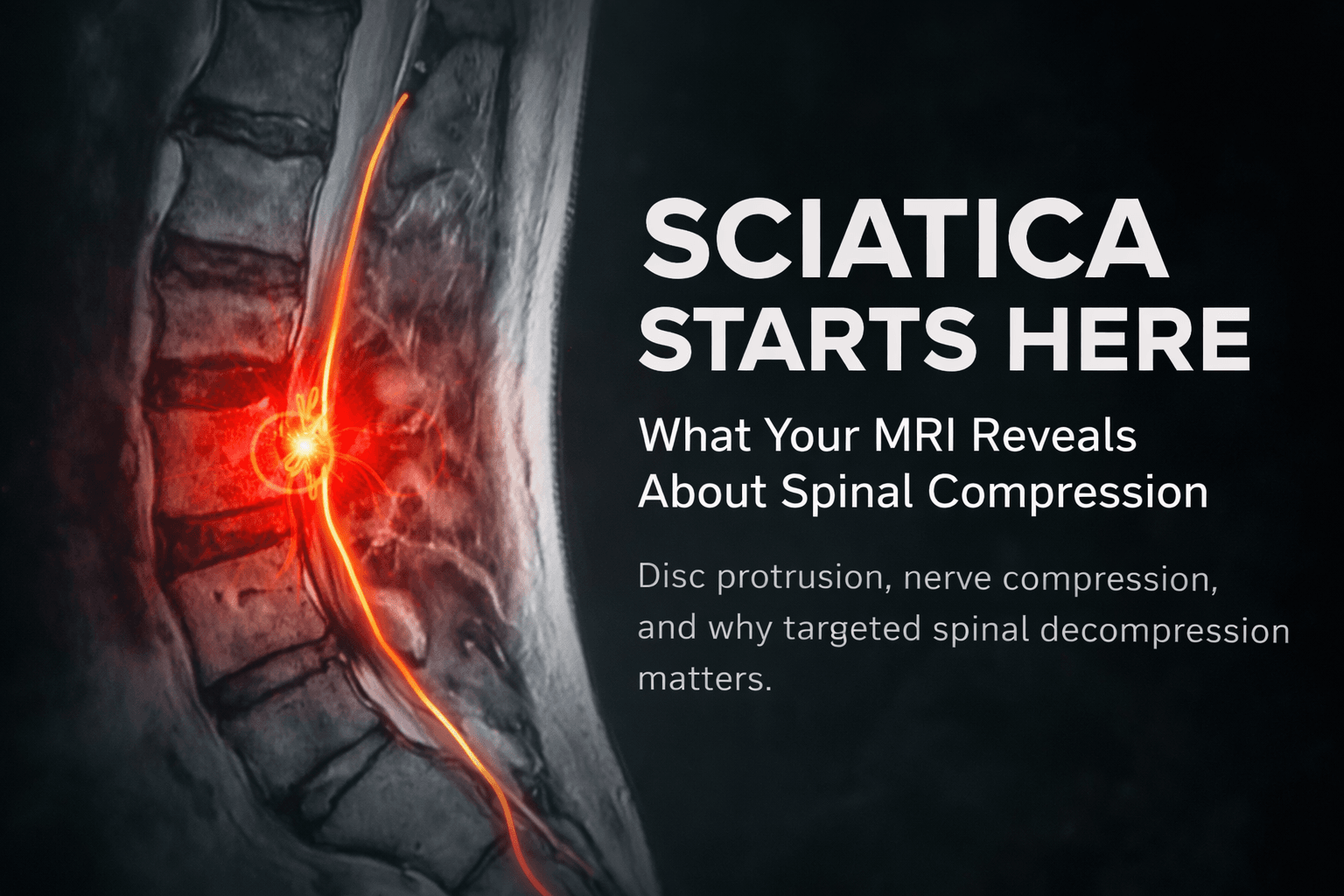
Sciatica and Spinal Compression Explained: What Your MRI Is Really Showing
Back pain is one of the most common health complaints in adults. Many people hear the word sciatica and assume it is the diagnosis, when in reality it is often a symptom of a deeper spinal issue.
Understanding what happens inside the spine is the first step toward recovery.
At All Well Scoliosis Centre, we believe patients should understand what their MRI actually means and why certain treatments work better than others.
What Is Sciatica?
Sciatica refers to pain that travels along the sciatic nerve, the longest nerve in the human body.
The sciatic nerve begins in the lower spine and runs through the hips, buttocks, and down the legs.
When this nerve becomes irritated or compressed, patients may experience:
-
Sharp pain shooting down the leg
-
Tingling or burning sensations
-
Numbness in the foot or leg
-
Weakness in the leg
-
Pain that worsens when sitting or bending
Sciatica itself is not the root problem. It is usually caused by pressure on a nerve in the lower spine.
What Is Spinal Compression?
Spinal Compression happens when the structures inside the spine lose the space they need to function properly.
Between each vertebra sits a disc, which acts as a cushion and shock absorber.
Over time these discs can:
-
lose hydration
-
degenerate with age
-
become overloaded from repetitive movement
-
compress due to heavy lifting or poor posture
When this happens, the disc may bulge outward.
This condition is known as a:
Disc Protrusion
A protruding disc can push into the spinal canal and press against nearby nerves.
That pressure is what produces sciatic nerve pain.
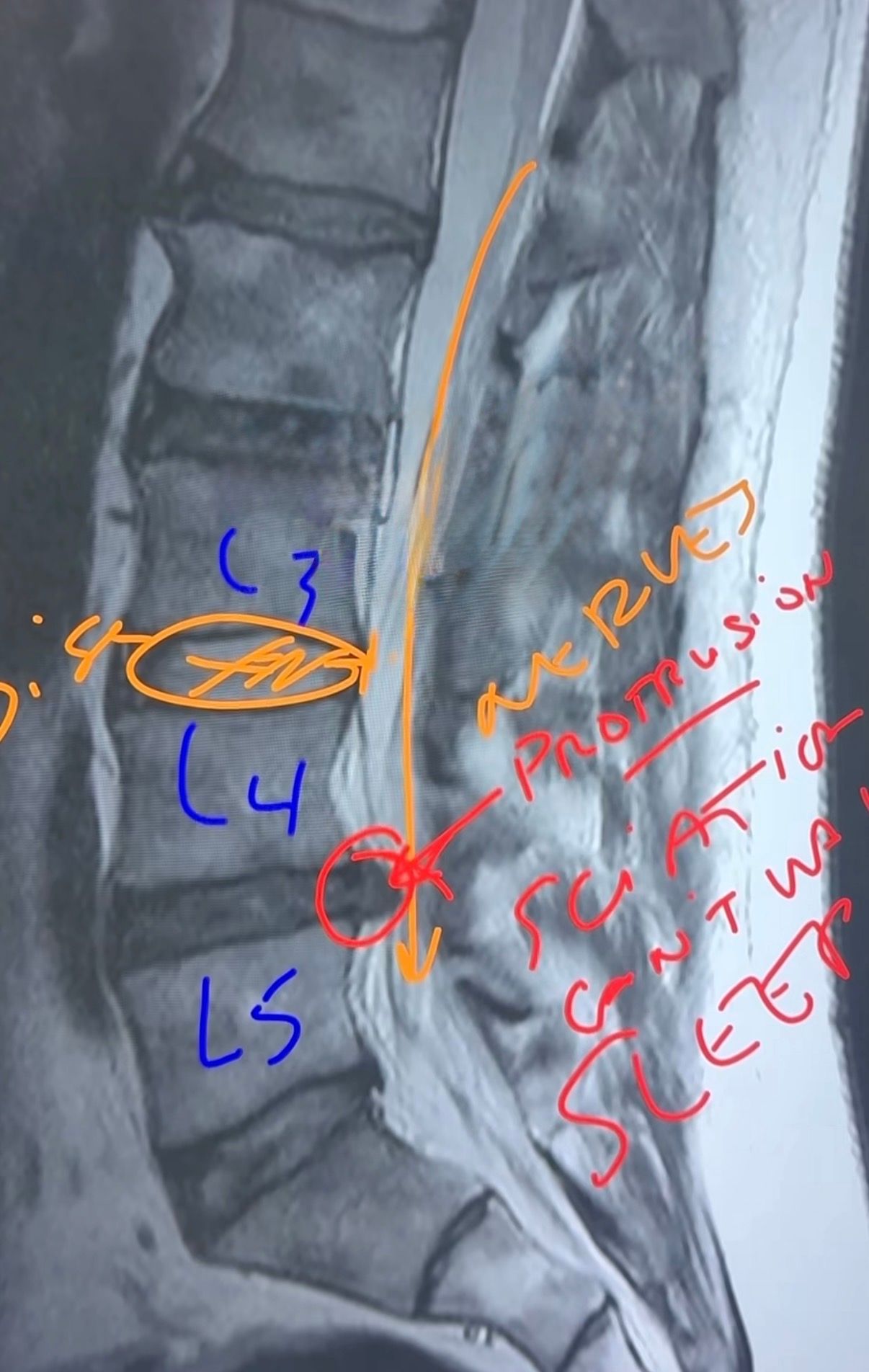
What This MRI Image Shows
In this MRI scan we are looking at the lumbar spine, specifically the vertebrae L3, L4, and L5.
The highlighted region shows a disc protrusion between L4 and L5.
Instead of sitting neatly between the vertebrae, the disc is bulging backward toward the spinal canal.
This protrusion compresses the nerve root that eventually forms part of the sciatic nerve pathway.
When the nerve is compressed, symptoms can include:
-
shooting pain down the leg
-
numbness
-
difficulty standing or walking
-
trouble sleeping due to pain
The MRI clearly shows how the disc is pushing into the nerve space, creating irritation.
Why Many Treatments Only Provide Temporary Relief
Patients with sciatica often try multiple treatments before finding relief.
Common approaches include:
-
pain medication
-
chiropractic adjustments
-
physiotherapy
-
dry needling
-
stretching exercises
These treatments can help reduce muscle tension, but they do not always address disc compression itself.
For example:
-
Dry needling focuses on muscle trigger points
-
Stretching improves flexibility but cannot precisely decompress a specific spinal segment
-
General chiropractic adjustments improve mobility but may not create enough space for a compressed disc
If the core issue is spinal compression, the spine often requires a more targeted solution.
Why We Invested in Spinal Decompression Technology
At our clinic we use precision decompression therapy to address spinal compression.
Hill DT Spinal Decompression Table
This technology applies controlled traction to the spine, gently separating the vertebrae and reducing pressure inside the disc.
The goals of spinal decompression are to:
-
increase space between vertebrae
-
reduce nerve compression
-
improve disc hydration
-
allow the bulging disc to retract gradually
Unlike general stretching, decompression is precisely calibrated to the affected spinal level.
Healing the Spine Requires Patience
One of the most important things patients must understand is that spine recovery takes time.
Your nerves behave like a rubber band.
If stretched aggressively, they can become more irritated.
But if stretched gradually and consistently, they adapt and recover.
Spinal decompression works in the same way.
It allows the body to slowly:
-
restore disc space
-
calm inflammation
-
relieve nerve pressure
-
rebuild stability in the spine
This is why treatment cannot be rushed.
In spinal healing, time is your ally.
A Philosophy Built on Personal Experience
At All Well Scoliosis Centre, trust is a fundamental part of how we practice.
Many of the treatments we offer are therapies that we have personally experienced ourselves or used within our own families.
For people who live active lifestyles—lifting weights, playing sports, traveling—the goal is not simply eliminating pain.
The goal is preserving movement and quality of life.
Wear and tear in adulthood should not stop you from:
-
exercising
-
traveling
-
carrying your children
-
enjoying the activities you love
The human body is remarkably resilient.
With the right care and the right environment for healing, it can recover more than most people expect.
Medical Disclaimer
This article is for educational purposes only and does not constitute medical advice.
Scoliosis varies significantly between individuals. Always consult a qualified healthcare professional before starting any new sport or exercise program, especially if you have scoliosis, spinal conditions, pain, or previous injuries. Participation in sports should be guided by individual assessment and professional recommendation.
The image is shared for educational purposes with patient consent. Individual outcomes vary. Structural correction does not automatically restore full respiratory function. Clinical assessment is required.
Copyright & Content Protection Notice
© 2026 All Well Scoliosis Centre. All rights reserved.
This content is original and protected by copyright law.
No part of this article may be reproduced, distributed, copied, or reused in any form without prior written permission. Unauthorized use, duplication, or content scraping is strictly prohibited.