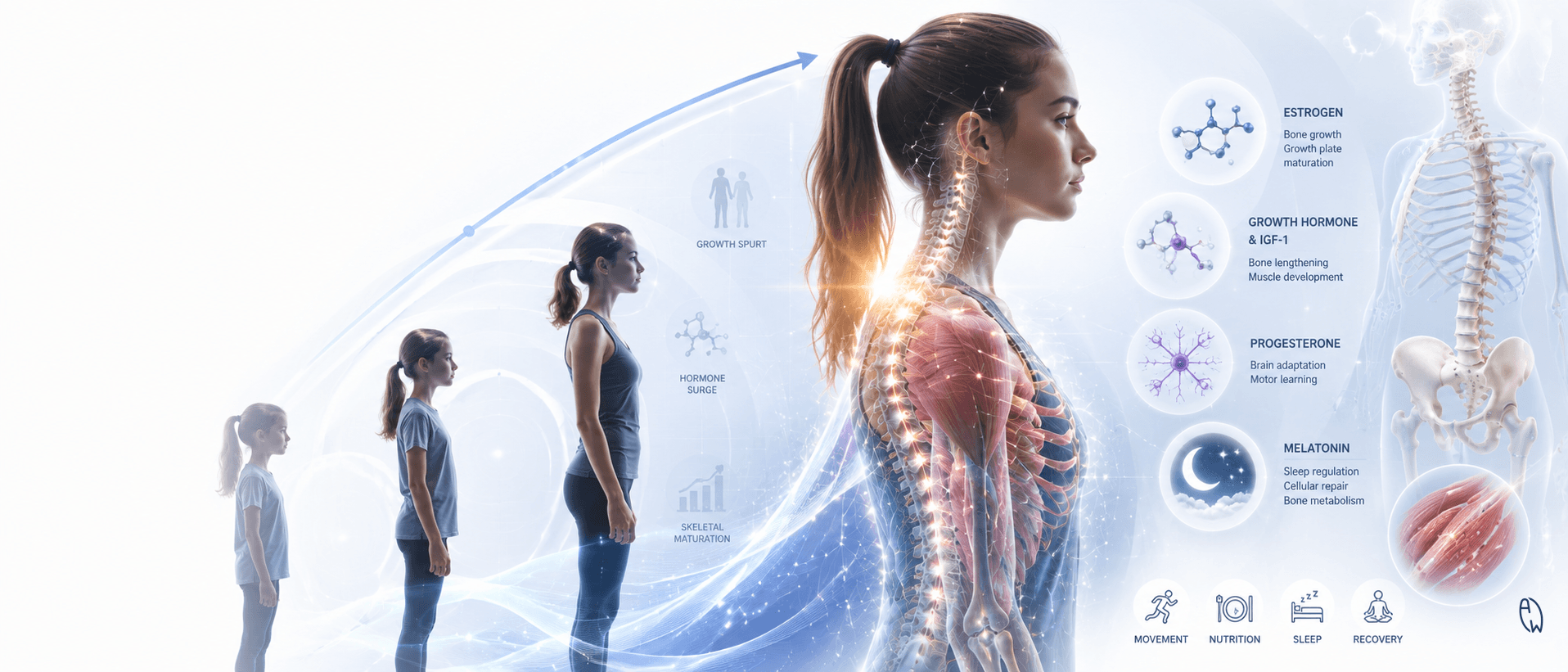
Part 3: Why Puberty Changes Everything — When Growth, Hormones, and Genetics Meet
For many families, scoliosis seems to appear suddenly.
A child grows normally for years.
They run, play sports, go to school, and have no obvious problems.
Then one day, a parent notices:
"One shoulder looks higher."
"One side of the ribs looks more prominent."
"The waist doesn't look even."
A routine screening or X-ray confirms the diagnosis:
Adolescent Idiopathic Scoliosis.
Naturally, many parents wonder:
"Why now?"
If scoliosis is influenced by genetics, why wasn't the curve visible from birth?
Why does it often appear around puberty?
The answer lies in understanding one of the most dramatic biological events of human life:
The adolescent growth spurt.
Puberty: The Body's Major Renovation Project
Remember our earlier analogy:
Your genes are the blueprint.
Your body is the building.
Puberty is the renovation.
During childhood, the body grows gradually. But during puberty, everything accelerates.
Bones lengthen rapidly.
Muscles must adapt.
Hormones surge.
The nervous system recalibrates.
The brain updates its understanding of the body's size, balance, and movement.
It is a remarkable transformation.
But rapid change also creates vulnerability.
Imagine renovating a building while people are still living inside.
The structure is changing.
The foundation is adjusting.
The support systems must keep up.
Most of the time, everything adapts smoothly.
However, in someone who already has a genetic susceptibility to scoliosis, this rapid period of growth may reveal imbalances that were previously unnoticed.
Puberty does not necessarily "cause" scoliosis.
Instead, it may expose a system that is struggling to adapt quickly enough.
Why Growth Speed Matters in Scoliosis
One of the strongest predictors of scoliosis progression is not simply age.
It is growth potential.
A 20-degree curve in a child who has nearly finished growing behaves very differently from the same curve in a child who is just entering a growth spurt.
Why?
Because growth creates change.
During adolescence, the spine can grow quickly within a short period.
The vertebrae increase in height.
The trunk becomes longer.
The body's centre of gravity shifts.
The brain must constantly update its map of where the body exists in space.
At the same time, muscles need to strengthen and coordinate around this changing structure.
If skeletal growth happens faster than muscular and neurological adaptation, imbalance may occur.
This is one reason monitoring growth stages is so important in scoliosis care.
Clinicians often look at indicators such as:
-
Age.
-
Height changes.
-
Pubertal development.
-
Skeletal maturity markers.
-
Growth remaining.
Understanding where a child is in their growth journey helps estimate the risk of curve progression.
Hormones: The Chemical Messengers Behind Growth
Growth does not happen randomly.
It is carefully coordinated by hormones.
Hormones are chemical messengers that tell different parts of the body when to grow, repair, mature, or adapt.
During puberty, hormone activity changes dramatically.
These hormonal changes influence:
-
Bone development.
-
Muscle growth.
-
Connective tissue.
-
Metabolism.
-
Brain development.
Researchers believe that hormonal regulation may be one of the important links between genetics and scoliosis progression.
The relationship is complex.
Hormones alone do not cause scoliosis.
But they may influence how a genetically susceptible body responds during rapid growth.
Estrogen: More Than a Reproductive Hormone
Many people think estrogen is only related to reproductive development.
In reality, estrogen is also one of the body's most important skeletal hormones.
Estrogen influences:
-
Bone mineral density.
-
Growth plate maturation.
-
Bone remodeling.
-
Muscle function.
During puberty, estrogen helps regulate when and how bones grow.
Researchers have investigated whether differences in estrogen signalling may contribute to scoliosis progression in certain individuals.
One theory suggests that if growth regulation becomes slightly uneven, different areas of the spine may mature at different rates.
Over time, this could contribute to asymmetrical loading.
However, it is important to understand:
Estrogen does not simply "cause scoliosis."
The relationship appears to involve genetics, receptors, growth patterns, and how tissues respond to hormonal signals.
This may also explain why scoliosis behaves differently later in life.
For example, after menopause, declining estrogen levels can contribute to reduced bone density. In some adults, especially those with existing spinal changes, weaker bone structure may influence progression of degenerative scoliosis.
Throughout life, hormones continue influencing how the spine adapts.
Growth Hormone and IGF-1: When the Body Accelerates
Two other important players during adolescence are:
Growth Hormone (GH)
and
Insulin-like Growth Factor-1 (IGF-1).
Their job is exactly what their names suggest:
They help the body grow.
They stimulate:
-
Bone lengthening.
-
Muscle development.
-
Tissue repair.
During puberty, GH and IGF-1 levels rise significantly.
This is necessary and healthy.
However, rapid growth requires coordination.
The skeleton may lengthen quickly, but the muscles, nervous system, and postural control systems must continuously adjust.
Imagine upgrading the frame of a building without updating the support cables.
The structure changes faster than the support system can adapt.
Researchers believe this mismatch between rapid growth and neuromuscular adaptation may contribute to why some scoliosis curves progress quickly during adolescence.
Progesterone and the Learning Brain
Progesterone is another hormone commonly associated with reproductive development.
But it also has important effects on the nervous system.
Research suggests progesterone influences molecules involved in brain adaptation, including Brain-Derived Neurotrophic Factor (BDNF).
BDNF supports:
-
Learning.
-
Memory.
-
Neural connections.
-
Motor adaptation.
Why does this matter for scoliosis?
Because posture is not only controlled by muscles.
It is controlled by the brain.
Your brain constantly learns:
How you stand.
How you walk.
How you balance.
How your body should feel in space.
This is why rehabilitation is not simply about strengthening weak muscles.
It is about teaching the nervous system a new pattern.
The brain must learn:
"This is where my body should be."
Melatonin: Sleep, Growth, and Regulation
Melatonin is best known as the sleep hormone.
But its role extends beyond helping us fall asleep.
Melatonin is involved in:
-
Circadian rhythm.
-
Bone metabolism.
-
Cellular regulation.
-
Nervous system function.
For decades, researchers have studied possible relationships between melatonin signalling and scoliosis.
The findings remain mixed, and melatonin should not be viewed as a direct cause of scoliosis.
However, this research highlights something important:
Sleep is not passive.
While we sleep, the body is actively:
-
Repairing tissues.
-
Regulating hormones.
-
Supporting growth.
-
Strengthening learning pathways in the brain.
For a growing child, quality sleep is one of the foundations of healthy development.
The Growing Body Needs Support
During puberty, the body is asking a lot from itself.
It needs materials to build.
It needs energy to grow.
It needs recovery time.
It needs movement to strengthen.
This is why lifestyle becomes important.
Not because healthy habits magically erase scoliosis.
They don't.
But because the body cannot build well without the right resources.
A growing spine benefits from:
-
Adequate protein for muscle development.
-
Calcium and vitamin D for bone health.
-
Regular exercise for strength and coordination.
-
Quality sleep for recovery.
-
Consistent movement instead of prolonged inactivity.
These choices create a better environment for the body during one of its most important periods of change.
Puberty Reveals the Importance of Adaptation
Perhaps the biggest lesson from puberty is this:
Change is unavoidable.
The body will grow.
Hormones will shift.
Bones will remodel.
The nervous system will adapt.
The question is not whether adaptation happens.
It always happens.
The question is:
What environment are we giving the body to adapt in?
Genetics may influence the starting point.
Puberty may accelerate the journey.
But daily choices, awareness, and appropriate care help shape how the body responds along the way.
Looking Ahead
So far, we have explored:
Genes — the blueprint.
Growth — the renovation.
Hormones — the messengers.
But one important system quietly connects them all:
The brain.
Your brain receives millions of signals every second telling it where your body is, how you are moving, and how to maintain balance.
This ability is called proprioception.
And it may be one of the most important missing pieces in understanding scoliosis.
In the next section, we will explore why scoliosis is not only about the spine you see on an X-ray, but also about the brain that controls it.