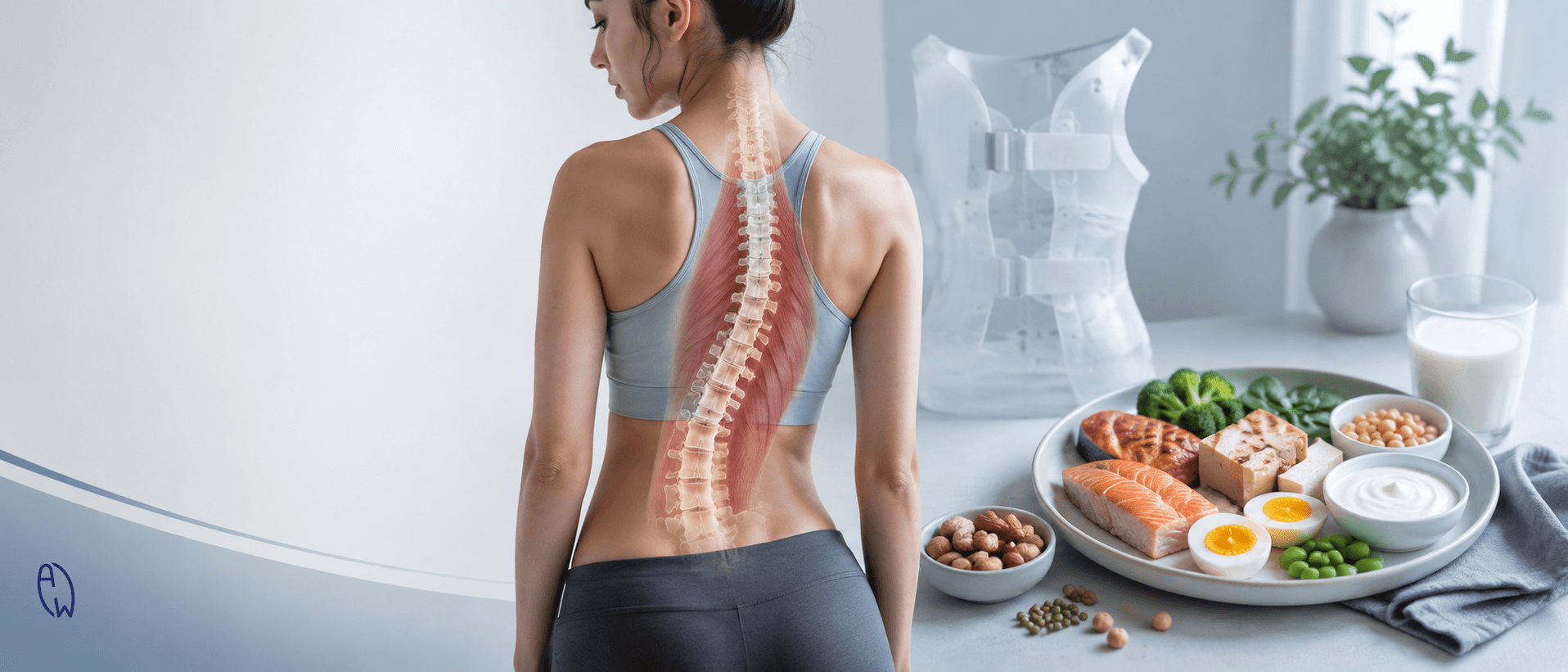
One question we hear surprisingly often from scoliosis patients is:
“Why am I so thin, and why is it so difficult for me to build muscle?”
Some people with scoliosis are naturally lean. Some have a low appetite. Others eat regularly but still struggle to gain weight and muscle.
So, does scoliosis cause a high metabolism?
Not necessarily.
There is currently no strong evidence that scoliosis itself causes an unusually fast metabolic rate.
But there is something interesting that researchers have observed repeatedly:
Some people with adolescent idiopathic scoliosis (AIS) have lower body weight and lower muscle mass than their peers.
And that makes nutrition worth paying attention to.
Scoliosis and Muscle Mass: What Does the Research Show?
A Japanese study examined the body composition of 210 girls with adolescent idiopathic scoliosis, aged 10 to 18.
Researchers measured BMI, body fat, lean muscle mass and estimated bone mass.
They found that girls with AIS tended to have lower BMI, body-fat percentage and lean muscle mass compared with healthy Japanese girls of the same age.
Among patients whose bone growth had finished, those with more severe scoliosis also had significantly lower BMI and lean muscle mass than those with moderate curves.
The researchers also found weak negative correlations between Cobb angle and BMI, lean muscle mass and estimated bone mass. In other words, lower body composition measures were associated with larger curves.
This does not prove that having less muscle causes scoliosis to progress.
But it raises an important question:
Are we paying enough attention to the patient's muscle mass and nutrition—not just the X-ray?
It's Not Just About Total Muscle Mass
There is another important piece of the puzzle.
[A 2023 systematic review examined research specifically looking at the paraspinal muscles] in people with adolescent idiopathic scoliosis.
These are the muscles that run alongside the spine and help contribute to spinal movement and control.
The review found evidence of differences between the two sides of the spinal curve.
On the concave side, researchers consistently reported characteristics including muscle atrophy, increased fatty infiltration, altered muscle fibers and reduced muscle activity.
However, the researchers emphasized an important limitation:
We still don't know whether these muscle changes are a cause or a consequence of scoliosis.
That distinction matters.
We should not tell a patient:
“Your weak muscles caused your scoliosis.”
The science does not support that conclusion.
But we can say something much more useful:
The muscles around the spine matter.
And maintaining muscle quality and physical capacity should be part of a comprehensive rehabilitation strategy.
Is Low BMI Common in Scoliosis?
The Japanese study isn't the only research showing differences in body composition.
Research has repeatedly reported associations between AIS and lower BMI or altered body composition.
So while we cannot simply say:
“Scoliosis makes you skinny.”
there is enough evidence to say:
Body weight and body composition deserve attention in scoliosis care.
This is particularly important when a patient is underweight, has a poor appetite or struggles to gain muscle.
But What About “High Metabolism”?
This is where we need to be careful.
A patient who is naturally thin may assume:
“I must have a very fast metabolism.”
Maybe—but being thin does not automatically mean having an unusually high metabolic rate.
Low body weight can result from many factors, including genetics, appetite, food intake, physical activity, growth, stress, illness and body composition.
Researchers still don't fully understand why lower BMI and muscle mass are observed in some people with AIS.
The important point is not to blame scoliosis for everything.
It is to notice the pattern and respond to it appropriately.
Your Spine Needs More Than a Brace
A brace can be an important part of scoliosis management when it is appropriately prescribed.
But a brace is external support.
Your body has its own support system too.
The muscles surrounding the trunk, spine and pelvis contribute to posture, movement and physical capacity.
That is why scoliosis rehabilitation should not be reduced to:
“Wear the brace and you're done.”
A more complete approach is:
Correct.
Exercise.
Strengthen.
Nourish.
Maintain.
The goal is not to reject the brace.
The goal is to build the body alongside the brace.
If you don't want your long-term strategy to depend entirely on external support, developing your own physical capacity becomes especially important.
Why Protein Matters
This is one reason we encourage our patients—especially those who are naturally thin or struggle to gain muscle—to pay attention to their protein intake.
Not just occasionally.
Consistently.
High-quality, minimally processed protein sources can include:
-
Eggs
-
Fish
-
Chicken
-
Lean meat
-
Greek yogurt
-
Milk
-
Tofu and tempeh
-
Beans and lentils
-
Nuts and seeds
But protein is only one part of the equation.
Muscle development requires adequate energy, protein, resistance exercise and recovery.
Think of it this way:
Exercise provides the stimulus.
Protein provides building blocks.
Food provides energy.
Recovery allows adaptation.
You need all four.
How Much Protein Do You Need?
If your goal is to maintain or build muscle, a useful practical starting point for many healthy adults who exercise is approximately:
Body weight (kg) × 1.2–1.6 g = daily protein target
For example:
Body Weight
Approximate Daily Protein
45 kg ----> 54–72 g
50 kg ----> 60–80 g
55 kg ----> 66–88 g
60 kg ----> 72–96 g
65 kg ----> 78–104 g
70 kg ----> 84–112 g
75 kg ----> 90–120 g
80 kg ----> 96–128 g
A large systematic review and meta-analysis of resistance-training studies found that protein supplementation increased gains in muscle mass and strength, with benefits generally plateauing at around 1.6 g/kg/day in healthy adults.
This is a practical guide for active adults, not a scoliosis-specific prescription.
People with kidney disease, other medical conditions, or specific nutritional needs should seek individualized advice from an appropriate healthcare professional.
What About Teenagers With Scoliosis?
This is particularly important because many scoliosis patients are still growing.
Children and adolescents have different nutritional requirements from adults, and their protein needs depend on age, growth, activity level and overall diet.
Don't simply apply an adult protein formula to a growing child.
A teenager who is underweight, has a poor appetite, is losing weight or is struggling to gain muscle should have their nutritional needs assessed individually by a pediatrician or qualified dietitian.
The goal is to support healthy growth, not simply to increase the number on the scale.
Don't Eat All Your Protein at Once
If you have a daily protein target, it can be easier to spread it across the day rather than trying to consume most of it at dinner.
For example, a 60 kg adult aiming for approximately 75–90 g of protein per day might distribute it roughly like this:
Breakfast: 20–25 g
Lunch: 25–30 g
Dinner: 25–30 g
Snack: 10–15 g
The exact distribution isn't the point.
Consistency is.
And if you have a small appetite, smaller nutrient-dense meals may be easier than trying to eat three very large meals.
You Cannot Build Muscle Without Giving Your Body Something to Build With
For the naturally thin scoliosis patient, this can be frustrating.
They exercise.
They work on their posture.
They perform their scoliosis-specific exercises.
They may even wear a brace.
But their muscle mass barely changes.
Sometimes the missing piece isn't another exercise.
It may be nutrition.
If your body is consistently receiving less energy and protein than it needs, building muscle becomes much harder.
That doesn't mean eating junk food simply to gain weight.
The goal should be adequate nutrition from quality foods, with enough protein and energy to support the demands placed on your body.
And if someone has persistent poor appetite, unexplained weight loss or difficulty gaining weight, it is important to look beyond scoliosis and seek appropriate medical or nutritional assessment.
Don't Just Focus on the Cobb Angle
When we look at a scoliosis X-ray, it is natural to focus on one number:
The Cobb angle.
But the person behind that X-ray matters too.
Are they underweight?
Are they eating enough?
Are they getting sufficient protein?
Are they maintaining muscle mass?
Are the muscles around the spine functioning well?
Are they strong enough to perform their exercises?
Are they recovering adequately?
These questions are part of looking at the whole person, not just the curve.
Don't Rely Only on External Support
A brace can provide external support.
Exercise can help develop movement control and physical capacity.
Strength training can help maintain and build muscle.
Nutrition provides the raw materials your body needs to adapt.
These things work together.
We should never tell a patient that eating protein will straighten their spine.
It won't.
And we should not claim that building muscle alone will stop scoliosis progression.
The research does not prove that.
But maintaining adequate nutrition and muscle mass is a sensible part of building a stronger, healthier body.
If you don't want your long-term strategy to depend entirely on something outside your body, building your own strength becomes even more important.
Build the Body, Not Just the Brace
Scoliosis care is not only about reducing a Cobb angle.
It is about helping the person become stronger, more capable and more confident in their own body.
Research shows that some people with AIS have lower BMI and lower lean muscle mass. Research also shows that the muscles surrounding the spine can have measurable differences on the two sides of a scoliosis curve.
We still don't know exactly why these relationships exist.
But we do know one thing:
Muscle does not build itself.
Give your body enough quality food.
Give it enough protein.
Give it the right exercise.
Give it time to recover.
Because the goal isn't to rely on external support alone.
Build the brace if you need it.
Build the strength you need.
Build the body that supports your movement.
Because scoliosis care shouldn't stop at the spine.