Severe Scoliosis Without Surgery: How a 17-Year-Old Reduced Her Curve from 49° to 21°
A Real Patient Story About Commitment, Family Support, and Why Scoliosis Treatment Takes Time
Can severe scoliosis improve without surgery?
When a scoliosis curve reaches 40 degrees or more, many families begin hearing discussions about spinal fusion surgery. While surgery may be necessary for some patients, others may choose to explore conservative treatment options first, particularly if they wish to preserve spinal mobility and avoid invasive procedures.
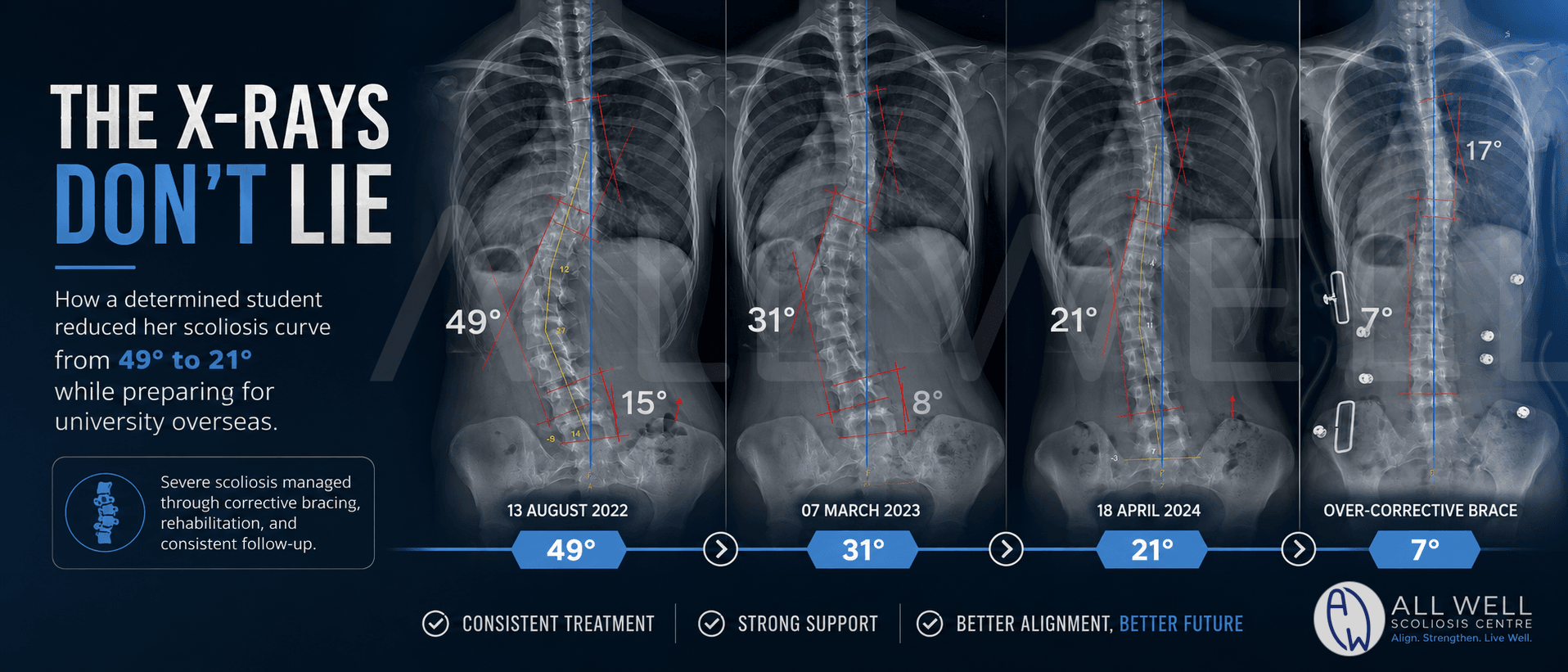
This case study follows a determined 17-year-old student who reduced her scoliosis curve from 49° to 21° over two years through consistent bracing, scoliosis-specific rehabilitation, and unwavering commitment.
Her journey was not easy.
She was preparing for her O-Level examinations, planning for university overseas, and balancing the normal pressures of teenage life. Yet despite the challenges, she stayed committed to her treatment plan and proved that meaningful change is possible when patients remain consistent.
Most importantly, her story demonstrates an important truth:
Scoliosis treatment is rarely about quick fixes. It is about long-term adaptation, discipline, and persistence.
Understanding Scoliosis Curve Severity
Scoliosis is measured using the Cobb Angle, the gold standard method for evaluating spinal curvature on X-rays.
Under 10 Degrees: Normal Spinal Variation
A curve below 10 degrees is generally considered a normal variation and is not diagnosed as scoliosis.
10°–24°: Mild Scoliosis
These smaller curves are usually monitored with routine examinations and periodic X-rays to ensure they are not progressing.
25°–39°: Moderate Scoliosis
Moderate curves often require closer observation. For growing adolescents, scoliosis-specific rehabilitation and corrective bracing may be recommended to help prevent progression.
40° and Above: Severe Scoliosis
Curves above 40 degrees are considered severe. Surgical consultation may be discussed, particularly when curves exceed 45–50 degrees and continue progressing.
When this patient first visited our clinic in August 2022, her primary thoracolumbar curve measured 49°, placing her firmly within the severe scoliosis category.
Why Scoliosis Often Progresses During Adolescence
Adolescence is one of the most critical periods for scoliosis progression.
During growth spurts, the spine can change rapidly. Hormonal changes, skeletal growth, and postural adaptation all influence how a curve develops.
Many teenagers experience curve progression during periods of accelerated growth, which is why early detection and regular monitoring are so important.
At age 17, this patient was nearing skeletal maturity, but her curve remained significant enough to require careful observation and intervention.
Without proper management, severe curves may continue to progress into adulthood.
Her Motivation: Avoiding Surgery If Possible
One of the biggest influences on her decision was seeing what a close family member experienced after spinal fusion surgery.
Her cousin had undergone spinal fusion for scoliosis.
While the surgery successfully corrected the spinal curve, she witnessed the long recovery process, physical limitations, and reduced spinal flexibility that followed.
Seeing this firsthand left a lasting impression.
She became determined to do everything she could to stabilize her scoliosis conservatively before considering surgery.
Her goal was simple:
Maintain her mobility, preserve her function, and avoid surgery if possible.
Tracking Progress Through Objective X-Ray Measurements
One of the challenges in scoliosis treatment is that symptoms do not always reflect what is happening structurally.
Some patients feel perfectly fine while their curves worsen.
Others experience discomfort despite relatively stable curves.
That is why periodic X-rays remain one of the most important tools for monitoring scoliosis progression.
Initial Assessment — 13 August 2022
-
Thoracolumbar Curve: 49°
-
Thoracic Curve: 38°
-
Pelvic Obliquity: 15°
At this stage, her scoliosis was classified as severe.
Follow-Up Assessment — 07 March 2023
-
Thoracolumbar Curve: 31°
-
Thoracic Curve: 28°
-
Pelvic Obliquity: 8°
The X-rays demonstrated measurable improvement in spinal alignment and balance.
Follow-Up Assessment — 18 April 2024
-
Thoracolumbar Curve: 21°
-
Thoracic Curve: 26°
-
Pelvic Obliquity: Continued improvement
After nearly two years of commitment, her primary curve had reduced from 49° to 21°.
Over-Corrective Brace X-Ray
-
Thoracolumbar Curve: 7°
-
Thoracic Curve: 17°
Her brace demonstrated excellent corrective potential and showed that the spine remained responsive to treatment.
What Does It Mean to Stabilize Scoliosis?
Many people assume that scoliosis treatment is only successful if the curve completely disappears.
That is not how scoliosis management works.
In reality, one of the primary goals of treatment is often stabilization.
For many patients, preventing progression can be just as important as reducing the Cobb angle.
A curve that remains stable over many years may help reduce the risk of future deterioration, pain, imbalance, and loss of function.
In this patient's case, not only was the curve stabilized, but meaningful improvements were also observed over time.
The Hidden Challenge: Balancing Treatment, Exams, and University Preparation
The X-rays tell only part of the story.
Behind every improvement was a teenager trying to manage one of the busiest periods of her life.
She was preparing for O-Level examinations.
She was planning for university.
She was thinking about moving overseas.
Meanwhile, she still had to complete her exercises, wear her brace, attend appointments, and stay committed to her rehabilitation program.
There were moments of frustration.
There were moments of stress.
There were moments when progress felt slower than expected.
But she continued showing up.
That consistency became one of the most important factors in her success.
The Role of Family Support
Every successful scoliosis journey requires a support system.
For this patient, her parents played a critical role.
They understood that scoliosis treatment is demanding.
The exercises can be repetitive.
The brace can be uncomfortable.
The progress can feel painfully slow.
Yet throughout the process, they remained supportive.
They did not constantly ask why the curve was not improving faster.
They did not compare her progress to others.
They trusted the process.
Most importantly, they believed in their daughter even during periods when she doubted herself.
That kind of support can make a tremendous difference during long-term scoliosis treatment.
Taking Her Treatment Overseas
Eventually, the day came when she had to leave Singapore to pursue higher education overseas.
Many patients worry that moving away means treatment must stop.
Fortunately, scoliosis management does not end when a patient leaves the clinic.
She took her brace with her.
She brought her exercise equipment.
She packed her balance-training tools.
She left with a personalised home program that could be performed independently inside her dormitory.
Instead of ending treatment, she transitioned into self-management.
That independence became another important milestone in her journey.
Why Scoliosis Treatment Cannot Be Rushed
One of the biggest misconceptions we encounter is the expectation of immediate results.
We live in a culture that rewards instant gratification.
Hungry?
Order a meal.
Problem solved.
But the human body does not operate that way.
The spine is living tissue.
Muscles are living tissue.
The nervous system is constantly adapting and learning.
Meaningful structural change takes time.
Consider professional athletes or bodybuilders.
Nobody develops strength, muscle, or athletic performance after a few workouts.
They spend years training consistently.
Scoliosis rehabilitation follows a similar principle.
The body responds to repetition.
The body responds to consistency.
The body responds to time.
There is NO shortcut for adaptation.
Surgery Is Not an Instant Solution Either
Sometimes patients assume surgery offers an immediate and effortless solution.
The reality is more complex.
We have worked with many patients who have undergone spinal fusion surgery.
For the right patient, surgery can be life-changing and absolutely necessary.
However, surgery also involves recovery, rehabilitation, adaptation, and long-term management.
There is no treatment pathway that completely eliminates effort.
Whether a patient chooses surgery or conservative care, commitment remains essential.
The X-Rays Don't Lie
When this patient first walked through our doors, she had a severe 49° scoliosis curve.
Two years later, that curve measured 21°.
Her over-corrective brace reduced the curve further to 7°.
These changes were not produced by luck.
They were not achieved through wishful thinking.
They were not the result of a miracle.
They were built through hundreds of small decisions repeated day after day, week after week, and year after year.
This case does not prove that every patient can avoid surgery.
Every scoliosis case is unique.
What it does demonstrate is that scoliosis progression is not always inevitable.
With early intervention, consistent treatment, supportive parents, and patient commitment, meaningful change can occur.
For this young woman, the journey from 49° to 21° was not defined by a single breakthrough moment.
It was defined by persistence.
And ultimately, the evidence is visible on the X-rays.
The journey was long. The sacrifices were real. The effort was relentless. But in the end, the evidence speaks for itself. Not opinions. Not promises. Not wishful thinking. The X-rays documented every step of the journey.