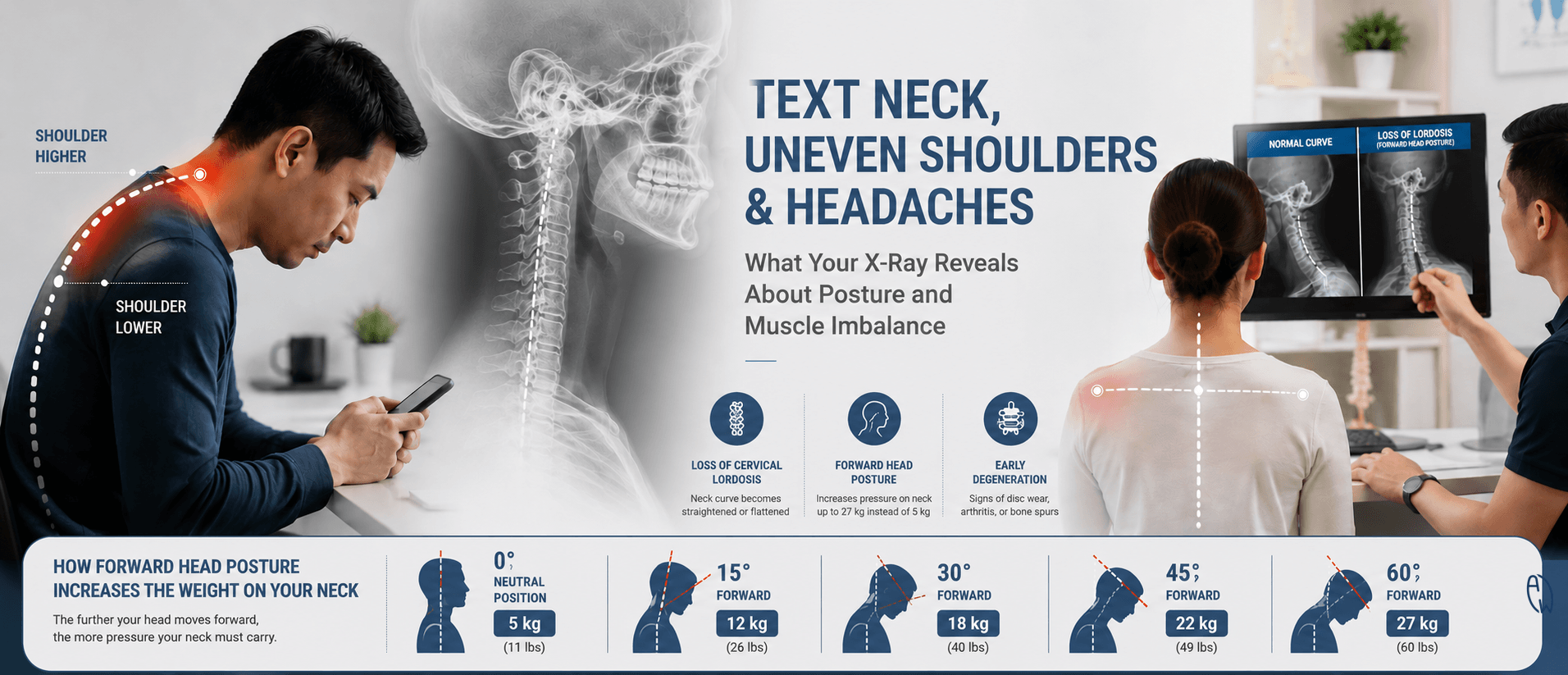
Text Neck, Uneven Shoulders, and Headaches: The Domino Effect of Poor Posture
Is Your Neck Pain Trying to Tell You Something?
Take a look around any office, classroom, café, or train station. Most people are spending hours every day looking down at their phones, tablets, or computers.
What many do not realize is that this seemingly harmless habit may be slowly changing the structure and function of their body.
Neck pain, headaches, shoulder tension, and uneven shoulders rarely happen overnight. More often, they develop gradually through years of poor posture, muscle imbalance, and repetitive stress.
One of the most common postural conditions seen today is known as Text Neck.
While the symptoms may start with mild stiffness or occasional headaches, the underlying problem often involves much more than the neck alone. The shoulders, shoulder blades, upper back, breathing muscles, and core all play important roles in maintaining healthy posture.
When one part of the system begins to fail, the body compensates. Over time, these compensations create a domino effect that can eventually lead to chronic pain, muscle imbalance, reduced mobility, and even structural changes visible on X-rays.
What Is Text Neck?
Text Neck refers to repetitive stress placed on the cervical spine due to prolonged forward head posture.
The average adult head weighs approximately 4.5–5.5 kilograms (10–12 pounds).
When the ears are positioned directly above the shoulders, the neck is designed to support this weight efficiently.
The problem begins when the head drifts forward.
The further the head moves in front of the shoulders, the harder the muscles, ligaments, and joints of the neck must work to support it.
This extra effort may not be noticeable initially. However, over months and years, the body begins adapting to this position.
The result is often:
-
Neck pain
-
Shoulder tension
-
Headaches
-
Upper back tightness
-
Reduced mobility
-
Postural fatigue
-
Poor posture
-
Uneven shoulders
The body adapts to the position you spend the most time in. Unfortunately, modern lifestyles encourage us to spend hours every day looking down.
Why Text Neck Causes Headaches
Many people are surprised to learn that their headaches may actually originate from their neck.
When the head moves forward, several muscles become overloaded, including the upper trapezius, sternocleidomastoid (SCM), levator scapulae, and the small muscles located at the base of the skull.
As these muscles become tight and fatigued, they can develop trigger points that refer pain into the head.
This often results in:
-
Headaches at the base of the skull
-
Pain behind the eyes
-
Tightness around the temples
-
Neck stiffness
-
Tension headaches after desk work
-
Frequent headaches after prolonged phone use
In many cases, people treat the headache without addressing the underlying postural cause.
Why One Shoulder Becomes Higher Than the Other
One of the most common signs of postural imbalance is uneven shoulder height.
You may notice:
-
One shoulder sitting higher than the other
-
Tightness on one side of the neck
-
One shoulder blade feeling different
-
Difficulty maintaining upright posture
-
One side feeling stronger than the other
This is rarely just a shoulder problem.
Instead, it is usually the result of muscle imbalances developing throughout the neck, shoulders, upper back, and core.
Some muscles become excessively tight and overactive while others become weak and underactive.
Over time, the imbalance becomes visible.
The Muscles That Become Tight and Overactive
Upper Trapezius
The upper trapezius is often the first muscle to become overloaded.
When tight, it can:
-
Elevate one shoulder
-
Create neck tension
-
Cause headaches
-
Contribute to shoulder asymmetry
Sternocleidomastoid (SCM)
The SCM runs from behind the ear to the collarbone.
When overactive, it may:
-
Tilt the head to one side
-
Rotate the neck unevenly
-
Contribute to headaches
-
Create neck stiffness
Pectoralis Major and Minor
Hours of sitting and screen use often shorten the chest muscles.
When tight, they:
-
Pull the shoulders forward
-
Create rounded shoulders
-
Restrict shoulder mobility
-
Alter breathing patterns
Levator Scapulae
This muscle connects the neck to the shoulder blade.
When overactive, it:
-
Pulls the shoulder blade upward
-
Creates neck stiffness
-
Contributes to shoulder elevation
Rhomboids
Although commonly weak, rhomboids can also become tight when compensating for poor shoulder mechanics.
This often contributes to:
-
Upper back tightness
-
Shoulder blade discomfort
-
Restricted movement
The Muscles That Become Weak and Underactive
Lower Trapezius
The lower trapezius helps stabilize the shoulder blades.
When weak:
-
Shoulder stability decreases
-
Neck muscles compensate
-
Posture worsens
Serratus Anterior
Often called the "forgotten muscle," the serratus anterior is essential for proper shoulder blade movement.
When weak:
-
Scapular stability decreases
-
Shoulder mechanics suffer
-
Neck strain increases
Rhomboids
Weak rhomboids can contribute to:
-
Rounded shoulders
-
Poor posture
-
Uneven shoulder height
-
Reduced shoulder blade control
Deep Neck Flexors
These small stabilizing muscles help maintain proper head position.
When weak:
-
The head drifts forward
-
Neck strain increases
-
Posture deteriorates
Deep Core Muscles
Your posture is only as strong as your foundation.
When the deep core muscles become weak:
-
The spine loses support
-
Shoulder mechanics worsen
-
Forward head posture increases
-
Compensation patterns develop
One-Sided Sports Can Create Muscle Imbalances
Athletes who participate in one-sided sports often develop asymmetrical muscle patterns.
Examples include:
-
Tennis
-
Badminton
-
Squash
-
Golf
-
Baseball
-
Bowling
Repeated use of one arm may cause:
-
One shoulder to elevate
-
One side of the neck to tighten
-
Uneven shoulder blade movement
-
Rotational muscle imbalances
Without proper rehabilitation and conditioning, these patterns may eventually contribute to pain and postural dysfunction.
What Does a Text Neck X-Ray Show?
Many people are surprised when they see their neck X-ray.
They often ask:
"Why is my neck straight?"
"Why am I getting headaches?"
"Why are my shoulders uneven?"
The answer often lies in years of muscular compensation.
A healthy neck normally has a gentle C-shaped curve known as cervical lordosis.
This natural curve allows the head's weight to be distributed efficiently through the spine.
However, prolonged forward head posture gradually changes how forces travel through the neck.
As muscles compensate and posture changes, the normal curve may begin to flatten.
One of the most common findings on a text neck X-ray is loss of cervical lordosis.
Instead of a healthy curve, the neck appears straightened.
In more advanced cases, the curve may even reverse.
Another common finding is forward head posture, where the cervical vertebrae sit further forward than normal.
As this occurs, the muscles of the neck, shoulders, and upper back must work significantly harder throughout the day.
Over time, X-rays may also reveal:
-
Disc degeneration
-
Reduced disc height
-
Cervical facet joint arthritis
-
Bone spur formation
-
Joint stiffness
It is important to understand that the X-ray shows the result of the problem, not necessarily the cause.
The X-ray reveals the structural changes.
The muscles tell the story of how the body got there.
The Domino Effect of Poor Posture
Poor posture rarely causes pain immediately.
Instead, the process develops gradually.
The head moves forward.
The shoulders round forward.
The chest tightens.
The upper trapezius becomes overworked.
The shoulder blades lose stability.
The deep neck muscles weaken.
The core becomes less active.
Movement becomes less efficient.
Eventually, the body reaches a tipping point.
This may appear as:
-
Chronic headaches
-
Neck pain
-
Shoulder pain
-
Upper back tightness
-
Muscle fatigue
-
Reduced mobility
-
Poor posture
The body does not break down one muscle at a time.
It compensates until it can no longer compensate effectively.
Why Breathing Matters More Than Most People Realize
Breathing and posture are closely connected.
Individuals with forward head posture and rounded shoulders often develop shallow chest breathing patterns.
Instead of using the diaphragm efficiently, they rely on the neck and shoulder muscles to assist with breathing.
This causes muscles such as the SCM, upper trapezius, and scalenes to remain active throughout the day.
Over time, this contributes to:
-
Neck tension
-
Headaches
-
Fatigue
-
Poor posture
-
Reduced rib cage mobility
Learning diaphragmatic breathing can help restore proper muscle balance while improving core stability and spinal support.
How to Correct Text Neck and Uneven Shoulders
The solution is not simply stretching or strengthening.
The goal is to restore balance.
Release Tight Muscles
Tight muscles often need to be relaxed before strengthening exercises become effective.
Areas that commonly benefit from stretching and mobility work include:
-
Upper trapezius
-
Sternocleidomastoid
-
Levator scapulae
-
Pectoralis major
-
Pectoralis minor
Professional care, stretching, mobility exercises, and soft tissue work can help reduce excessive tension.
Strengthen Weak Muscles
Once tight muscles begin to relax, strengthening should focus on restoring stability.
Helpful exercises may include:
-
Chin tucks
-
Wall slides
-
Resistance band rows
-
Bird-dog exercises
-
Dead bug exercises
-
Scapular retraction drills
-
Core stabilization exercises
The goal is not simply stronger muscles but better coordination and endurance.
Improve Scapular Stability
The shoulder blades form the foundation of healthy shoulder movement.
When the shoulder blades function properly:
-
Neck strain decreases
-
Posture improves
-
Shoulder mechanics improve
-
Headaches may reduce
Retrain Your Breathing
Proper diaphragmatic breathing helps:
-
Activate deep core muscles
-
Reduce neck muscle overuse
-
Improve posture
-
Enhance spinal stability
Good posture and good breathing often improve together.
Your Shoulders Tell the Story of Your Posture
When one shoulder sits higher than the other, it is often a sign that the body has been compensating for a long time.
One side becomes tight and overactive.
The opposite side becomes weak and underactive.
The neck works harder.
The shoulder blades lose stability.
The core becomes less efficient.
Eventually pain appears.
Correcting posture is not simply about standing straighter.
It is about restoring balance between tight and weak muscles, improving breathing mechanics, strengthening the body's support system, and creating healthier movement habits.
At All Well Scoliosis Centre, we do not just look at the X-ray. We assess posture, muscle balance, breathing patterns, scapular stability, spinal alignment, and movement habits to understand the bigger picture.
The X-ray shows us the structure.
The muscles tell us the story.
Together, they help guide a personalized approach toward better posture, improved movement, and long-term spinal health.