80% of People Will Experience Back Pain in Their Lifetime — Are You Training Your Spine Correctly?
Most people spend hours training their muscles.
They work on their arms, legs, chest, and core. They chase heavier weights, more repetitions, and personal bests in the gym.
But very few people spend time training the one structure that supports all of those movements:
The spine.
Considering that up to 80% of people will experience back pain during their lifetime, it's surprising how often spinal health is overlooked.
Many people assume that if they can lift heavy weights, they must have a strong back.
Unfortunately, that's not always true.
A healthy spine is about much more than strength alone.
It also needs mobility, stability, balance, coordination, and the ability to move well in everyday life.
Why Your Middle Back Matters
When people think about back pain, they usually focus on the neck or lower back.
However, the middle back, also known as the thoracic spine, plays an important role in how your entire body moves.
Your middle back helps you:
-
Turn and rotate
-
Reach overhead
-
Maintain good posture
-
Breathe efficiently
-
Transfer movement between your upper and lower body
When the middle back becomes stiff, other areas often have to compensate.
This can lead to:
-
Neck pain
-
Shoulder pain
-
Lower back pain
-
Poor posture
-
Reduced flexibility
Many people spend years stretching their lower back when the real problem is a stiff middle back.
Lifting Heavy Doesn't Automatically Mean Your Spine Is Healthy
One of the biggest misconceptions in fitness is that strength and spinal health are the same thing.
They are not.
A person may be able to deadlift a significant amount of weight yet still have poor spinal mobility and movement control.
In fact, many people train their muscles harder than they train their movement.
The body is designed to bend, rotate, reach, and adapt to different positions.
If your training only focuses on moving weight up and down, you may be missing important movement patterns that help keep your spine healthy.
A truly healthy spine needs:
-
Strength
-
Mobility
-
Stability
-
Body awareness
-
Good movement habits
It's not about choosing one over the other.
It's about developing all of them together.
A Straight Spine Is Not Always A Stronger Spine
This is something I frequently observe when working with scoliosis patients.
Many people assume that a curved spine automatically means weakness.
However, that is not always the case.
Some of my scoliosis patients are actually stronger and move better than individuals with perfectly straight spines.
I've seen patients with scoliosis perform lifting exercises just as well as people without scoliosis.
Meanwhile, some individuals with straight spines struggle because their backs are extremely stiff and lack movement.
This highlights an important lesson:
The appearance of the spine does not always predict how well it functions.
A spine that moves well, adapts well, and is properly conditioned can often perform better than a spine that looks perfect on an X-ray but lacks mobility and control.
More Flexibility Is Not Always Better
Many people believe they should stretch as much as possible.
But more flexibility is not always the answer.
A spine that is excessively flexible without enough support can become unstable and more vulnerable to injury.
This is especially important for people with hypermobility.
Being able to bend further than everyone else does not automatically mean your spine is healthier.
The goal is not maximum flexibility.
The goal is balanced mobility and stability.
Your spine should move when it needs to move and stay stable when it needs to stay stable.
Too much stiffness can cause problems.
Too much flexibility can also create problems.
The healthiest spine usually sits somewhere in the middle.
Train Your Spine, Muscles, and Nervous System Together
Every movement starts with communication between your brain, nerves, muscles, and joints.
This is why spinal exercises should not focus only on strength.
They should also improve how your body controls movement.
Good spinal training can help improve:
-
Posture
-
Balance
-
Coordination
-
Mobility
-
Body awareness
-
Everyday movement
Whether you're lifting weights, carrying groceries, playing sports, or sitting at a desk, your spine acts as the foundation for everything you do.
The Goal Is Not Perfection
Many people become obsessed with having perfect posture, a perfectly straight spine, or perfect movement.
The truth is that the human body is not designed to be perfect.
It is designed to adapt.
The goal is not to create a spine that never bends.
The goal is to create a spine that can move, support, and protect you throughout life.
Train For Life, Not Just The Gym
The strongest people are not always the ones who lift the heaviest weights.
Often, they are the people who can continue moving well, staying active, and enjoying life as they age.
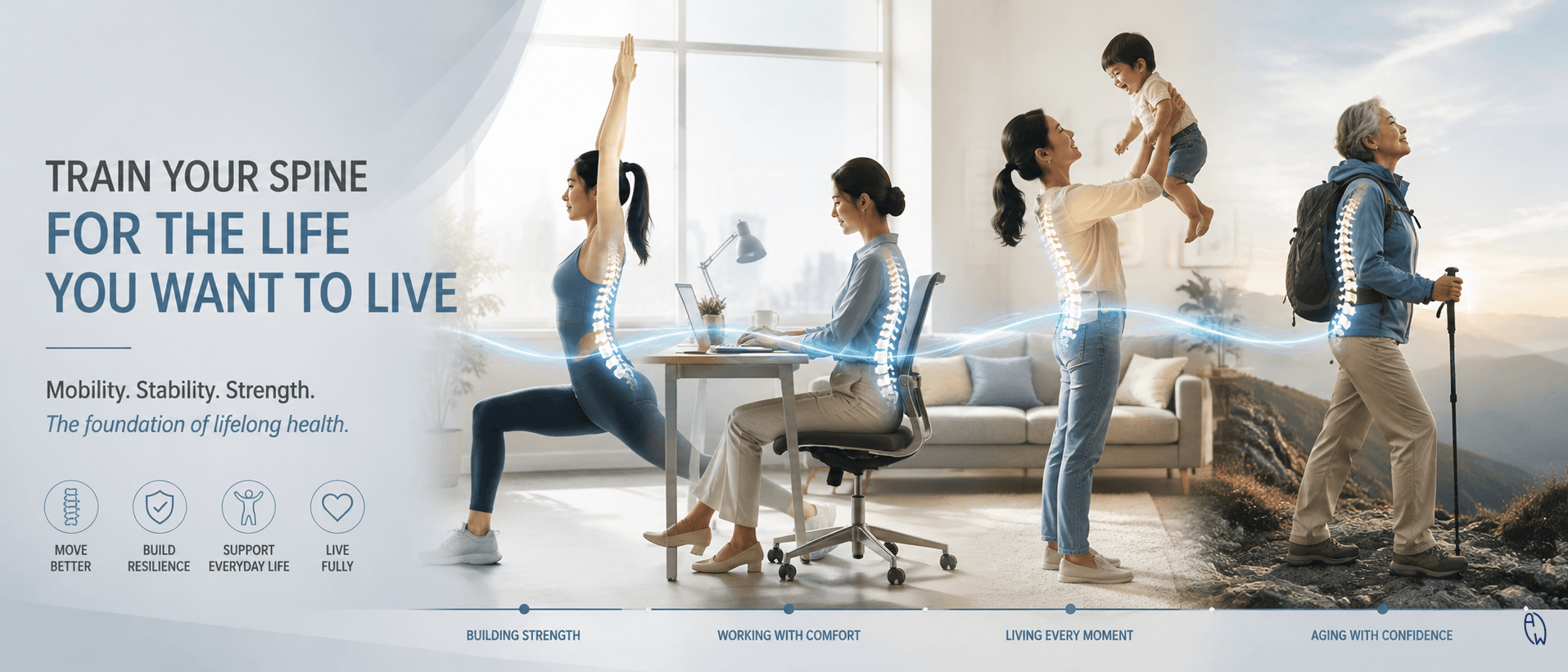
A healthy spine allows you to:
-
Play with your children
-
Travel comfortably
-
Enjoy sports and hobbies
-
Maintain independence as you get older
-
Stay active without fear of movement
Your muscles matter.
But your spine is the foundation that supports them all.
So the next time you exercise, don't just ask yourself how much weight you can lift.
Ask yourself how well your spine can move.
Because a healthy spine isn't just about strength.
It's about having the mobility, stability, and confidence to keep doing the things you love for years to come.