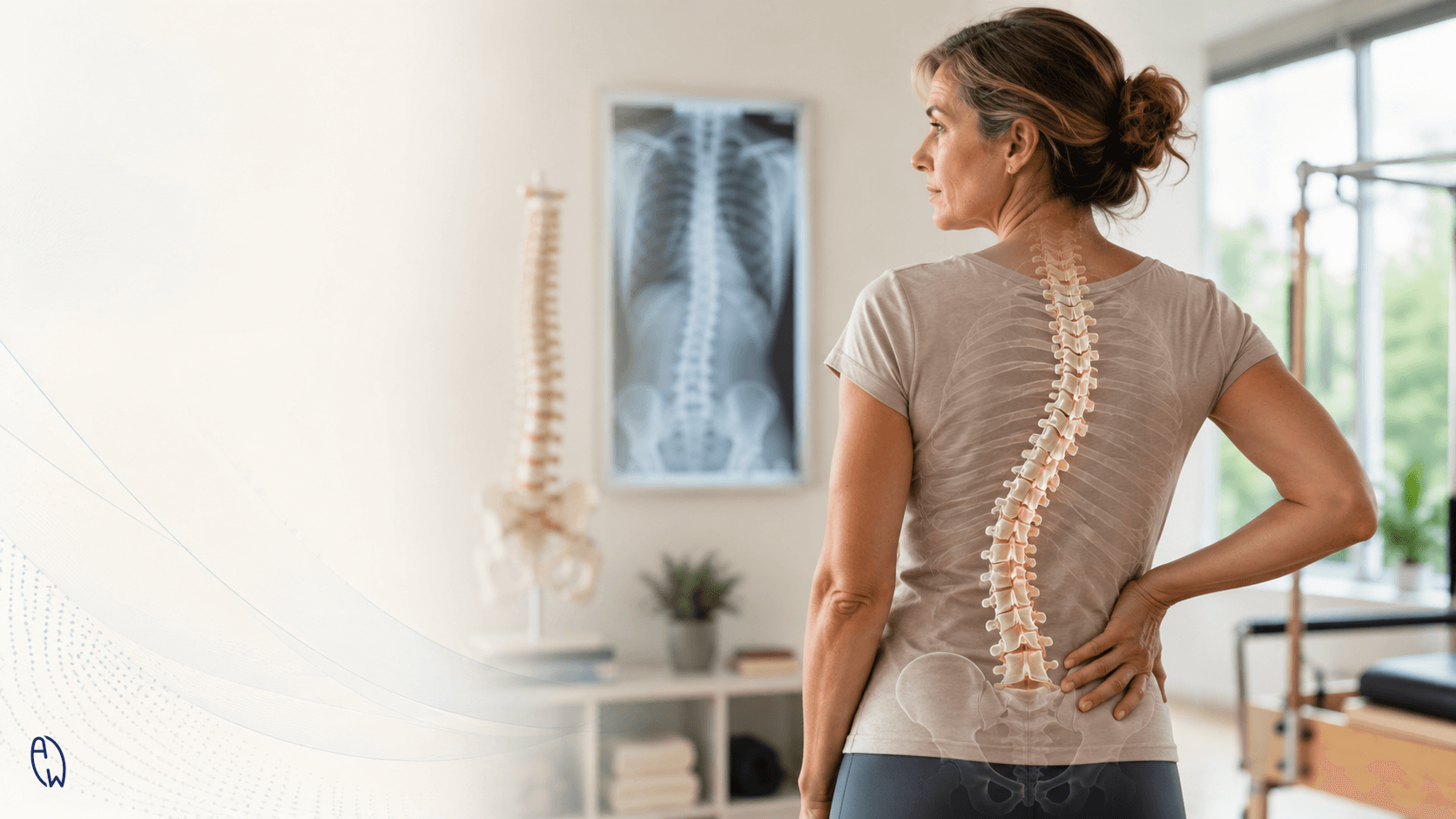
Why Does My Scoliosis Hurt Now When It Never Hurt Before?
You may have had scoliosis for years without knowing it. So why does your back hurt now?
One of the most common things I hear from adults after they discover they have scoliosis is:
“I didn't know I had scoliosis.”
And often, the next sentence is:
“I've had back pain once in a while, but I thought it was normal.”
This is something I hear quite often.
Some people discover scoliosis because they finally have an X-ray for back pain. Others notice that one shoulder looks higher, their waist appears uneven, or their clothes no longer seem to fit the same way on both sides.
And sometimes, someone else notices the imbalance first.
I have had patients tell me that their Pilates instructor noticed something unusual about their alignment or movement. They had already assumed their occasional back pain was simply part of life, or that their neck pain was caused by working at a computer.
After working with them for several private Pilates sessions, the instructor recommended further assessment and an X-ray.
That can be an important moment.
Because sometimes the question is not:
“Why did my scoliosis suddenly appear?”
It may be:
“What changed around a spine that may have been curved for years?”
You Can Have Scoliosis Without Knowing It
Scoliosis does not always cause pain.
Many people live with a spinal curve for years without knowing they have one. Their body may gradually adapt to its particular shape, making the asymmetry feel normal.
You may have thought:
-
“One shoulder has always been higher.”
-
“My posture is just like that.”
-
“My back hurts sometimes. Everyone gets back pain.”
-
“My neck hurts because of my work.”
-
“My clothes fit differently on one side.”
-
“I probably just have tight muscles.”
Sometimes these explanations may be correct.
But persistent asymmetry or recurring pain is worth understanding rather than automatically dismissing as normal.
Discovering scoliosis as an adult does not necessarily mean you have recently developed scoliosis.
You may simply have discovered something that has been present for many years.
Why Can Scoliosis Start Hurting Later in Life?
This is where things become more interesting.
The shape of your spine is only one part of the picture.
Your discs, facet joints, muscles, ligaments, movement patterns, physical activity, work habits and overall conditioning can all change over time.
As a result, the mechanical environment around your spine at 50 may be very different from the one you had at 20.
Your scoliosis may not have suddenly become painful.
Your body's ability to compensate may have changed.
Age-Related Changes Can Change the Mechanical Environment
As we age, changes can occur in the intervertebral discs and facet joints.
Discs can lose height and flexibility. Facet joints can develop degenerative changes. Muscles supporting the spine may also lose strength or endurance.
These changes can occur even in people who do not have scoliosis.
However, when scoliosis is already present, the way forces are distributed through different parts of the spine can be different.
Over time, degeneration may become one of several factors contributing to stiffness, discomfort or changes in spinal mechanics.
This is one reason adult scoliosis and spinal degeneration often need to be considered together.
But there is an important distinction:
Pain does not automatically mean your scoliosis has progressed.
And scoliosis can sometimes progress without causing obvious pain.
These are two different questions.
For a deeper explanation of what actually determines whether a scoliosis curve progresses, see Will My Scoliosis Get Worse? What Actually Determines Spinal Progression. Will My Scoliosis Get Worse? What Actually Determines Spinal Progression
Your Muscles May Have Been Compensating for Years
Your body is constantly trying to keep you balanced.
If your spine is curved or rotated, your muscles may develop different strategies to maintain your posture and movement.
You may not consciously notice this.
You simply stand, walk, sit and move.
But over many years, some muscles may repeatedly work harder than others.
Eventually, you may begin noticing:
-
Back fatigue after standing
-
Tightness after sitting
-
Aching after prolonged activity
-
Neck or shoulder tension
-
Difficulty maintaining a comfortable posture
-
Relief after changing position or moving around
These symptoms do not prove that scoliosis is responsible.
But when they occur together with persistent spinal asymmetry, they are worth investigating.
Your Lifestyle May Have Changed More Than Your Spine
Sometimes the biggest change is not your scoliosis.
It is your life.
Perhaps you used to walk more.
Now you spend most of your day sitting.
Perhaps you exercised regularly when you were younger.
Now work and family responsibilities leave less time for movement.
Perhaps your job requires many hours at a computer.
Perhaps you have simply become less active over the years.
Your spine has to respond to the demands placed upon it.
A body that previously tolerated a particular movement pattern may become less tolerant when strength, mobility and endurance change.
This is why two people with similar scoliosis curves can have completely different experiences.
One person may have a relatively large curve and little pain.
Another may have a smaller curve but experience significant discomfort.
The Cobb angle is important, but it is not the whole story.
“My Neck Hurts Because of My Work”
I hear this one often too.
Someone may spend hours working at a computer and understandably assume their neck pain is simply caused by their job.
And yes, prolonged computer work, static postures and repetitive activities can contribute to neck discomfort.
But when neck pain occurs together with noticeable spinal imbalance, it may be useful to look at the whole body rather than only the neck.
The spine works as a connected system.
Changes in the thoracic spine, lumbar spine or pelvis can influence how the body positions and moves the head and neck.
This does not mean scoliosis automatically causes neck pain.
It means that persistent symptoms deserve a broader assessment when they occur together with noticeable changes in alignment or movement.
Sometimes You Notice Your Clothes Before You Notice Your Spine
Not everyone discovers scoliosis because of pain.
Some people notice it because their clothes start fitting differently.
A dress may hang lower on one side.
A shirt may appear to rotate around the body.
One side of the waist may look different.
One trouser leg may seem to sit differently.
One shoulder may appear higher.
For some people, the first concern is purely aesthetic.
There is nothing wrong with wanting to understand changes in your appearance.
But scoliosis is more than simply an uneven appearance.
A structural scoliosis curve can involve changes in the three-dimensional alignment and rotation of the spine.
The visible imbalance is only one part of the picture.
For a real-world example of why posture and movement matter beyond appearance, see Posture Correction for Scoliosis: Strength, Movement & Freedom. Posture Correction for Scoliosis: Strength, Movement & Freedom
A Pilates Teacher May Notice What You Have Normalised
This is why I have a lot of respect for movement professionals who know when to refer.
A Pilates instructor may see a client repeatedly over many sessions.
They may notice that one side consistently moves differently, that rotation is limited, or that an imbalance remains despite working on strength, mobility and control.
They do not need to diagnose scoliosis.
Their role may simply be to recognise:
“This deserves a closer look.”
I have had patients whose Pilates instructors encouraged them to obtain an X-ray after noticing persistent imbalance.
One patient was particularly impressed because they had never considered that they might have scoliosis.
If you are a Pilates teacher reading this and you have referred a client to our clinic after noticing something similar, please let me know. I would genuinely like the opportunity to thank you personally.
Sometimes the most valuable thing you can do is recognise when your client may benefit from another professional's assessment.
Pain Is Personal
One of the biggest mistakes we can make with scoliosis is assuming that the size of the curve tells us exactly how much pain someone should have.
It doesn't.
Pain is highly individual.
Two people can have similar-looking curves and completely different symptoms.
One may have little or no pain.
Another may struggle with daily activities.
Pain can be influenced by many factors, including tissue sensitivity, muscular endurance, physical activity, sleep, previous injuries, degeneration and individual differences in how the nervous system responds to discomfort.
So statements such as:
“Your curve is only 20°, so it shouldn't hurt.”
or:
“Your curve is 50°, so you must be in severe pain.”
are overly simplistic.
Your experience of pain is real, even if someone else's experience with a similar curve is completely different.
Does Pain Mean Your Scoliosis Is Getting Worse?
Not necessarily.
This is perhaps the most important point in the entire article.
There are really two separate questions.
Has the scoliosis progressed?
This concerns whether the spinal curvature has changed over time.
Why am I experiencing pain?
This concerns what may currently be contributing to your symptoms.
They can be related, but they are not the same thing.
For example, a person may develop pain because of degenerative changes, muscular fatigue or reduced mobility without a major change in their Cobb angle.
Conversely, a spinal curve can progress gradually without causing obvious symptoms.
A single X-ray shows the shape of your spine at one point in time. Comparing appropriate imaging over time can provide much more information about whether a curve is actually progressing.
So don't use pain as your only measure of what is happening to your scoliosis.
What About Internal Organs?
You may have heard that scoliosis can affect the internal organs.
This needs some context.
Most people with scoliosis do not have their organs being compressed simply because they have a spinal curve.
However, more severe spinal deformities—particularly significant thoracic deformities—can alter the shape and mechanics of the chest and, in some cases, affect breathing and pulmonary function.
The impact depends on factors such as the size and location of the curve, the degree of rotation and the overall deformity.
So it is important not to catastrophise a scoliosis diagnosis.
A spinal curve is not automatically a threat to your internal organs.
But significant curves deserve appropriate assessment because scoliosis can involve much more than what you see in the mirror.
What About Osteopenia and Osteoporosis?
Bone health becomes increasingly important as we age.
Osteopenia and osteoporosis can reduce bone strength and increase the risk of vertebral fractures.
This is particularly relevant when assessing older adults with spinal deformity or changes in spinal shape.
But having scoliosis does not automatically mean you have osteopenia or osteoporosis.
They are separate conditions, although they can coexist.
If you have risk factors for reduced bone density, your healthcare professional may recommend appropriate bone-health assessment.
Understanding the shape of your spine and understanding the strength of your bones are two different parts of looking after your spine.
Don't Assume Every New Pain Is “Just Scoliosis”
This is equally important.
If you have scoliosis and develop new pain, it is tempting to blame everything on the curve.
But back pain can have many causes.
It could be related to muscles, discs, joints, nerves, an old injury, physical activity or another condition altogether.
That is why a proper assessment matters.
The goal should not be to make every symptom fit the scoliosis diagnosis.
The goal is to understand what is actually happening.
When Should You Get Your Scoliosis Checked?
It may be worth seeking an appropriate assessment if you notice:
-
Recurring or persistent back pain
-
Increasing spinal stiffness
-
New or worsening asymmetry
-
One shoulder or hip appearing higher
-
Changes in how your clothes fit
-
Increasing difficulty maintaining a comfortable posture
-
Persistent neck or back discomfort
-
A noticeable change in your spinal shape
-
An instructor, therapist or healthcare professional noticing a significant imbalance
New neurological symptoms, significant weakness, loss of bladder or bowel control, severe unexplained pain or other concerning symptoms should be assessed promptly by an appropriate healthcare professional.
You Don't Have to Wait Until Your Back Hurts
Perhaps the most important lesson is that you do not have to wait for significant pain before understanding your spine.
Some people discover scoliosis because they hurt.
Some discover it because their clothes fit differently.
Some notice a shoulder or hip imbalance.
Some are referred by a Pilates instructor.
And some discover it completely by accident.
There is no single way scoliosis announces itself.
Finding out that you have scoliosis can certainly be unsettling.
But a scoliosis diagnosis does not automatically mean that your spine is rapidly deteriorating, that you will develop severe pain, or that you will need major treatment.
The purpose of an assessment is not to make you worry.
It is to replace guessing with understanding.
Frequently Asked Questions About Scoliosis Pain
Can scoliosis suddenly start hurting?
Yes, symptoms can become noticeable later in life even if the scoliosis has been present for many years. New pain does not necessarily mean that the curve suddenly developed or rapidly progressed. Degenerative changes, muscle fatigue, changes in activity and other factors may contribute.
Does scoliosis get worse with age?
Not necessarily. Some curves remain relatively stable for many years. Adult curves can progress, particularly when degenerative changes and other risk factors are present, but progression varies considerably between individuals.
Can scoliosis cause back pain?
Scoliosis can be associated with back pain, but not everyone with scoliosis experiences pain. Symptoms may also come from discs, facet joints, muscles, nerves or other conditions. A scoliosis diagnosis should not automatically be assumed to be the cause of every episode of back pain.
Can scoliosis cause neck pain?
Scoliosis does not automatically cause neck pain. However, changes in spinal alignment and movement patterns can influence how the body positions and moves the head and neck. Persistent neck pain together with noticeable spinal imbalance may warrant broader assessment.
Does a bigger scoliosis curve mean more pain?
Not necessarily. Cobb angle measures the degree of spinal curvature, but pain is influenced by many other factors. Someone with a larger curve may have little pain, while another person with a smaller curve may experience significant symptoms.
Should I get an X-ray if I think I have scoliosis?
If you have persistent asymmetry, recurring symptoms or a healthcare professional or movement professional has noticed a possible spinal curve, an appropriate clinical assessment can help determine whether imaging is warranted.
Can scoliosis affect internal organs?
Most people with scoliosis do not experience organ compression simply because they have a spinal curve. In more severe spinal deformities, particularly significant thoracic curves, changes in the shape and mechanics of the chest can affect breathing and pulmonary function.
Can Pilates help someone with scoliosis?
Pilates can be useful for developing strength, mobility, body awareness and movement control, depending on the individual. However, Pilates instructors should not be expected to diagnose scoliosis. When persistent structural asymmetry is noticed, appropriate clinical assessment can complement movement-based exercise.
The Better Question Isn't Always “Why Does My Scoliosis Hurt?”
If you have had scoliosis for years and only recently developed pain, the better question may be:
“What has changed around my spine?”
Has there been a change in the curve?
Has degeneration developed?
Have your muscles become less conditioned?
Has your daily activity changed?
Has your movement pattern changed?
Could something other than scoliosis be responsible for the pain?
These questions can lead to a much more useful conversation.
Because your spine is not simply an X-ray.
It is a living, moving structure that changes with age, activity and the demands you place upon it.
If You Think You May Have Scoliosis, Let's Explore It
Perhaps you have been living with occasional back pain for years and always assumed it was normal.
Perhaps your neck has been bothering you and you have blamed your work.
Perhaps your Pilates teacher, trainer or someone close to you has pointed out an imbalance.
Perhaps your clothes suddenly seem to fit differently.
Or perhaps you simply looked in the mirror one day and thought:
“Something isn't quite symmetrical.”
Don't automatically assume it is just posture.
But don't automatically assume the worst either.
Find out what is actually happening.
If you have scoliosis, the goal is not simply to chase a straighter-looking X-ray.
It is to understand your curve, your movement, your symptoms, your spinal health and your individual goals—and then make informed decisions about what may be appropriate for you.
If you have a question about scoliosis, let me know.
You may be asking a question that many other people with scoliosis are wondering about too.