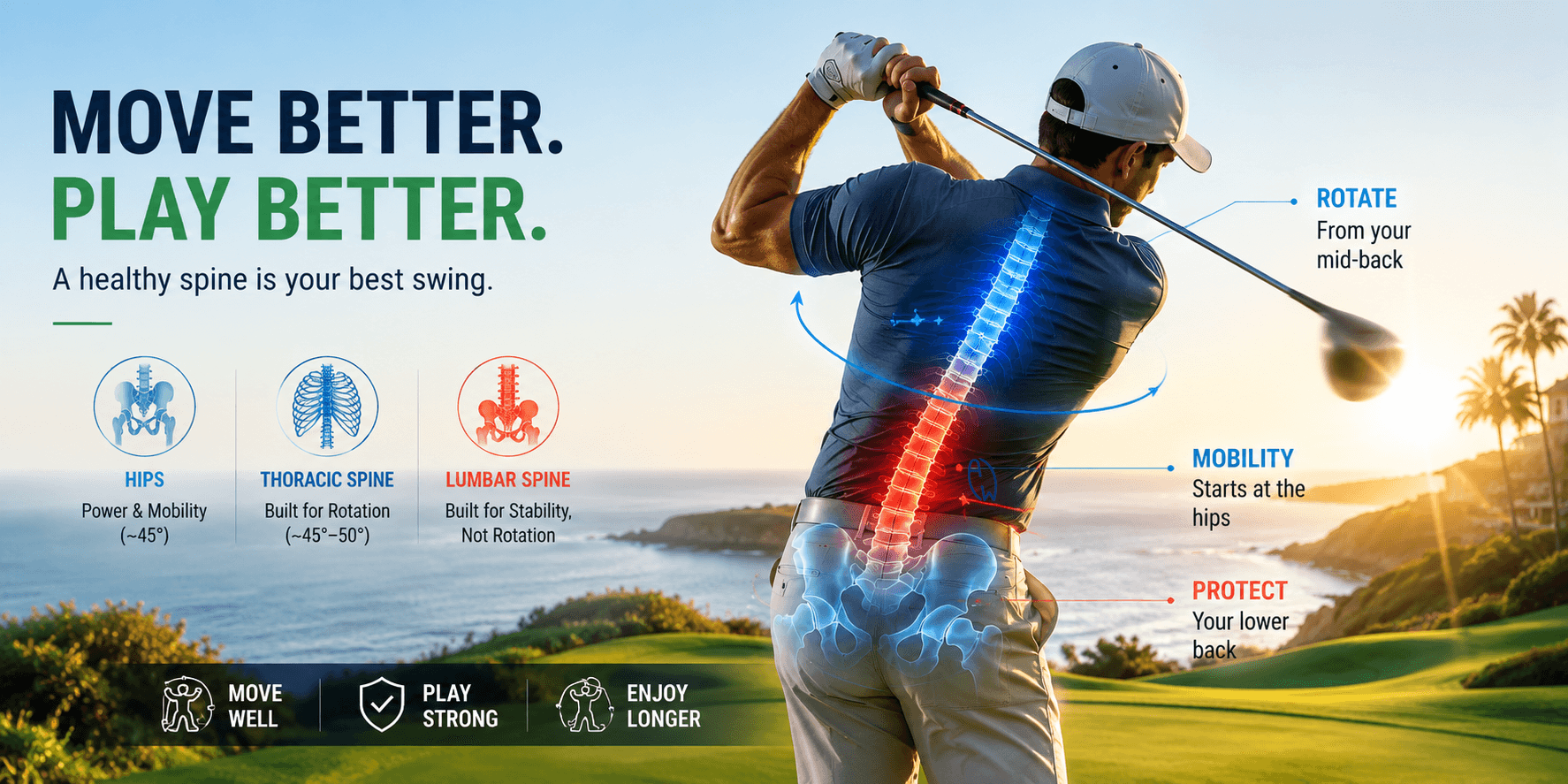
Why Most Golfers Hurt Their Back — The Real Cause of Golf Lower Back Pain
Golf may look smooth and controlled, but the golf swing places enormous rotational stress on the body within milliseconds.
That is why lower back pain remains one of the most common injuries among amateur and recreational golfers.
At All Well Scoliosis Centre, we regularly see avid golfers struggling with:
-
recurring lower back stiffness
-
trail shoulder tightness
-
reduced driving distance
-
post-round soreness
-
chronic spinal tension that never fully goes away
Many golfers assume the pain is simply part of aging.
But in reality, the problem is often mechanical.
And surprisingly, the painful area is usually not the true source of the problem.
The Real Reason Most Golfers Hurt Their Lower Back
The golf swing is a rotational movement.
The mistake many recreational golfers make is rotating from the wrong place — the lower back.
The lumbar spine is not designed for aggressive repetitive rotation.
Its primary job is stability and load bearing.
When golfers repeatedly force rotation through the lumbar spine, round after round and year after year, the tissues eventually become overloaded.
This can contribute to:
-
chronic lower back pain
-
muscle spasms
-
facet joint irritation
-
disc stress
-
stiffness after golfing
-
loss of rotational power
-
recurring flare-ups
The body will always search for movement somewhere.
If the hips and thoracic spine are not moving properly, the lower back becomes the compensation zone.
And compensation eventually becomes pain.
The Mechanics of Golf Rotation
One of the biggest misunderstandings in golf biomechanics is where rotation should actually come from during the swing.
The vast majority of rotational movement should come from:
-
the hips
-
the thoracic spine (mid-back)
—not the lower back.
Thoracic Spine: Built for Rotation
The thoracic spine is anatomically designed for rotational movement and typically allows approximately 45º – 50º of rotation.
This region helps golfers:
-
create separation
-
generate swing speed
-
maintain fluid motion
-
reduce unnecessary stress on the lumbar spine
When thoracic mobility is healthy, the body can rotate efficiently without forcing excessive torque into the lower back.
When it becomes stiff, the lumbar spine often takes over.
Hips & Glutes: The Engine of the Golf Swing
The hips act as both the engine and anchor of the golf swing.
Proper hip internal and external rotation allows golfers to coil and rotate powerfully while keeping the lower spine relatively stable.
Pelvic Rotation approx 45º
Strong and mobile glutes help:
-
stabilize the pelvis
-
transfer force efficiently
-
improve rotational control
-
protect the lower back during downswing acceleration
Without proper hip mobility, the body begins searching for movement elsewhere.
And unfortunately, that “elsewhere” is often the lumbar spine.
Why Lumbar Rotation Causes Injury
When golfers lack mobility in the hips or thoracic spine, they commonly compensate by:
-
swaying excessively
-
twisting through the lumbar spine
-
overextending during follow-through
-
forcing rotational speed from unstable segments
The lumbar spine simply is not built for excessive rotational loading.
Repeated twisting under high-force conditions — especially during the downswing — may contribute to:
-
muscle strains
-
facet irritation
-
inflammation
-
disc injuries
-
chronic lower back pain
-
persistent stiffness after playing golf
Limited Hip/T-Spine Mobility → Excess Lumbar Compensation
This is why many golfers continue stretching or massaging the lower back without solving the true problem.
The actual restriction is often happening above or below the painful area.
A Golf Swing Should Not Destroy Your Body
There is increasing discussion among rehabilitation professionals, movement specialists, and golf biomechanics experts regarding how modern golf swing mechanics may overload the body.
Many traditional swing models emphasize aggressive early downswing rotation and excessive spinal torque.
For some golfers — especially recreational players without elite mobility, sequencing, or strength — this becomes highly stressful over time.
The goal should never be:
- forcing the body to fit the swing
The goal should be:
- building a swing the body can tolerate long term
A durable golf swing depends on:
-
mobility
-
sequencing
-
force transfer
-
postural control
-
rotational stability
-
load management
—not simply rotating harder.
In Golf, the Spine Has 3 Important Jobs
1. Rotate
You need controlled thoracic rotation to create separation and speed.
This rotation should come primarily from:
-
the thoracic spine
-
the hips
-
proper pelvic control
—not excessive twisting through the lower back.
2. Resist Excess Motion
The spine must also stabilize while force is being generated elsewhere.
This requires:
-
anti-rotation control
-
lateral stability
-
core strength
-
balance under load
A spine that moves too much can become just as problematic as one that moves too little.
3. Transfer Force
Power in golf does not come from excessive spinal motion.
It comes from efficiently transferring force:
-
from the ground
-
through the hips
-
through the core
-
into the club
Efficient golfers are usually better at transmitting force — not simply creating more movement.
Why Some Golfers Lose Distance as They Age
Many golfers believe:
“I’m just getting older.”
But often, what they are truly losing is:
-
hip mobility
-
thoracic rotation
-
sequencing efficiency
-
rotational control
We commonly see golfers who:
-
still exercise regularly
-
still strength train
-
still play multiple rounds weekly
…but their movement quality slowly becomes more compensatory.
The hips rotate less.
The thoracic spine stiffens.
The body loses efficient sequencing.
As a result, the lower back and shoulders absorb increasing amounts of stress.
This often leads to:
-
reduced swing speed
-
decreased driving distance
-
trail shoulder tightness
-
fatigue
-
recurring lower back pain
Real Clinical Pattern We Commonly See
A 63-year-old golfer presents with:
-
lower back stiffness
-
trail shoulder discomfort
-
reduced distance off the tee
They already:
-
weight train
-
stretch regularly
-
practice yoga
Yet their golf performance continues declining.
On assessment:
-
the painful areas may not actually be the stiffest areas
-
lumbar range may appear acceptable
-
shoulder motion may seem normal
But the real restrictions are often:
-
thoracic rotation
-
hip internal rotation
-
pelvic mobility
-
rotational control
Once those regions are dynamically loaded and retrained properly, many golfers report:
-
reduced pain
-
smoother swings
-
improved mobility
-
less stiffness after rounds
-
improved driving distance
Sometimes surprisingly quickly.
Protecting Your Lower Back During Golf
To reduce stress on the lumbar spine and improve rotational efficiency, golfers should focus on improving the mobility and control of surrounding joints.
Improve Hip Mobility
Hip internal and external rotation are critical for a healthy golf swing.
If the hips stop rotating early, the lumbar spine is forced to compensate.
Golfers should regularly work on:
-
hip internal rotation
-
glute mobility
-
hip flexor mobility
-
pelvic control
-
rotational stability
The hips should create motion.
The lower back should transfer and stabilize it.
Improve Thoracic Extension & Rotation
The thoracic spine must move freely so the upper body can rotate over a stable lower body.
Restricted thoracic extension often causes golfers to:
-
lose rotational range
-
overload the lower back
-
compensate through the shoulders and neck
-
stand up early during the swing
Mobility drills targeting the mid-back can significantly improve swing mechanics and reduce spinal stress.
Maintain Better Posture
Posture at address directly affects how the spine moves during the swing.
An exaggerated:
-
S-posture (over-arched lower back)
or
-
C-posture (rounded spine)
can lock the facet joints and artificially restrict healthy rotation.
A neutral spine position allows:
-
better force transfer
-
improved sequencing
-
reduced joint compression
-
more efficient rotational mechanics
Good posture is not about being perfectly straight.
It is about creating a balanced athletic position where the body can rotate efficiently without compensation.
5 Mobility Drills That May Help Golfers
Dynamic Pigeon Stretch
Helps improve hip external rotation and glute mobility.
Half-Kneeling Thoracic Opener
Encourages thoracic rotation while stabilizing the pelvis.
Swiss Ball Hip Drops
Improves pelvic control and lumbar stability.
Dumbbell Thoracic Opener
Improves rotational movement through the mid-back.
Half-Kneeling Cable Lift
Builds rotational control and force transfer patterns.
These drills are most effective when performed consistently — not only before a round of golf.
Daily movement quality matters.
Mobility Alone Is Not Enough
Mobility gives you access.
Strength gives you control.
Durable Golf Swing = Mobility + Strength + Control
A golfer with flexibility but poor stability may still overload the spine.
A golfer who is strong but stiff may compensate through the lower back.
The goal is balance.
The body should:
-
rotate efficiently
-
control force properly
-
transfer power safely
-
tolerate repetitive golf long term
Final Thoughts
Back pain in golfers is rarely random.
In many cases, the body is compensating for:
-
poor hip mobility
-
restricted thoracic rotation
-
inefficient force transfer
-
weak rotational control
-
postural limitations
The lower back often becomes the victim of movement problems happening elsewhere.
Golf should challenge your skills — not break down your body.
Training:
-
hip mobility
-
thoracic rotation
-
spinal control
-
posture
-
force transfer mechanics
may help golfers:
-
move better
-
swing more efficiently
-
reduce pain
-
improve endurance
-
maintain driving distance
-
continue playing for years with fewer setbacks
A body that rotates efficiently through the hips and thoracic spine is a body that can enjoy golf for a very long time.