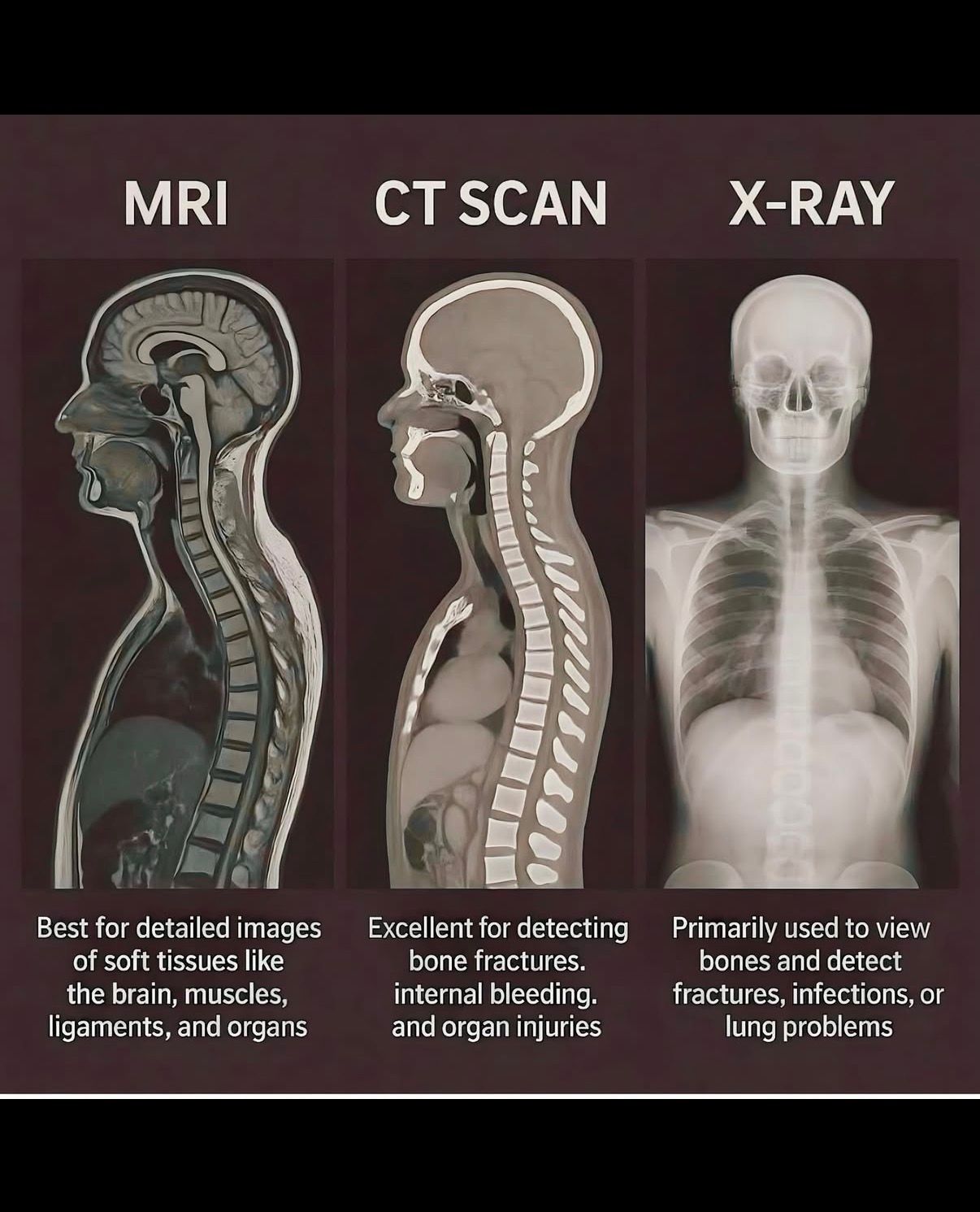
Why We Use X-Ray for Scoliosis — And Not MRI or CT
Closing the Research Gap Between Imaging, Measurement, and Safe Care
In scoliosis care, how we see the spine determines how we treat it.
Yet many patients and parents ask an important question:
“Why do you use X-ray instead of MRI or CT scans?”
The answer lies in a critical research and clinical gap — the difference between diagnostic imaging and measurement imaging.
The Research Gap: Seeing vs Measuring the Spine
Modern medicine offers powerful imaging tools. MRI and CT scans are remarkable technologies — but they were not designed to measure spinal curvature accurately.
Most scoliosis research, global treatment guidelines, and long-term outcome studies rely on standing spinal X-rays, not MRI or CT.
Why?
Because scoliosis is a three-dimensional structural condition influenced by gravity, posture, and load.
👉 X-ray is the only imaging modality that allows precise, repeatable measurement of spinal curvature under real-life conditions.
Why X-Ray Is the Gold Standard in Scoliosis Care
1. Accurate Measurement of Curve Degree
Scoliosis management depends on exact angles, such as Cobb measurements.
-
X-ray shows true curve magnitude
-
Allows side-by-side comparison over time
-
Enables us to track progression, stabilization, or improvement
MRI and CT cannot reliably measure these angles, especially in a standing, weight-bearing position.
2. Structural Visibility That Matters in Scoliosis
X-ray clearly shows:
-
Vertebral alignment
-
Bone integrity
-
Fractures or anomalies
-
Signs of infection
-
Rib positioning
-
Lung field symmetry (critical in thoracic scoliosis)
In scoliosis, lung space and rib structure matter — not just the spine itself.
3. Low Radiation, High Clinical Value
Modern digital scoliosis X-rays use minimal radiation, far lower than CT scans, while delivering far more relevant information for conservative scoliosis care.
CT scans expose patients to significantly higher radiation and are not appropriate for routine scoliosis monitoring, especially in children and adolescents.
Where CT Scans Truly Belong
CT scans are excellent for:
-
Detailed bone architecture
-
Surgical planning
-
Assessing fractures or complex deformities
In practice, CT is most commonly used by orthopaedic surgeons to determine surgical candidacy, not conservative management.
👉 If a patient reaches a point where surgery is being considered, CT may be appropriate — but that is a different stage of care.
Where MRI Truly Excels
MRI is invaluable for:
-
Soft tissues
-
Brain and spinal cord
-
Muscles and ligaments
-
Discs and organs
-
Neurological symptoms
We may recommend or review MRI when:
-
There is unexplained pain
-
Neurological symptoms are present
-
Ligament or disc injury is suspected
However, MRI does not measure spinal curvature accurately, nor does it reflect how the spine behaves under gravity.
Prevention vs Repair: A Critical Distinction
Most patients who come to us are not injured from trauma.
They are seeking:
-
Early detection
-
Curve monitoring
-
Postural correction
-
Non-invasive intervention
-
Long-term spinal health
This is preliminary and preventive care, not emergency repair.
X-ray is the appropriate tool for this purpose.
My Role as Chiropractor Specialised in Scoliosis
As chiropractor specialising in scoliosis:
-
I am trained extensively in radiographic analysis
-
We use imaging to guide care — not to over-treat
-
We focus on alignment, neuromuscular coordination, and structural stability
Our goal is to:
Strengthen the foundation of the spine and its neuromuscular control — not to mask symptoms.
Knowing Our Limits: Ethical Care First
If you present with:
-
Torn ligaments
-
Acute trauma
-
Progressive neurological signs
-
Conditions outside conservative care
👉 We will refer you.
We work with a trusted network of:
-
Orthopaedic specialists
-
Neurologists
-
Medical doctors
-
Imaging centres
Physiotherapy often becomes part of care after orthopaedic diagnosis, especially for muscle or soft-tissue injury.
What We Are Not
We are not miracle workers.
We are not “one-scan-fix-all” practitioners.
We are not snake-oil salespeople.
We are trained to do no harm, to work within evidence, and to stay in our lane.
Our Commitment
If we can help, we will guide you clearly.
If we cannot, we will refer responsibly.
That is not weakness — that is professional integrity.
“I will not promise what the body cannot safely deliver.
I will promise honesty, structure, and care.”
This is the oath we stand by.