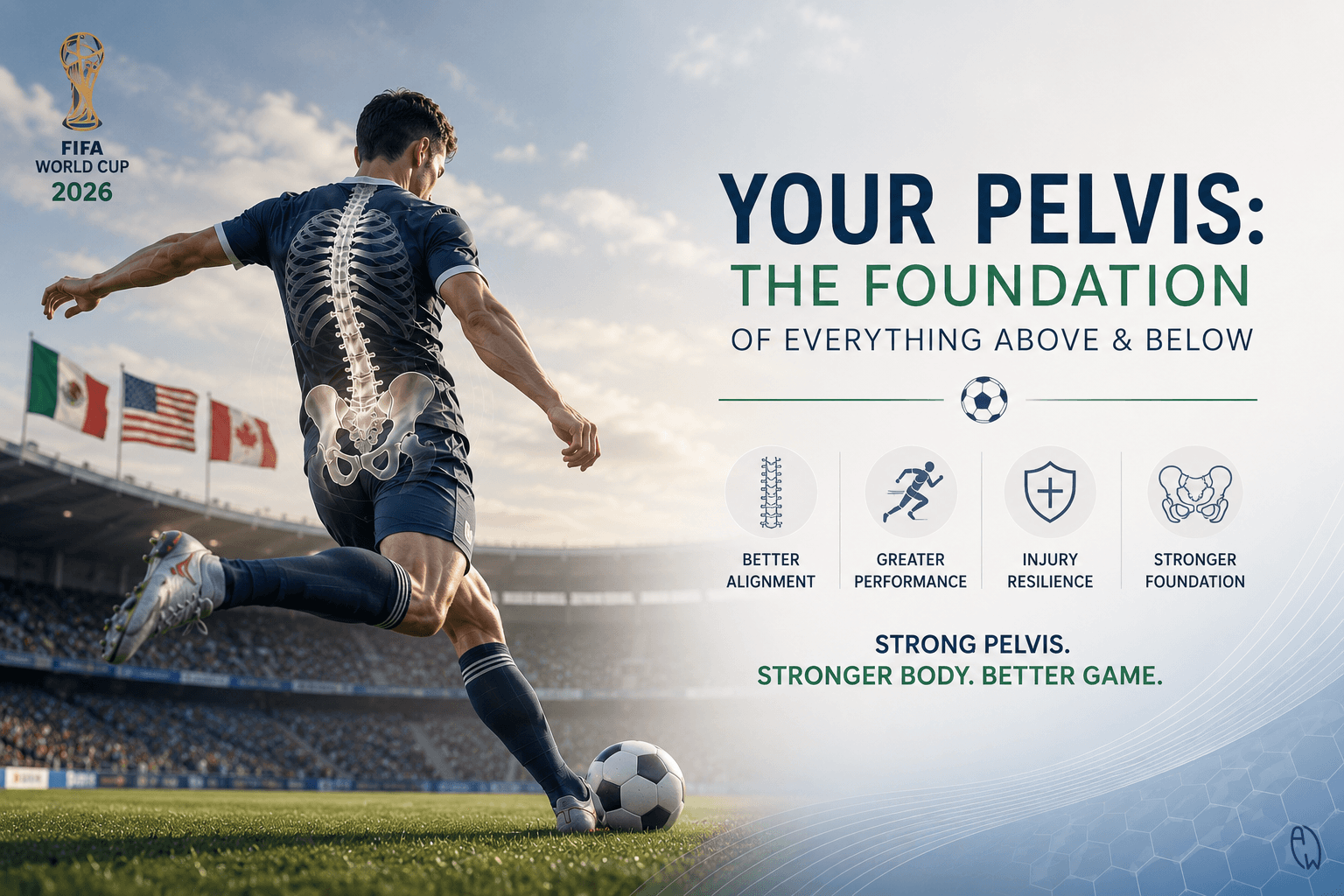
Your Pelvis: The Foundation of Posture, Spinal Health, and Athletic Performance
Everything Above and Below Connects to It
When most people think about posture, back pain, or scoliosis, they naturally focus on the spine.
However, one of the most important structures influencing spinal alignment and movement is often overlooked: the pelvis.
The pelvis is the foundation of the human body. It serves as the bridge between the spine above and the legs below. Every movement you make—whether you're walking, sitting, lifting, running, or playing sports—depends on the position and stability of your pelvis.
Just as a building cannot remain stable on an uneven foundation, the spine cannot function optimally when the pelvis is tilted, rotated, or shifted out of balance.
This is why, when assessing many scoliosis patients, we often begin by evaluating the pelvis first.
The Spine Balances on the Pelvis
The spine sits directly on top of the pelvis.
When the pelvis is level and stable, the spine has a solid base from which to support the rib cage, shoulders, neck, and head.
However, when the pelvis tilts forward, backward, rotates, or shifts to one side, the spine must compensate to keep the body upright and the eyes level with the horizon.
Over time, these compensations can contribute to:
-
Poor posture
-
Uneven spinal loading
-
Increased muscle tension
-
Joint stress
-
Altered movement patterns
-
Lower back discomfort
In scoliosis, pelvic imbalances may influence how the body adapts and manages spinal curves.
Your Pelvis Influences Breathing, Posture, and Core Function
Many people are surprised to learn that the pelvis affects much more than the hips.
The pelvis works closely with:
-
The diaphragm
-
The abdominal muscles
-
The pelvic floor
-
The deep spinal stabilizers
-
The rib cage
Together, these structures form the body's core stability system.
When the pelvis is positioned well, the diaphragm can move more efficiently, breathing becomes more effective, and the core muscles can better support the spine.
When pelvic alignment is compromised, breathing mechanics, posture, and movement efficiency may also be affected.
This is why improving posture is often about much more than simply "standing up straight."
The Muscles That Control Pelvic Position
The pelvis is influenced by a complex network of muscles that must work together in balance.
Iliopsoas (Hip Flexors)
The iliopsoas is one of the most powerful hip flexors in the body.
When it becomes tight, it can pull the pelvis forward into an anterior pelvic tilt, increasing stress on the lower back and altering spinal alignment.
Gluteal Muscles
The glutes help stabilize the pelvis during standing, walking, running, and lifting.
Weak glutes can reduce pelvic stability and contribute to compensation patterns throughout the body.
Hamstrings
The hamstrings attach directly to the sit bones of the pelvis.
Because of this attachment, hamstring tension has a direct influence on pelvic tilt and spinal posture.
Quadratus Lumborum (QL)
Located deep within the lower back, the quadratus lumborum helps stabilize the spine and pelvis while assisting with side bending.
When one side becomes tighter than the other, asymmetrical loading and pelvic imbalance can occur.
Adductors
The adductors along the inner thigh help control leg movement and stabilize the pelvis during walking, running, and athletic activities.
When these muscles become imbalanced, pelvic mechanics may be altered.
What Happens When One Side Becomes Tight?
The body functions as a connected system.
A problem in one area rarely stays isolated.
1. Pelvic Tilt or Pelvic Shift
Tight muscles can pull the pelvis out of its ideal position, creating:
-
Pelvic tilt
-
Pelvic rotation
-
Lateral pelvic shift
2. Spinal Compensation
Once the pelvis changes position, the spine often compensates to maintain balance.
This may result in:
-
Uneven spinal curves
-
Increased muscular tension
-
Joint compression
-
Reduced movement efficiency
3. Upper Body Imbalance
The effects can travel upward into:
-
The rib cage
-
The shoulders
-
The neck
-
The head
Many postural issues seen in the upper body actually originate from the foundation below.
4. Pain and Dysfunction
Over time, these compensations may contribute to:
-
Lower back pain
-
Hip pain
-
Knee discomfort
-
Muscle tightness
-
Reduced mobility
-
Fatigue
The Pelvis Is Also the Foundation of Athletic Performance
The importance of the pelvis extends far beyond posture and spinal health.
As the world watches elite football players compete on the biggest stages, most people focus on the feet, speed, and skill.
Yet behind every sprint, powerful shot, and rapid change of direction is a strong and stable pelvis.
Whether you're a professional athlete, weekend football player, runner, golfer, or fitness enthusiast, your pelvis acts as the central hub that transfers force throughout the body.
Think of the pelvis as the transmission system in a high-performance sports car.
The engine may generate power, but without an efficient transmission, that power never reaches the wheels.
Maximum Power and Speed
Every sprint, jump, kick, and change of direction begins with force generated from the ground.
A stable pelvis allows this force to travel efficiently through the body.
When pelvic stability is lacking, energy leaks occur, reducing performance.
A strong pelvis helps athletes:
-
Sprint faster
-
Accelerate quicker
-
Jump higher
-
Shoot harder
-
Generate more power
The pelvis is where strength becomes performance.
Agility, Balance, and Movement Control
Football, tennis, basketball, and many other sports require constant changes in direction.
The gluteal muscles, particularly the gluteus medius, play a critical role in stabilizing the pelvis during these movements.
A stable pelvis allows athletes to:
-
Cut sharply
-
Pivot efficiently
-
Maintain balance
-
React quickly
Without pelvic control, movement becomes less efficient and more energy is wasted.
Injury Prevention Starts with Stability
Many common sports injuries can be linked to poor pelvic control and muscle imbalances.
A stable pelvis helps protect:
-
The lower back
-
The hips
-
The groin
-
The hamstrings
-
The knees
Improved pelvic stability may reduce the risk of:
-
Hamstring strains
-
Hip pain
-
Sports hernias
-
Lower back pain
-
Knee injuries
The stronger the foundation, the more resilient the body becomes.
The Often Forgotten Pelvic Floor
One of the most overlooked components of performance and spinal health is the pelvic floor.
The pelvic floor forms the base of the core system and works together with the diaphragm, abdominal muscles, and spinal stabilizers.
For both men and women, a healthy pelvic floor contributes to:
-
Better spinal support
-
Improved force transfer
-
Greater balance
-
Enhanced athletic performance
-
Improved core control
It also plays an important role in managing pressure during high-impact activities such as running, jumping, and lifting.
Why Pelvic Assessment Matters in Scoliosis
Scoliosis is not simply a spinal condition.
It involves the interaction of the spine, pelvis, rib cage, muscles, breathing system, and nervous system.
Because the spine balances directly on the pelvis, assessing pelvic position is often an essential part of understanding the body's overall compensatory patterns.
A comprehensive scoliosis evaluation should include:
-
Pelvic alignment
-
Hip mobility
-
Muscle balance
-
Core function
-
Breathing mechanics
-
Functional movement assessment
Addressing the foundation first often creates a more stable environment for long-term postural improvement.
A World Cup Thought: Soccer, Scoliosis, and the Pelvis
In the spirit of the World Cup, I know many of my patients are passionate football fans. In fact, I have worked with several young athletes over the years, including one patient who dreamed of pursuing a professional soccer career.
It reminds me that whether you're standing in a classroom, working in an office, or chasing a ball on the world's biggest stage, the same principles apply.
A soccer player's success depends on power, speed, balance, agility, and endurance. All of these qualities rely on a strong and stable pelvis.
The pelvis serves as the foundation that transfers force between the legs, core, and spine. When it functions well, athletes can sprint faster, change direction more efficiently, generate more power, and reduce their risk of injury.
This is also why many soccer players develop side-to-side muscular imbalances. The repetitive use of a dominant kicking leg can influence pelvic position, movement patterns, and sometimes even contribute to postural changes that resemble functional scoliosis.
The good news is that scoliosis does not automatically prevent someone from participating in sports. Professional footballers such as Alessandro Nesta and Ivan Toney have demonstrated that athletes with scoliosis can continue to compete at a high level with proper management, conditioning, and support.
Whether your goal is improving your posture, managing scoliosis, reducing pain, or becoming a better athlete, the foundation remains the same:
A stronger pelvis creates a stronger body.
The Bottom Line
Your pelvis is much more than a collection of bones connecting your hips.
It is the foundation of posture, breathing, movement, spinal health, and athletic performance.
Everything above and below connects to it.
Whether your goal is reducing back pain, improving scoliosis management, moving more efficiently, preventing injury, or becoming a stronger athlete, the pelvis plays a central role in how your body functions.
Because when the foundation is strong, everything built upon it has the opportunity to perform at its best.