14-Day Intensive Scoliosis Rehabilitation Program
Measurable Cobb Angle Reduction Through Structured Corrective Training
Scoliosis treatment often progresses slowly when rehabilitation is limited to weekly therapy sessions. Many patients struggle to fully understand how to control their spinal alignment with only one hour of therapy per week.
At All Well Scoliosis Centre in Singapore, we developed a 14-day intensive outpatient scoliosis rehabilitation program designed to accelerate neuromuscular learning, spinal awareness, and corrective movement patterns.
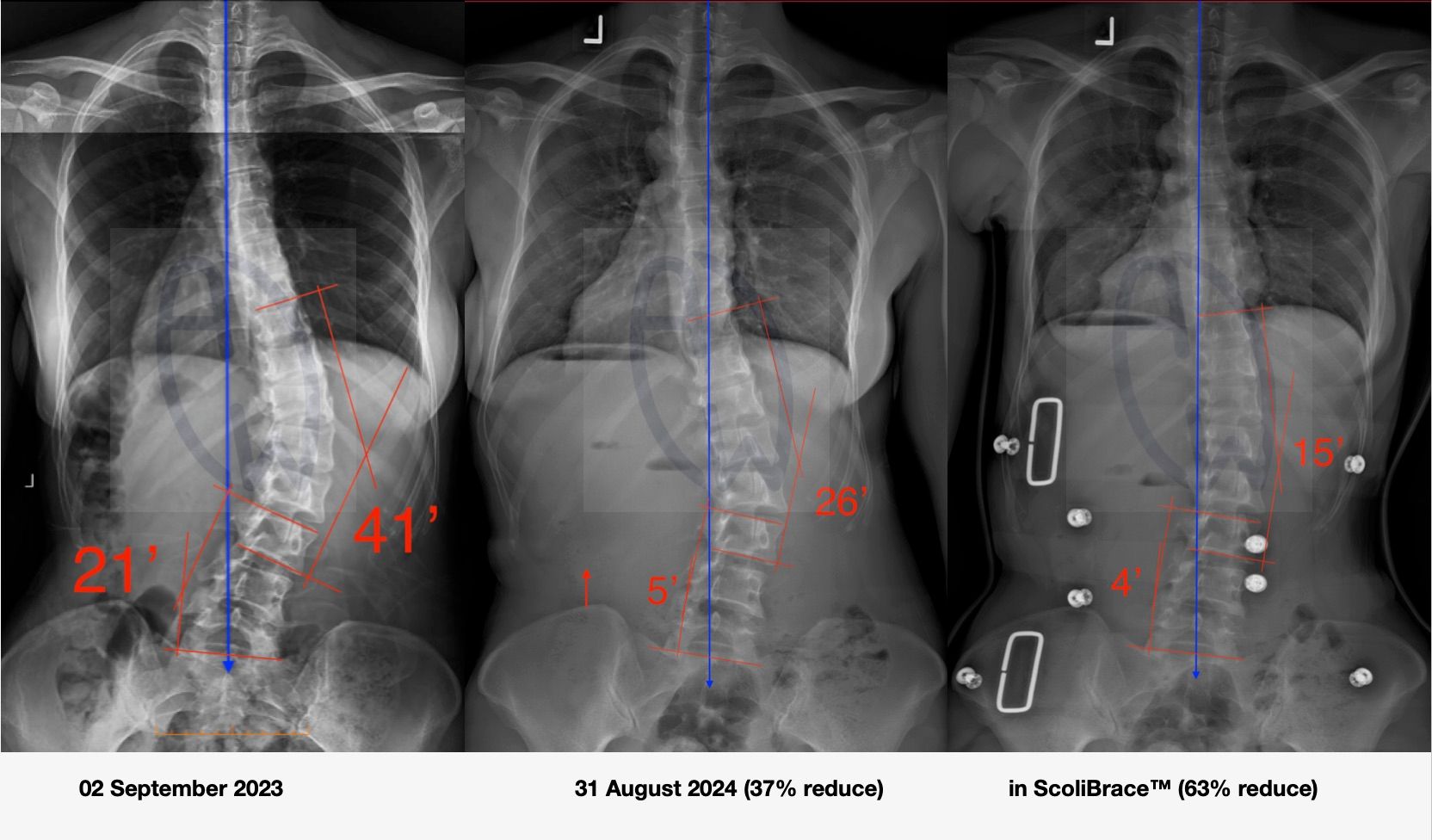
In a prospective clinical observation, patients completing this program demonstrated measurable improvements in spinal alignment, including Cobb angle reduction visible on radiographic imaging.
Why Intensive Scoliosis Rehabilitation?
Scoliosis is not simply a sideways spinal curve. It is a three-dimensional deformity involving:
• lateral spinal curvature
• vertebral rotation
• rib cage asymmetry
• muscular imbalance
• altered breathing mechanics
Because of this complexity, successful conservative scoliosis management often requires multiple coordinated approaches.
At our centre, we combine several evidence-informed rehabilitation strategies, including:
• structural spinal correction techniques from the CLEAR Method
• custom 3-dimensional bracing using ScoliBrace
• physiotherapeutic scoliosis-specific exercises
• neuromuscular awareness and breathing training using ScoliBalance
Instead of applying these methods separately, they are integrated into a structured rehabilitation protocol.
Program Structure
The program is delivered as an intensive 14-day outpatient rehabilitation block.
Patients typically participate in 6–8 hours of guided corrective training per day, including:
1. Assisted spinal traction and decompression
Designed to reduce spinal loading and prepare the spine for corrective training.
2. Neuromuscular spinal stabilization
Targeted exercises that retrain asymmetrical muscle patterns common in scoliosis.
3. Rotational breathing techniques
Training rib cage expansion and improving breathing mechanics.
4. Postural correction training
Patients learn how to actively correct their spinal alignment during standing, sitting, and movement.
5. Corrective movement integration
Applying spinal correction strategies into real-life daily activities.
6. Custom brace evaluation (when indicated)
Assessment and fitting of ScoliBrace to support long-term curve management.
Clinical Observation
To evaluate the effect of this intensive program, we conducted a prospective cohort observation involving patients undergoing the full 14-day rehabilitation protocol.
Study Design
Location: All Well Scoliosis Centre, Singapore
Program duration: 14 days intensive outpatient rehabilitation
Patients underwent:
• baseline standing X-ray with Cobb angle measurement
• completion of the full 14-day rehabilitation program
• follow-up X-ray assessment
Radiographic comparisons were performed under similar standing conditions to evaluate changes in spinal alignment.
Results
Preliminary observations demonstrated measurable improvements in spinal curvature in a large proportion of participants.
Average Cobb Angle Reduction
X° reduction following completion of the 14-day program.
Patient Response Rate
Y% of patients demonstrated measurable curve reduction on follow-up radiographic imaging.
The degree of improvement varied depending on several factors:
• curve flexibility
• skeletal maturity
• baseline curve magnitude
• patient participation and engagement in corrective training

Why Many Patients Travel Internationally for Intensive Programs
Patients from Europe, Australia, and Asia increasingly seek intensive scoliosis rehabilitation programs because weekly therapy sessions often provide limited time to develop neuromuscular control.
Short-term intensive programs allow patients to:
• develop spinal awareness faster
• learn corrective breathing techniques
• retrain postural control
• understand their individual curve mechanics
Once patients understand how their spine moves and compensates, they become more capable of maintaining corrective posture in daily life.
An Integrated Corrective System
Rather than relying on a single therapy model, our program integrates several complementary approaches:
• structural correction principles from the CLEAR Method
• bracing support using ScoliBrace
• physiotherapeutic scoliosis-specific exercise
• neuromuscular retraining and breathing control with ScoliBalance
This integrated system aims to help patients actively participate in their scoliosis correction and long-term spinal health.
Limitations
This observation reflects outcomes from a single clinical centre and should be interpreted accordingly.
Future studies will aim to include:
• larger patient cohorts
• long-term follow-up
• functional and quality-of-life outcomes
Conclusion
Our preliminary clinical observations suggest that a 14-day intensive scoliosis rehabilitation program may produce measurable improvements in spinal alignment while helping patients rapidly understand and control their spinal mechanics.
When patients learn how to actively manage their posture, breathing, and spinal positioning, they become empowered participants in their long-term scoliosis care.
At All Well Scoliosis Centre, our goal is not only to reduce spinal curvature but to equip patients with the skills and knowledge needed to maintain spinal health for life.
Medical Disclaimer
This article is for educational purposes only and does not constitute medical advice.
Scoliosis varies significantly between individuals. Always consult a qualified healthcare professional before starting any new sport or exercise program, especially if you have scoliosis, spinal conditions, pain, or previous injuries. Participation in sports should be guided by individual assessment and professional recommendation.
The image is shared for educational purposes with patient consent. Individual outcomes vary. Structural correction does not automatically restore full respiratory function. Clinical assessment is required.
Copyright & Content Protection Notice
© 2026 All Well Scoliosis Centre. All rights reserved.
This content is original and protected by copyright law.
No part of this article may be reproduced, distributed, copied, or reused in any form without prior written permission. Unauthorized use, duplication, or content scraping is strictly prohibited.