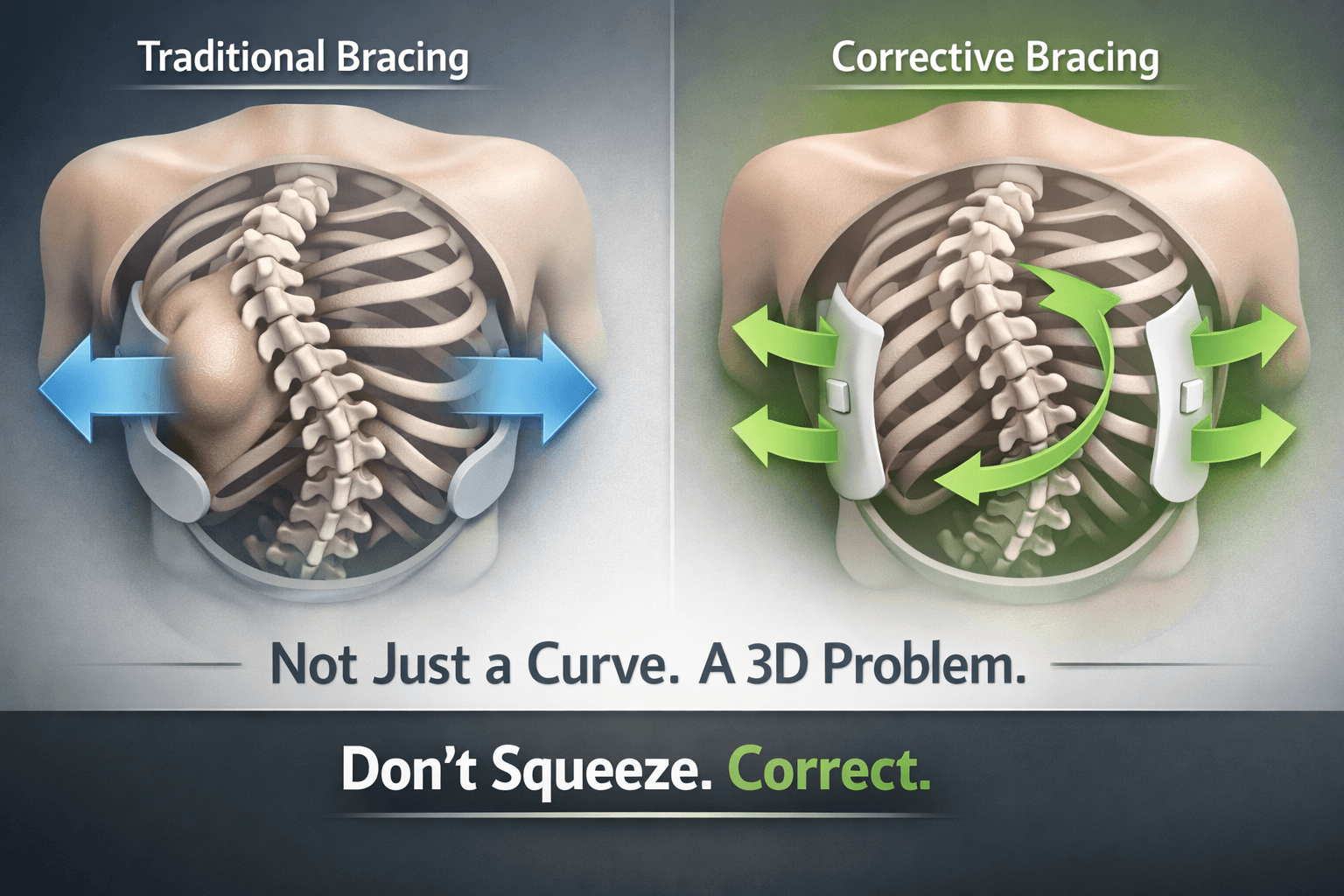
How to Reduce Scoliosis Curves: Why 3D Correction Matters
Scoliosis isn’t just a sideways bend of the spine—it’s a 3-dimensional condition. The spine doesn’t simply curve; it also rotates and shifts, affecting the ribs, posture, and overall body balance.
This is why effective treatment must go beyond just addressing lateral bending—it must also correct rotation and structural imbalance.
The Boston Brace: Why Traditional Bracing Falls Short
The Boston Brace is the most commonly used brace in traditional scoliosis treatment, designed with one primary goal:
to stop curve progression through immobilization.
Immobilizing the spine means limiting movement—but this approach comes with significant limitations.
The Key Problem: Scoliosis Is Not 2D
The Boston Brace does not treat scoliosis as a 3-dimensional condition. Instead, it focuses mainly on the sideways (lateral) curve, without addressing the critical rotational component of the spine and rib cage.
Because of this, patients may experience:
-
Persistent or worsening rib prominence
-
Limited postural improvement
-
Minimal change in spinal alignment
What Happens in Real Cases?
-
Out-of-brace X-ray: 28°
-
In Boston Brace: 28°
-
Result: 0° correction
While the Boston Brace may help slow or stop progression, especially in thoracic curves, true curve reduction is not typically expected.
Limitations of Traditional Bracing
Traditional braces—including the Boston Brace, Milwaukee brace, Providence brace, Charleston bending brace, and Wilmington brace—share similar challenges:
-
Squeezing mechanism that compresses the torso
-
Limited ability to improve spinal position
-
No meaningful correction of rotation
-
Potential for increased rib deformity over time
Additional concerns include:
1. Muscle Weakness & Rigidity
Because the spine is immobilized, muscles are underused—leading to:
-
Weakening of spinal support muscles
-
Increased stiffness and reduced flexibility
2. Poor Compliance
Bracing is often prescribed for up to 23 hours a day. However:
-
Bulky designs are hard to conceal
-
Discomfort reduces wear time
-
Non-custom fits can worsen adherence
And here’s the reality:
Even the best brace won’t work if it isn’t worn consistently.
Corrective Bracing: A 3D Solution
Modern corrective bracing—such as ScoliBrace—takes a completely different approach.
Instead of squeezing, it uses targeted pushing forces to:
-
De-rotate the spine
-
Improve alignment
-
Restore balance to the torso
Real Patient Outcome
-
Before: 28° curve
-
With corrective brace: 8°
-
Result: 71% curve reduction
Why Corrective Bracing Works Better
Corrective bracing is designed to work with the body, not against it:
-
Allows controlled movement, not full immobilization
-
Encourages muscle activation and balance
-
Improves posture in all 3 dimensions
When combined with a scoliosis-specific exercise program, results can include:
-
Curve reduction
-
Pain relief
-
Better posture and symmetry
-
Improved muscle strength and coordination
The Missing Piece: A Complete Treatment Approach
Bracing alone is rarely enough. Real results come from combining:
-
Corrective bracing
-
Targeted rehabilitation
-
Postural retraining
-
Muscle strengthening programs
The Takeaway
Traditional braces like the Boston Brace may help slow progression, but they are not designed to correct scoliosis in 3D.
If your goal is real curve reduction and long-term structural improvement, the approach must evolve:
👉 Don’t just immobilize the spine.
👉 Correct it in all three dimensions.
Medical Disclaimer
This article is for educational purposes only and does not constitute medical advice.
Scoliosis varies significantly between individuals. Always consult a qualified healthcare professional before starting any new sport or exercise program, especially if you have scoliosis, spinal conditions, pain, or previous injuries. Participation in sports should be guided by individual assessment and professional recommendation.
The image is shared for educational purposes with patient consent. Individual outcomes vary. Structural correction does not automatically restore full respiratory function. Clinical assessment is required.
Copyright & Content Protection Notice
© 2026 All Well Scoliosis Centre. All rights reserved.
This content is original and protected by copyright law.
No part of this article may be reproduced, distributed, copied, or reused in any form without prior written permission. Unauthorized use, duplication, or content scraping is strictly prohibited.