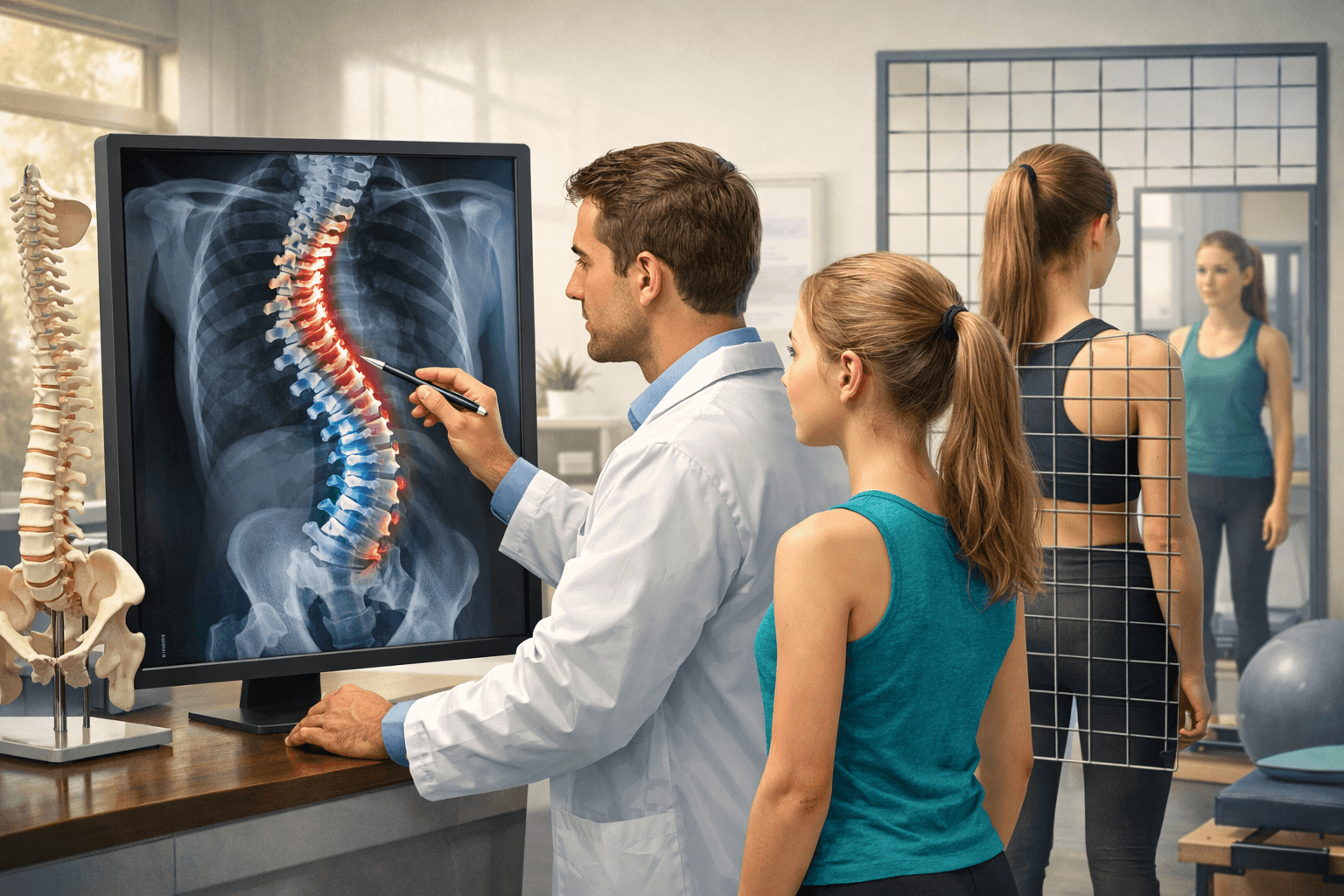
Can Chiropractic, Massage, or Physiotherapy Alone Reduce Scoliosis?
Scoliosis patients and parents often ask the same question:
-
Can chiropractic adjustment reduce scoliosis?
-
Will massage therapy correct the spinal curve?
-
Is physiotherapy alone enough to treat scoliosis?
These are valid questions, but the honest answer is that scoliosis management is complex and rarely solved by a single treatment approach.
Every practitioner has a different way of helping scoliosis patients. Chiropractors, physiotherapists, orthopedic specialists, and massage therapists each use their training and experience to serve patients in their own way.
At our clinic, we respect every practitioner who is genuinely trying to help people living with scoliosis.
However, after more than 10 years specializing in scoliosis care, we stand firmly behind the protocol that has produced the most consistent progress for our patients.
Our Protocol for Managing Scoliosis
Over the years, I have explored and tested many scoliosis treatment methods and rehabilitation approaches.
Through clinical experience, I found that scoliosis becomes much easier to manage when multiple systems are combined, rather than relying on only one modality.
Our approach integrates several specialized scoliosis systems:
-
CLEAR Institute methodology (https://clear-institute.org/)
-
ScoliBrace (https://scolicare.com/patients-scolibalance/)
-
ScoliBalance developed by ScoliCare
-
Physiotherapeutic Scoliosis Specific Exercises (PSSE)
By combining these systems, we can address scoliosis through several important mechanisms:
Structural correction
Helping improve spinal alignment and biomechanics.
Neuromuscular retraining
Teaching the brain and muscles how to maintain improved posture.
Muscle strength and endurance
Building the muscular support that protects the spine.
Postural awareness
Helping patients maintain better spinal positioning in daily life.
Scoliosis is not just a sideways curve. It is a three-dimensional spinal deformity involving rotation, muscle imbalance, and neurological adaptation. Because of this complexity, we believe a multidisciplinary rehabilitation strategy provides better long-term management.
Why We Do Not Compare Other Practitioners
Patients sometimes ask us to compare our program with other clinics.
To be transparent, we do not spend our time analyzing other practitioners’ protocols.
Each healthcare professional practices according to their own training, philosophy, and clinical experience.
Instead of comparing practitioners, we encourage patients to:
-
Research different scoliosis approaches
-
Ask practitioners detailed questions
-
Understand the science behind each protocol
-
Evaluate the time and commitment required
Today, there is a surge of information and research available, and patients can study many treatment options before making a decision.
Healthcare should not be about blindly following a method. It should be about understanding what works best for your body and your goals.
Responsibility in Scoliosis Care
We strongly believe patients should take an active role in their own health.
If you are an adult, you are responsible for choosing the care that aligns with your needs.
If you are under 18, your parents or guardians will help make those decisions.
But regardless of age, we encourage patients to be advocates for their own bodies.
When considering scoliosis treatment, you should carefully weigh:
-
Your personal goals
-
The financial investment
-
The time commitment required
-
Your willingness to stay consistent
Scoliosis improvement is rarely instant. It requires discipline, endurance, and patience.
What Happens When the Spine Improves?
A question we hear frequently is:
“If my scoliosis improves or stabilizes, does treatment stop?”
The answer is usually no.
The human body is not static. It is constantly adapting.
Ask yourself:
-
Do muscles stay strong without exercise?
-
Can we work continuously without rest?
-
Does the body remain stable without movement?
Your spine is a structure, and your muscles protect that structure. Your nervous system coordinates both.
Because of this, long-term scoliosis care often shifts into maintenance and monitoring.
When a patient’s spine becomes stable:
-
Clinic visits may become less frequent
-
Rehabilitation exercises continue
-
Periodic spinal monitoring ensures stability
The goal is not just reducing a curve. The goal is maintaining long-term spinal balance and function.
Our Treatment Philosophy
At our clinic, scoliosis care is never limited to a single technique.
We do not provide only short 15-minute adjustments.
We do not rely only on stretching.
We do not focus solely on strengthening exercises.
Instead, our program integrates structural care, rehabilitation, neuromuscular training, and postural correction.
Many patients who come to us are highly motivated individuals. Scoliosis rehabilitation requires endurance and commitment.
So an important question patients should ask themselves is:
“Am I willing to commit to the process?”
If the answer is yes, we are always happy to welcome you into the program.
No Long-Term Packages
We also believe healthcare should never trap patients financially.
Our clinic does not tie patients into long-term treatment packages.
You always have the freedom to decide whether the program continues to benefit you.
If at any point you feel it is no longer helpful, you are free to stop.
However, after more than a decade working with scoliosis patients, I remain confident in the protocol we use because we have seen how it helps many individuals manage their spine more effectively.
Requesting a Case Review
If you would like us to review your case, you may send your most recent spinal X-ray to our clinic.
We can then explain whether our program may be appropriate for your situation.
But regardless of the path you choose, we encourage every patient to research deeply, ask questions, and make informed decisions about their spine health.
Medical Disclaimer
This article is for educational purposes only and does not constitute medical advice.
Scoliosis varies significantly between individuals. Always consult a qualified healthcare professional before starting any new sport or exercise program, especially if you have scoliosis, spinal conditions, pain, or previous injuries. Participation in sports should be guided by individual assessment and professional recommendation.
The image is shared for educational purposes with patient consent. Individual outcomes vary. Structural correction does not automatically restore full respiratory function. Clinical assessment is required.
Copyright & Content Protection Notice
© 2026 All Well Scoliosis Centre. All rights reserved.
This content is original and protected by copyright law.
No part of this article may be reproduced, distributed, copied, or reused in any form without prior written permission. Unauthorized use, duplication, or content scraping is strictly prohibited.