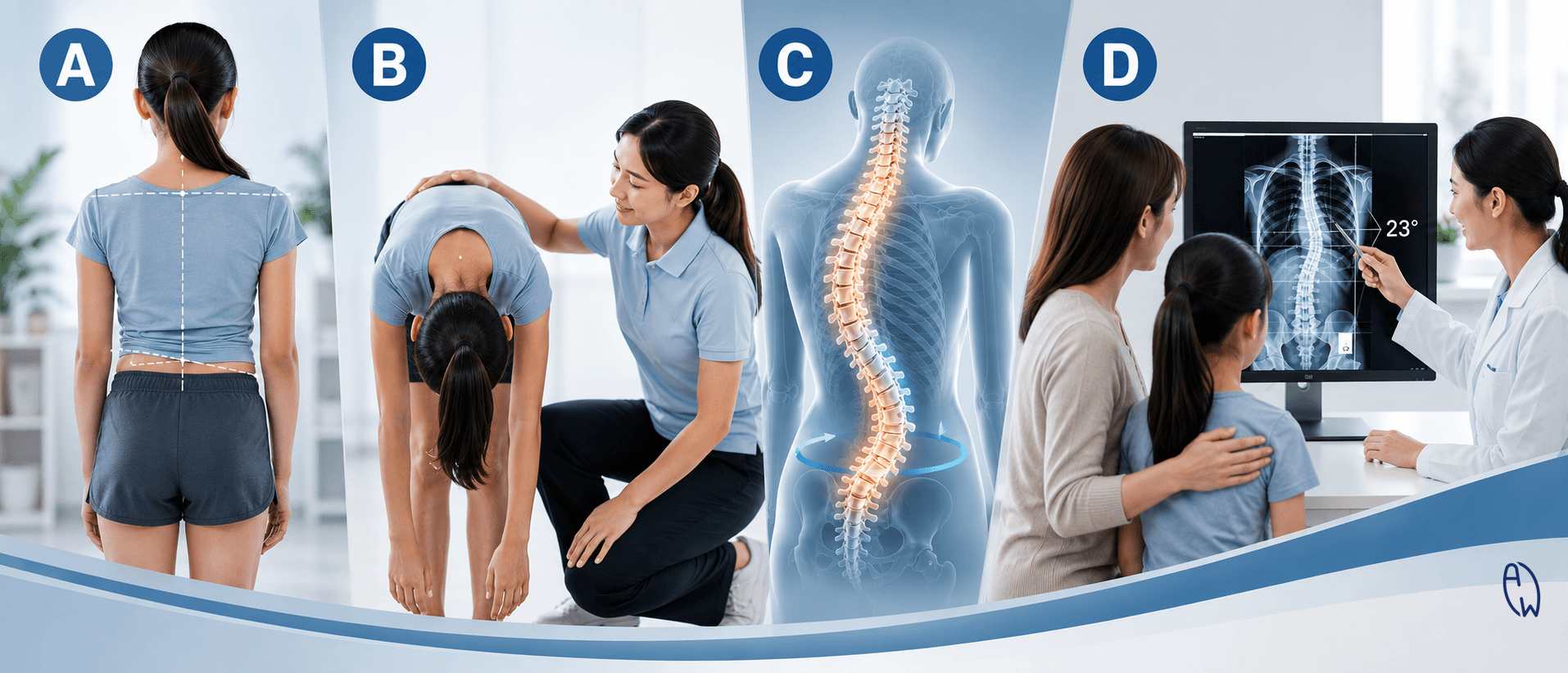
ABCD of Scoliosis: A Simple Guide to Early Detection That Every Parent Should Know
Did you know that early detection is one of the most important factors in managing scoliosis?
Scoliosis often develops gradually. Many children and teenagers do not complain of pain, which means the condition can go unnoticed until the curve becomes more obvious.
The good news? You don't need medical training to spot the early warning signs.
Healthcare professionals often encourage families to remember the ABCD of Scoliosis—a simple step-by-step guide that helps identify signs worth investigating.
Let's go through each letter.
A – Asymmetry in the Back or Waist
The first clue to scoliosis is often asymmetry.
Instead of looking for pain, look for unevenness.
Ask yourself:
-
Is one shoulder higher than the other?
-
Does one shoulder blade stick out more?
-
Is one side of the waist more indented?
-
Does one hip appear higher?
-
Are the clothes hanging unevenly?
-
Is the rib cage more prominent on one side?
These differences may be subtle at first.
That's why it helps to occasionally check your child's posture while they are standing naturally.
Did You Know?
Many children with scoliosis have no pain at all. In fact, uneven shoulders or a crooked waist are often the very first signs noticed by parents.
B – Bend Forward
One of the simplest screening methods is the Adam's Forward Bend Test.
This test helps reveal spinal rotation, which is one of the defining characteristics of scoliosis.
How to Perform the Test
-
Have the person remove or lift clothing so the back is clearly visible.
-
Stand behind them.
-
Ask them to keep their knees straight.
-
Slowly bend forward until the hands hang between the knees or reach toward the floor.
-
Observe the back from behind.
Look for:
-
One side of the ribs appearing higher
-
A rib hump
-
One side of the lower back sticking out
-
Uneven shoulders
-
Rotation of the spine
A noticeable rib hump is often easier to see during this test than when standing upright.
Important
The Adam's Forward Bend Test is only a screening tool. It cannot confirm or rule out scoliosis on its own.
C – Check for a Curve
If you notice asymmetry or an uneven back during the forward bend test, the next step is to check for a possible spinal curve.
A healthy spine looks straight when viewed from behind.
With scoliosis, the spine develops an abnormal sideways curve that may resemble:
-
A C-shaped curve
-
An S-shaped curve
In addition to the sideways curve, scoliosis also involves rotation of the vertebrae, making it a three-dimensional condition rather than simply a curved spine.
Signs That May Suggest a Curve
-
Uneven shoulders
-
Uneven hips
-
Rib prominence
-
Leaning to one side
-
Clothes that no longer fit evenly
-
Head not centered over the pelvis
If any of these signs are present, it is time for a professional assessment.
D – Diagnosis by X-ray
The only way to officially diagnose scoliosis is through a standing spinal X-ray.
An X-ray allows a scoliosis specialist to:
-
Confirm whether scoliosis is present
-
Measure the Cobb angle
-
Determine the location of the curve
-
Identify the type of scoliosis
-
Assess the severity
-
Monitor whether the curve is progressing over time
The Cobb angle is considered the international standard for measuring scoliosis.
Generally:
-
Less than 10°: Not classified as scoliosis
-
10° or greater: Meets the definition of scoliosis
Your healthcare provider may also assess skeletal maturity, posture, spinal balance, and other factors before recommending treatment.
Why Early Detection Matters
Scoliosis is often easier to manage when identified early.
Depending on the person's age, growth stage, and curve severity, treatment options may include:
-
Observation and regular monitoring
-
Scoliosis-specific exercises (PSSE)
-
Bracing for growing children and adolescents
-
Rehabilitation programs
-
Surgery in severe or progressive cases
Not every curve requires treatment, but every suspected curve deserves proper evaluation.
Common Questions About the ABCD of Scoliosis
At what age should children be checked for scoliosis?
Scoliosis commonly appears during the rapid growth spurt between 10 and 16 years old, but it can occur at any age, including infancy and adulthood.
Does scoliosis always cause pain?
No. Most adolescents with scoliosis experience little or no pain, which is why regular screening is so important.
Can parents check for scoliosis at home?
Yes. Looking for asymmetry and performing the Adam's Forward Bend Test are simple screening methods that parents can safely perform at home. However, they do not replace a professional evaluation.
If my child has uneven shoulders, does that mean they have scoliosis?
Not necessarily. Uneven shoulders can have several causes. A healthcare professional can determine whether scoliosis or another condition is responsible.
Is an X-ray necessary?
Yes. A standing spinal X-ray is the gold standard for confirming scoliosis and measuring the Cobb angle. Without an X-ray, scoliosis cannot be accurately diagnosed or monitored.
Remember the ABCD of Scoliosis
The ABCD approach is an easy way to remember what to look for:
-
A – Asymmetry in the shoulders, waist, ribs, or hips
-
B – Bend Forward using the Adam's Forward Bend Test
-
C – Check for a Curve or signs of spinal rotation
-
D – Diagnosis by X-ray with a scoliosis specialist
Early detection gives families more options and allows treatment, when needed, to begin at the right time.
If you notice any of these warning signs, Don't wait. A professional assessment can provide reassurance—or identify scoliosis early enough to make a meaningful difference.