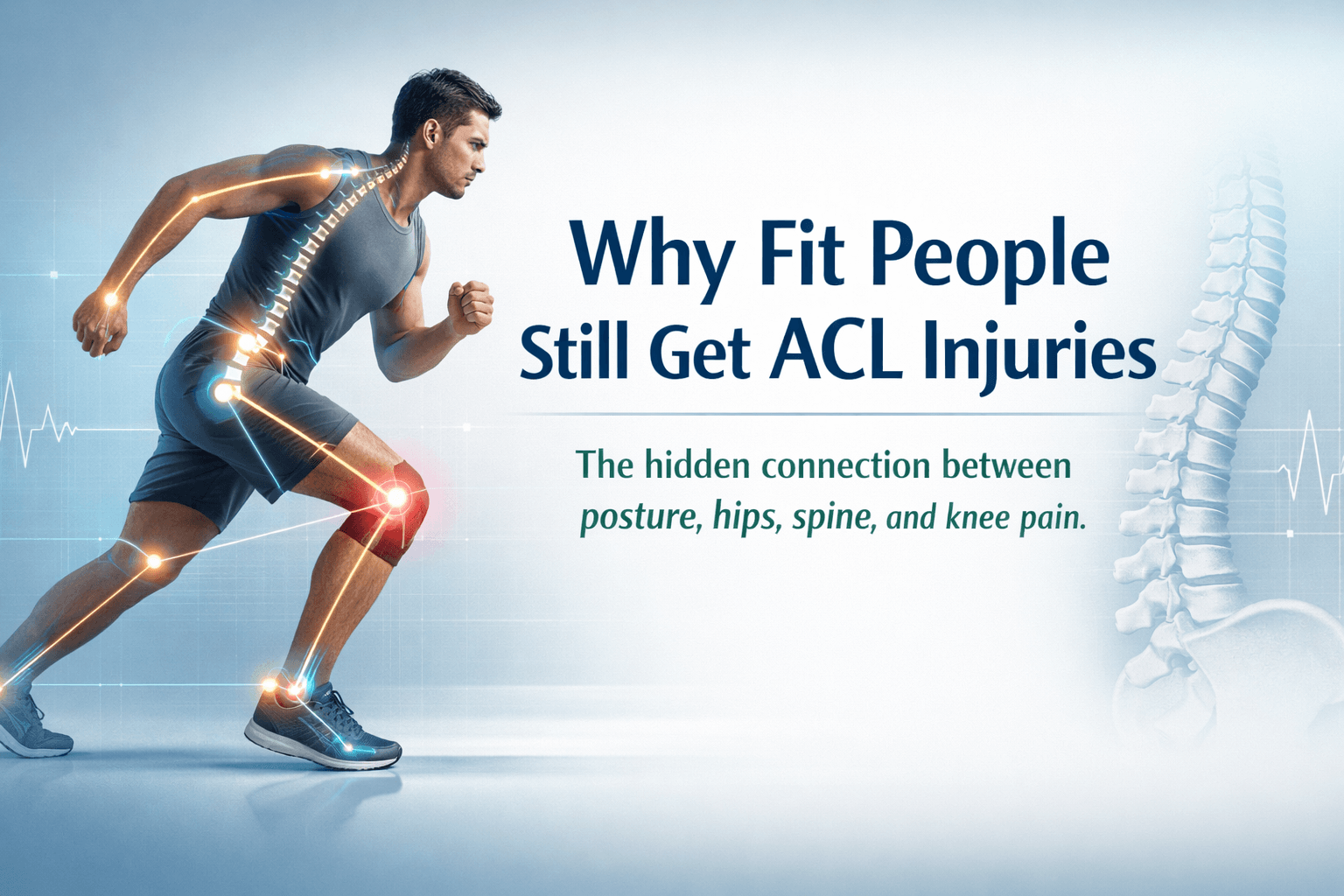
ACL Tears and Knee Pain: Why Active, Healthy People Still Get Injured
You exercise.
You lift weights.
You do resistance training.
You walk everywhere.
You run occasionally.
You make sure your protein intake is enough every day.
You are not overweight. You are disciplined with your health.
So when knee pain suddenly appears—or worse, an ACL tear—the question becomes:
How did this happen to me?
Many active people assume ligament injuries only happen to athletes who push too hard or people who are overweight. But in reality, ACL injuries and chronic knee pain are extremely common among healthy, active individuals.
And here is something many people don't realize:
Your knee problem may not actually start in your knee.
What Is the ACL and Why Does It Tear?
The Anterior Cruciate Ligament (ACL) is one of the most important stabilizing ligaments in the knee joint. It prevents the shin bone from sliding forward and helps control rotational movement.
ACL injuries commonly happen during:
-
Sudden direction changes
-
Pivoting movements
-
Landing from jumps
-
Deceleration during running
-
Poor alignment during weight training
But the real root cause is often deeper than the knee itself.
The Myth: Knee Pain Is Only a Knee Problem
Many people believe knee pain is purely orthopedic and unrelated to spinal care.
But let me ask you a question:
Is your knee connected to your spine?
The answer is yes.
Your body works as a kinetic chain. This means your joints, muscles, and nerves work together as a single system.
When one area loses stability or alignment, the body compensates somewhere else.
Most commonly, knee problems originate from:
-
Hip instability
-
Pelvic imbalance
-
Foot mechanics
-
Postural misalignment
Your spine plays a central role in coordinating all of this.
The Hip–Knee Connection Most People Ignore
In clinical practice, one of the biggest drivers of knee injury is hip dysfunction.
When the hips do not stabilize properly:
-
The knee collapses inward
-
The kneecap tracks incorrectly
-
Ligaments take excessive strain
This is often called valgus collapse, which dramatically increases ACL injury risk.
I can often predict knee pain simply by observing how someone:
-
stands
-
walks
-
loads weight
-
positions their feet
Sometimes even the shape of the foot tells the story.
What Your Feet Can Reveal About Knee Problems
For example, bunions are extremely common among:
-
dancers
-
runners
-
athletes
-
people who train frequently
The medical term for bunions is Hallux Valgus.
Foot instability changes the entire biomechanical chain, affecting:
foot → ankle → knee → hip → spine
If the foot collapses or rotates, the knee compensates.
Over time, this compensation increases ligament stress, leading to:
-
knee clicking
-
chronic pain
-
cartilage wear
-
ligament injuries such as ACL tears
Training Hard Is Not the Same as Moving Correctly
Many active individuals assume that because they train regularly, they are protected from injury.
But the real question is:
Are the right muscles doing the work?
During resistance training or running, many people unknowingly compensate with the wrong muscles.
Common mistakes include:
-
lifting with the lower back instead of the hips
-
knees collapsing inward during squats
-
poor hip positioning while running
-
lack of glute activation
-
weak core stabilization
Without proper alignment, repeated training simply reinforces faulty movement patterns.
Over time, these patterns overload the knee.
Posture: The Missing Link in Injury Prevention
Posture is not just about standing up straight.
It reflects how your entire neuromuscular system organizes movement.
Even subtle imbalances in posture can affect:
-
joint loading
-
muscle recruitment
-
ligament strain
-
balance and stability
This is why continuous postural monitoring is essential for long-term injury prevention.
Modern technologies like posturography and stabilometry allow clinicians to detect small postural deficits before they become injuries.
These assessments help identify:
-
asymmetrical weight distribution
-
balance instability
-
muscular compensation
-
faulty movement patterns
Why We Monitor Posture in the Clinic
Patients sometimes ask why we take posture photos regularly or introduce new exercise challenges during treatment sessions.
There is a reason for this.
These evaluations create a benchmark of your body's alignment and stability.
By tracking posture over time, we can:
-
detect early imbalances
-
adjust treatment strategies
-
retrain proper movement patterns
-
prevent injuries before they happen
Postural analysis helps patients become more aware of their own body mechanics outside the clinic.
Because the goal is not just to treat pain.
The goal is to prevent the next injury.
The Real Goal: Building a Resilient Body
Your body is an incredibly adaptive system.
But adaptation only happens when the right signals are given.
When posture, movement, and muscle activation are aligned, your body becomes:
-
stronger
-
more stable
-
more efficient
-
less prone to injury
Even if you already train hard.
Even if you eat well.
Even if you are disciplined.
Without proper biomechanics, injuries can still happen.
The Posture Test
Try this simple observation.
Stand normally and look in the mirror.
Do your knees collapse inward?
Do your feet rotate outward?
Does one hip drop lower than the other?
These subtle signs can reveal movement imbalances that may eventually lead to knee injuries.
The body always gives signals before the injury happens.
We just have to learn how to read them.
Final Thought: Prevention Is a Skill
Preventing ligament injuries like ACL tears requires more than strength.
It requires awareness.
Awareness of:
-
posture
-
hip positioning
-
foot mechanics
-
muscle activation
-
movement quality
Because sometimes the difference between staying active and suffering a long-term injury is not how hard you train.
It is how well your body moves.
And when you understand your body's mechanics, you gain the ability to protect it for life.
Medical Disclaimer
This article is for educational purposes only and does not constitute medical advice.
Scoliosis varies significantly between individuals. Always consult a qualified healthcare professional before starting any new sport or exercise program, especially if you have scoliosis, spinal conditions, pain, or previous injuries. Participation in sports should be guided by individual assessment and professional recommendation.
The image is shared for educational purposes with patient consent. Individual outcomes vary. Structural correction does not automatically restore full respiratory function. Clinical assessment is required.
Copyright & Content Protection Notice
© 2026 All Well Scoliosis Centre. All rights reserved.
This content is original and protected by copyright law.
No part of this article may be reproduced, distributed, copied, or reused in any form without prior written permission. Unauthorized use, duplication, or content scraping is strictly prohibited.