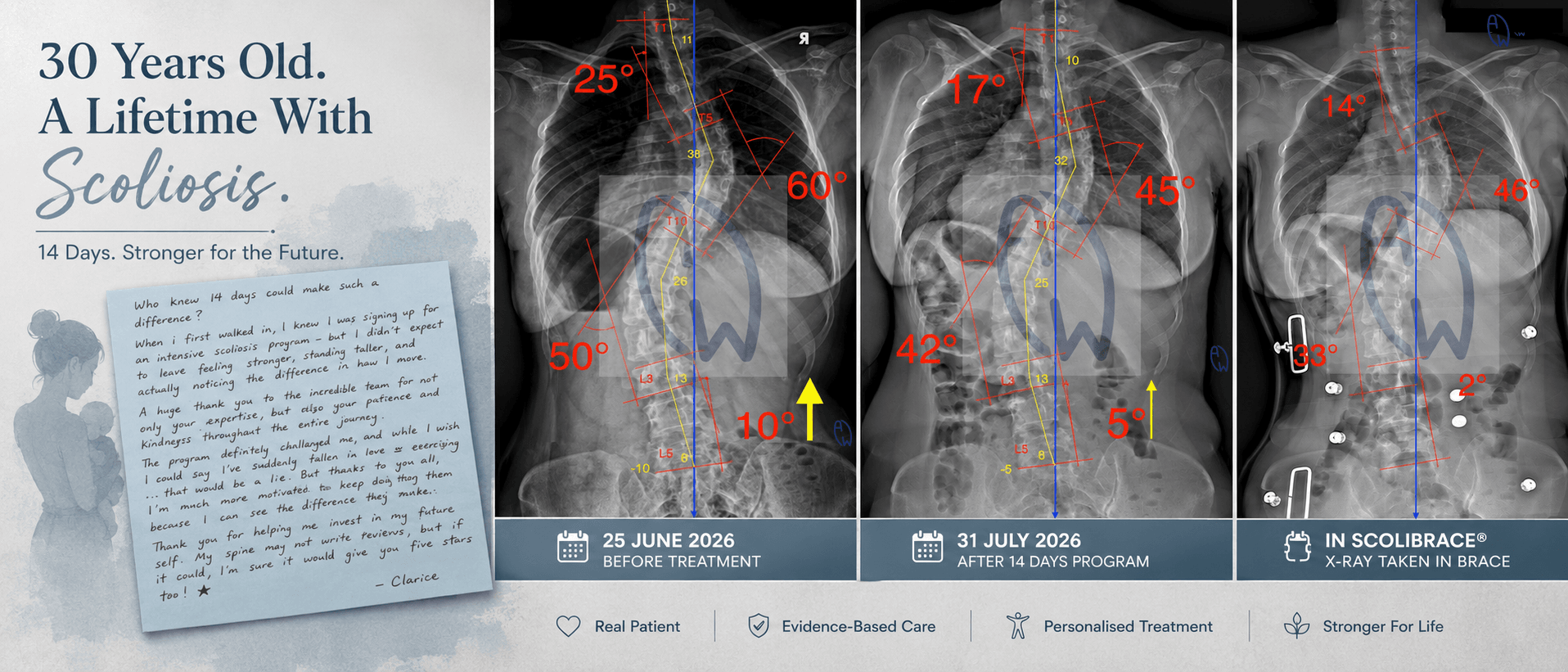
Adult Scoliosis at 30: From Years of Pain and “Wait and See” to Feeling Stronger
A new mother of twins shares why she finally decided to prioritize her spine—and what changed after 14 days of intensive scoliosis care.
“Who knew 14 days could make such a difference?”
For this 30-year-old woman, scoliosis was not something new.
She had lived with it for most of her life.
She had learned to cope with it. She had learned to live with the discomfort. She had followed medical advice to monitor her condition and wait.
But life kept moving.
She built a career in the corporate world.
She got married.
She became a mother.
And then, suddenly, she had two newborn babies depending on her.
At some point, “wait and see” no longer felt like enough.
Not because anyone had failed her.
But because her life had changed.
And she began asking a different question:
“What can I do now to take better care of my body and protect my independence for the future?”
Quick Answer: Can Adults With Scoliosis Still Make Progress?
Yes—but adult scoliosis is different from scoliosis in a growing child or teenager.
Treatment goals for adults may include improving strength and movement, managing symptoms, supporting function, addressing posture and, in selected cases, using bracing or other non-surgical approaches. Learn more about adult scoliosis treatment, pain, mobility and long-term spinal health.
A short intensive program may help someone learn new movement strategies, build strength and become more aware of how they use their body. However, 14 days cannot guarantee permanent correction of a scoliosis curve or a particular Cobb-angle result.
This story is about one woman.
Her X-rays are part of her story.
But perhaps her biggest change was something an X-ray cannot measure:
She left feeling stronger.
She Had Lived With Scoliosis for Most of Her Life
When she first walked into All Well Scoliosis Centre, she already knew what it meant to live with scoliosis.
It had been part of her life for years.
She had experienced pain.
She had adapted her movements.
She had learned to carry on.
And like many people who have lived with a chronic condition for a long time, she had become very good at coping.
But coping is not necessarily the same as thriving.
She was only 30, yet she was already thinking about what her spine might mean for the decades ahead.
Would the pain become worse?
Would her physical ability decline?
Would she eventually lose some of her independence?
And perhaps most frightening of all:
Would she still be able to keep up with her children?
When “Wait and See” Became Years
Earlier in her life, she had been advised to monitor her scoliosis.
Observation can be an appropriate part of scoliosis management in certain circumstances, particularly when a person has stopped growing and a curve is stable or not causing significant problems.
So she waited.
Then she waited some more.
Meanwhile, life happened.
She entered the corporate world.
She built a family.
She became pregnant.
And eventually, she became a mother of twins.
The circumstances were no longer the same as when she had first been told to wait.
The question was no longer simply:
“Is my curve getting worse?”
It became:
“How can I support my body so I can continue doing everything my life now requires?”
That was a very different question.
She Wasn't Just a Corporate Professional Anymore
At 30, she was balancing a demanding corporate life with one of the most physically and emotionally demanding seasons of life:
new motherhood.
And not just one baby.
Twins.
Two little babies who needed to be carried, fed, comforted, bathed and cared for.
There was work.
There were sleepless nights.
There were household responsibilities.
There were endless things that needed her attention.
And underneath all of it was her own body.
A body that had been dealing with scoliosis for years.
A body that had already been experiencing pain.
A body that she had learned to push through.
But motherhood changed the way she looked at her future.
She began to wonder:
“What if one day I can't do all of this anymore?”
That fear was not about vanity.
It was about independence.
It was about being able to pick up her children.
Being able to work.
Being able to travel.
Being able to live her life.
Being able to be the mother she wanted to be.
If pregnancy and motherhood have raised questions about how scoliosis affects the body, delivery or postpartum recovery, see our guide to pregnancy and scoliosis.
The Fear That Kept Her From Exercising
One of the most important parts of her story is something that cannot be seen on an X-ray.
She was afraid to exercise.
Because of previous medical advice and her fear of making her scoliosis worse, she had avoided physical activity for much of her life.
She wasn't someone who came into the program already fit.
She wasn't someone who enjoyed going to the gym.
She wasn't someone who had spent years building strength.
In fact, she had almost the opposite starting point.
She had spent years being careful.
And when you live with scoliosis, it can be easy to become afraid of movement.
But scoliosis does not automatically mean that a person should stop moving or avoid all exercise.
For adults with scoliosis, the more useful question is often not “Should I exercise?” but “What type of movement is appropriate for my spine?”
Our guide to Pilates, yoga, weights and swimming for adults with scoliosis explores how different forms of exercise may fit into an adult scoliosis lifestyle.
For her, learning to move was therefore more than physical training.
It was also about rebuilding confidence in her own body.
She Had Never Really Been Physically Active
This is what made her decision particularly meaningful.
She wasn't starting from a foundation of fitness.
She was starting from fear.
She had spent years thinking that physical activity might make her scoliosis worse.
Now she had to learn that movement could be approached differently.
This is where scoliosis-specific exercise can be useful.
Unlike a generic workout program, scoliosis-specific exercises (PSSE) are designed around the individual's curve pattern, posture, movement and treatment goals.
The objective is not simply to exercise more.
It is to learn how to move more intentionally.
For adults, this may include improving postural awareness, spinal stability, movement control, muscular endurance and confidence in everyday activities.
And that was exactly what she needed to begin rebuilding.
“What If I Lose My Independence?”
This was one of the fears that stayed with her.
She had two newborn babies.
She had a career.
She had a family.
She had a future she wanted to live.
And she did not want to reach a point where her physical condition prevented her from being independent.
That thought became a turning point.
She could continue waiting.
Or she could start doing something.
She chose the second.
She Made a Firm Decision: “I'm Going to Do This.”
There were many reasons why she could have postponed treatment.
She had babies.
She had work.
She had responsibilities.
She had never been physically active.
She was afraid of exercise.
And she was already tired.
But she also had something very important:
determination.
She decided that she was going to commit to 14 days.
Not because someone promised her a perfect spine.
Not because she expected scoliosis to disappear.
But because she realized that continuing to do nothing was no longer the future she wanted.
She wanted to give herself a chance.
Her Mother and Husband Gave Her Something Very Important: Time
Sometimes the hardest part of taking care of yourself is not knowing what to do.
It is finding the space to actually do it.
Her mother and husband supported her throughout the 14-day program.
That support allowed her to temporarily step away from her usual responsibilities and focus on herself.
For 14 days, she did something that many mothers struggle to do:
She put herself on the priority list.
Not above her children.
Not instead of her family.
But alongside them.
Because her health was part of the future she wanted to build with them.
Her 14 days were not simply time away from her babies.
They were an investment in the mother she hoped to remain for many years to come.
Fourteen Days of Doing Something She Had Never Done Before
The intensive program challenged her.
She had to learn movements that were unfamiliar.
She had to work muscles she had not previously trained.
She had to pay attention to posture and body awareness.
And she had to keep showing up.
For someone who had previously avoided exercise because of fear, this was a significant psychological and physical step.
It was not easy.
And she did not pretend that it was.
In her handwritten note after completing the program, she wrote:
“The program definitely challenged me.”
She even joked that saying she had suddenly “fallen in love” with exercise would be a lie.
That honesty is important.
She didn't suddenly become someone who loved exercising.
Something else happened instead.
She began to see why it mattered.
“I'm More Motivated to Keep Doing Them Because I Can See the Difference”
That sentence from her handwritten message may be one of the most important parts of the entire story.
Because lasting change rarely comes from motivation alone.
It often comes from experiencing enough progress to believe that the effort is worthwhile.
She began noticing differences in how she moved.
She felt stronger.
She felt taller.
She became more aware of her body.
And she left with something she had not expected:
motivation to continue.
Not because she loved exercise.
But because she could see a reason to keep doing it.
Scoliosis Is More Than a Sideways Curve
Looking at a scoliosis X-ray, it is tempting to focus on one number.
The Cobb angle.
But scoliosis is more complex than that.
It is a three-dimensional spinal condition, involving not only side-to-side curvature but also vertebral rotation and changes in the spine's front-to-back alignment.
Our article on why scoliosis is three-dimensional explains why evaluating only the Cobb angle does not tell the entire story.
This matters because two people can have similar Cobb angles yet look and function very differently.
For her, the goal was never simply to chase a number.
It was to understand how her whole body was coping with the curve.
What Changed on Her X-Rays?
Her X-rays showed substantial differences in the measured spinal curves between the images provided.
June 25, 2026
The measurements shown on the image included approximately:
-
Upper thoracic curve: 25°
-
Main thoracic curve: 60°
-
Lumbar curve: 50°
-
Lower lumbar measurement: 10°
July 31, 2026
The measurements shown included approximately:
-
Upper thoracic curve: 17°
-
Main thoracic curve: 45°
-
Lumbar curve: 42°
-
Lower lumbar measurement: 5°
In ScoliBrace®
The third image is specifically labeled “in ScoliBrace®” and shows approximately:
-
Upper thoracic curve: 14°
-
Main thoracic curve: 46°
-
Lumbar curve: 33°
-
Lower lumbar measurement: 2°
These differences are visually striking.
But this is where we need to be careful.
Understanding Her Cobb Angle Measurements
The Cobb angle is the standard radiographic measurement used to quantify a scoliosis curve.
You can read more about Cobb angle measurement, severity and treatment in our detailed guide.
However, Cobb-angle measurements have inherent variability.
Differences can occur because of positioning, imaging technique, selection of vertebral endplates and the person performing the measurement.
Therefore, we should not treat every numerical difference between two X-rays as proof of a permanent structural change.
The measurements need to be interpreted alongside the imaging conditions, clinical findings and the patient's overall progress.
Why the In-Brace X-Ray Matters
The third X-ray was taken in ScoliBrace®.
That means the measurements represent the spine while it was being supported by the brace.
An in-brace image can provide information about how the curve responds while corrective forces are being applied.
It should not automatically be interpreted as proof that the same degree of correction would remain when the brace is removed.
You can learn more about scoliosis bracing and 3D ScoliBrace™ and how corrective bracing is used as part of non-surgical scoliosis care.
This distinction is extremely important.
We should not tell a patient:
“Your spine improved by exactly X degrees because of 14 days of treatment.”
That would be too simplistic.
Instead, we can say:
Her X-rays showed meaningful differences during this period, while her clinical experience also showed an important functional change: she felt stronger.
Both pieces of information matter.
Her Biggest Change Wasn't the Cobb Angle
This is where her story becomes much bigger than an X-ray.
Because if we only look at the numbers, we miss the person.
The X-ray doesn't show:
The woman who had lived with scoliosis for years.
The woman who had endured pain.
The woman who was afraid to exercise.
The corporate professional.
The new mother of twins.
The woman who was frightened about losing her independence.
The woman who had to ask her family for help so she could spend 14 days focusing on herself.
And the X-ray certainly doesn't show the determination it took for her to say:
“I'm going to do this.”
She Didn't Start Young. She Started When She Was Ready.
It would be easy to compare her journey with that of a younger patient.
But adult scoliosis is not the same situation as scoliosis in a growing teenager.
A teenager may still have significant skeletal growth remaining.
An adult has different biological, physical and lifestyle considerations.
The goals of treatment can also be different.
So her progress should not be compared directly with that of a younger patient.
But perhaps that is exactly why her story matters.
She did not start early.
She started when she was ready.
And she proved something important to herself:
It was not too late to begin taking care of her body.
What Can 14 Days Do?
Fourteen days cannot erase a lifetime of scoliosis.
It cannot guarantee a permanent change in spinal curvature.
It cannot promise that every patient will experience the same result.
And it should never be presented as a “14-day cure.”
But 14 focused days can provide an important beginning.
Depending on the individual and treatment approach, an intensive program may help a patient:
-
Learn new movement strategies
-
Improve body awareness
-
Begin building strength and control
-
Learn scoliosis-specific exercises
-
Understand how to integrate exercises into daily life
-
Explore whether bracing is appropriate
-
Develop better confidence with movement
-
Establish habits that can continue after the intensive program
This is one reason All Well's approach combines different components rather than relying on a single intervention. You can learn more about why one scoliosis therapy alone is usually not enough.
For this patient, the most important outcome was simple:
She felt stronger.
What 14 Days Cannot Guarantee
It is equally important to understand what an intensive program cannot promise.
Fourteen days cannot guarantee:
-
A permanent reduction in Cobb angle
-
Elimination of scoliosis
-
Elimination of pain
-
Prevention of future progression
-
Avoidance of surgery
-
The same result in another patient
Scoliosis is highly individual.
The type of curve, age, skeletal maturity, structural characteristics, symptoms, physical condition and many other factors can influence management and outcomes.
That is why this is a patient story, not a promise.
Can Adults With Scoliosis Exercise?
This was one of her biggest questions.
The answer is generally yes.
Having scoliosis does not automatically mean that someone needs to stop moving or avoid all exercise.
But “exercise with scoliosis” should not mean blindly following a generic workout program.
The right approach depends on the individual.
Someone with significant pain, neurological symptoms, major structural changes or other medical conditions may need additional assessment and specific restrictions.
For this patient, the goal was not to turn her into an athlete.
It was to help her become more capable in her own body.
If you're unsure where to start, our guide to movement practices for adults with scoliosis explores Pilates, yoga, resistance training and swimming, as well as why personalization matters.
Can a 30-Year-Old Still Do Something About Scoliosis?
This is perhaps the question we hear most often.
“Isn't it too late?”
Thirty is not the same as 13.
Treatment expectations must be realistic.
But being an adult does not mean you have to stop caring about your spine.
Adult scoliosis can be managed in different ways depending on the individual, including observation, exercise-based approaches, symptom management, bracing in selected situations and, when indicated, surgery.
Our adult scoliosis treatment guide discusses the importance of pain management, mobility, function and maintaining independence as adults navigate scoliosis.
The right question is therefore not:
“Can I make my spine look like a teenager's?”
A better question may be:
“What can I do now to improve my strength, movement, function and quality of life?”
That is the question she decided to ask.
Her Body Wasn't Betraying Her
Perhaps one of the most meaningful lessons from her journey is this:
Her body had been coping.
For years, her muscles and movement patterns had adapted to the shape of her spine.
She had found ways to work.
Ways to stand.
Ways to move.
Ways to carry on.
Her body had helped her through pregnancy.
Through childbirth.
Through sleepless nights.
Through work.
Through motherhood.
Through pain.
It wasn't simply a body that had “failed.”
It was a body that had been trying to keep going.
And now she wanted to give it more support.
That change—from simply enduring to actively caring for herself—may be one of the most important outcomes of her journey.
Better Posture Is Part of the Bigger Picture
Her journey also highlighted something many adults with scoliosis notice: posture and body awareness.
But posture needs to be understood correctly.
Good posture can support comfort, movement efficiency and muscular balance, but poor posture does not simply cause structural scoliosis, and “sitting up straight” does not cure it.
Our article Posture and Scoliosis: Does Sitting Up Straight Really Help? explains the difference between healthy posture and structural scoliosis.
For her, posture was not about forcing herself to stand perfectly all day.
It was about learning how her body moved and developing better control.
Sometimes Taking Care of Yourself Is Part of Taking Care of Your Family
There is something particularly powerful about her story as a new mother.
Mothers often put themselves last.
The babies come first.
Work comes first.
The household comes first.
Everyone else's needs come first.
And eventually, there is very little time left for the person carrying all of it.
Her 14 days reminded her that prioritizing herself did not mean she loved her family any less.
In fact, it was the opposite.
She wanted to remain strong.
She wanted to remain independent.
She wanted to be able to care for her children.
She wanted to be present for the future she was building.
Sometimes investing in yourself is not selfish.
Sometimes it is an investment in everyone who depends on you.
Her Biggest Win Was Feeling Stronger
We could spend the entire article talking about the X-ray numbers.
60°. 45°. 50°.
42°. 33°. 25°.
17°. 14°.
Those numbers are interesting.
But they don't tell the entire story.
Her biggest win was not a particular number.
It was this:
She felt stronger.
For someone who had spent years afraid of physical activity, that is significant.
For someone raising newborn twins, that is significant.
For someone who had spent years living with scoliosis and pain, that is significant.
For someone who feared losing her independence, that is significant.
And for us, that was already good enough.
Another Adult Scoliosis Story
Her experience is one example of how different adult scoliosis cases can look.
Another adult patient at All Well began treatment in her 30s with a very different presentation. Her X-rays showed a more flexible curve that changed substantially over several months of rehabilitation and corrective bracing.
You can read her adult scoliosis X-ray journey and see why age alone does not tell us how an individual spine will respond.
The important lesson is not that every adult will achieve the same X-ray changes.
It is that every adult scoliosis case deserves individual assessment rather than assumptions based on age alone.
For another example of a more severe adult presentation, you can also read this severe adult scoliosis case study involving CLEAR rehabilitation and ScoliBrace™.
What Her Story Teaches Us
Her story does not mean every 30-year-old with scoliosis should expect the same X-ray changes.
It does not mean 14 days is enough to treat every adult scoliosis case.
It does not mean scoliosis can be cured without surgery.
And it does not mean that everyone needs an intensive program.
What it does show is something much more human.
You can start late.
You can start afraid.
You can start without being physically active.
You can start while life is busy.
You can start after years of waiting.
And you can still make the decision to take better care of yourself.
Life Goes On. So What Will You Do With It?
She could have continued waiting.
She could have continued telling herself that she was too busy.
She could have continued putting herself last.
She could have continued being afraid of movement.
Instead, she made a decision.
Not a promise of a perfect spine.
Not a promise of a pain-free future.
Just a decision:
“I need to do something about this.”
Fourteen days did not erase a lifetime of scoliosis.
But she walked away feeling stronger.
And sometimes, stronger is where the future begins.
Frequently Asked Questions About Adult Scoliosis
Can scoliosis get worse after age 30?
Adult scoliosis can behave differently depending on the type of scoliosis, the size and characteristics of the curve, degenerative changes and other individual factors. If you are concerned about progression, assessment and periodic monitoring can help establish what is happening with your spine.
You can also explore our adult scoliosis treatment guide for more information.
Is it too late to treat scoliosis at 30?
No. Being 30 does not mean there is nothing you can do.
Treatment goals may be different from those of a growing child and can include managing symptoms, improving strength and function, developing movement strategies and, in selected situations, considering bracing or other non-surgical care.
Can adults with scoliosis exercise?
Generally, yes.
The type of exercise should be individualized, particularly when someone has significant pain or other medical concerns.
Read more about exercise and movement for adults with scoliosis.
Can exercise cure scoliosis?
Exercise should not be described as a cure for scoliosis.
Scoliosis-specific exercise may help improve posture, body awareness, strength, movement control and function, but outcomes vary between individuals.
Learn more about PSSE and scoliosis-specific exercise.
Can an adult wear a scoliosis brace?
In selected cases, adults may use a custom brace as part of a broader treatment strategy.
The role of bracing in adults is different from bracing during skeletal growth, so assessment is important.
Learn more about 3D scoliosis bracing and ScoliBrace™.
Can a scoliosis brace permanently straighten an adult spine?
An in-brace X-ray shows how the spine appears while the brace is applying corrective forces.
It should not automatically be interpreted as proof of permanent correction after the brace is removed.
What does a Cobb angle measure?
The Cobb angle is a radiographic measurement used to quantify the degree of a spinal curve.
Read our detailed guide to Cobb angle measurement, severity and scoliosis treatment.
Is scoliosis only a sideways curve?
No.
Scoliosis is a three-dimensional spinal condition involving side-to-side curvature, vertebral rotation and changes in front-to-back spinal alignment.
Learn more in Why Scoliosis Is Three-Dimensional.
Can scoliosis be cured without surgery?
Scoliosis should not be marketed as something that can simply be “cured” through a short non-surgical program.
Non-surgical care may help with symptoms, function, movement, posture and other aspects of scoliosis management, depending on the individual.
What is the goal of adult scoliosis treatment?
The goal depends on the individual.
It may include maintaining or improving function, managing pain, improving strength and movement, supporting posture, monitoring the curve and addressing progression or other complications when appropriate.
Read more about adult scoliosis and long-term spinal health.
A Note About This Patient Story
This article describes the experience of one 30-year-old woman who underwent a 14-day intensive scoliosis program.
Her experience and X-ray changes should not be interpreted as a guarantee of what another person will experience.
The X-ray measurements shown in this story are the measurements displayed on the provided images. The final image is specifically labeled “in ScoliBrace®”, and therefore should not be interpreted as equivalent to an out-of-brace measurement or as proof of permanent correction.
Cobb-angle measurements can vary between assessments because of positioning, image quality, end-vertebra selection and measurement technique.
Individual scoliosis treatment should be based on appropriate clinical assessment and medical advice.
The Takeaway
You may have lived with scoliosis for years.
You may have been told to wait and see.
You may have learned to live with the pain.
You may have stopped exercising because you were afraid of making things worse.
You may have a demanding career.
You may have children who need you.
You may feel that you have already waited too long.
But your future is still worth investing in.
You don't have to become an athlete.
You don't have to love exercise.
You don't have to start young.
You simply have to decide that your future self deserves your attention too.
Because life goes on.
And you deserve to be strong enough to live it.
Continue Reading
For adults living with scoliosis:
About This Patient Story
This story is based on a real patient experience at All Well Scoliosis Centre and is shared with permission. Patient experiences vary, and treatment outcomes cannot be guaranteed.