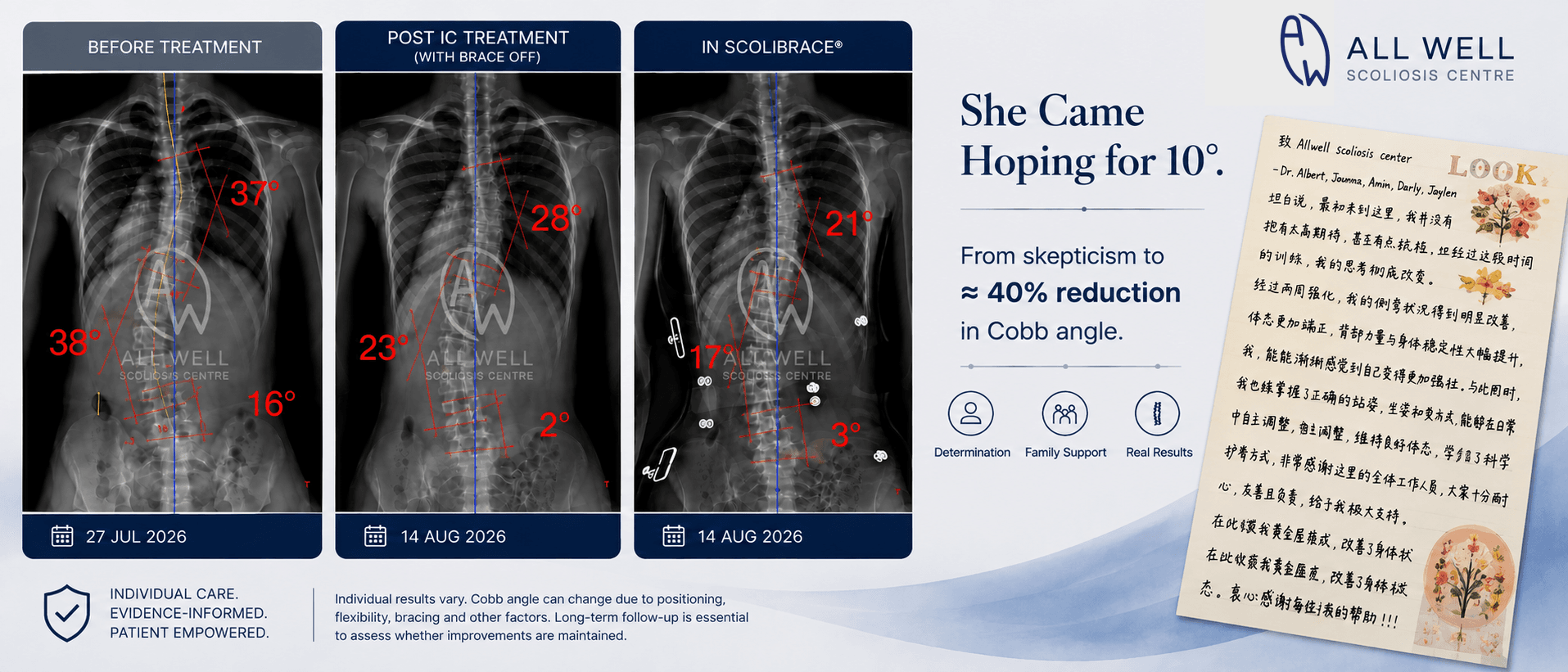
Scoliosis Success Story: She Came Hoping for 10°. Her X-Rays Told a Bigger Story.
She arrived skeptical after a previous treatment experience in Shanghai. She thought a 10° improvement would already be enough. After 14 treatment days, her X-rays revealed meaningful changes across multiple measured spinal curves—but the most remarkable transformation wasn't just on the X-ray.
Quick Answer: Can a Cobb Angle Improve?
Yes. In some patients, Cobb angle measurements can decrease following individualized scoliosis treatment. In this case, one measured curve changed from 38° to 23°, a 15° difference, representing an approximately 40% reduction. Other measured curves also improved during the same treatment period.
However, this is an individual patient's outcome—not a guaranteed result. Cobb angle measurements can vary depending on positioning, spinal flexibility, and how the X-ray is taken and measured. Long-term follow-up remains essential to determine whether those changes are maintained over time.
The initial X-ray was taken on 27 July 2026, and the post-treatment X-ray was taken on 14 August 2026. Although these dates are 18 calendar days apart, she completed 14 actual treatment days, with four days falling on public holidays.
And perhaps that's what makes this story so meaningful.
It isn't simply about numbers.
It's about trust, perseverance, and discovering what becomes possible when someone commits wholeheartedly to their own health.
She Didn't Come Looking for a Miracle
When she first walked into All Well Scoliosis Centre, she carried something heavier than her scoliosis.
She carried disappointment.
Before coming to Singapore, she had already undergone scoliosis treatment in Shanghai. Like many patients who have tried something before without seeing the outcome they hoped for, she didn't arrive expecting dramatic promises.
She arrived cautious.
She arrived skeptical.
And honestly, we respected that.
She wasn't asking for perfection.
She wasn't asking for a miracle.
She quietly told us that if her curve improved by 10 degrees, she would already consider that a success.
That sentence stayed with us.
Because it revealed something important.
She wasn't looking for someone to convince her.
She simply wanted a reason to believe again.
We Never Promised Her 40%
One thing matters deeply to us.
We never told her that we could reduce her curve by 40%.
We never promised a specific number.
Every scoliosis spine is different.
Age, growth, curve pattern, spinal flexibility, rotation, muscle control, and brace compliance can all influence how an individual responds. Responsible scoliosis care isn't built on guarantees.
It's built on partnership.
We explained the process.
She chose to trust it.
And then she did something that cannot be prescribed.
She showed up.
Every treatment day.
Fourteen Treatment Days. Three Curves. A Remarkable X-Ray.
Her first standing X-ray was taken on 27 July 2026.
Her post-treatment X-ray was taken on 14 August 2026.
Although the X-rays were taken 18 calendar days apart, she completed 14 treatment days during that period, with four days being public holidays.
And after those 14 treatment days, the X-ray showed something encouraging.
The most prominent measured curve had changed from 38° to 23°.
That is a 15° difference.
Mathematically, the calculation is straightforward:
38 minus 23 equals 15.
Fifteen divided by 38 equals 39.5%.
Rounded, that's approximately 40%.
But as we looked more closely, we realized the story didn't end there.
The upper measured curve had also changed—from 37° to 28°, a 9° reduction, or approximately 24.3%.
Then we noticed the lower measured curve.
It had changed from 16° to 2°—a 14° reduction, representing approximately 87.5% for that particular measured angle.
Three measured curves.
Three different changes.
Three reminders that scoliosis is never just one number.
Then Came the Third X-Ray
The third image may actually be the most educational.
This X-ray was taken while she was wearing her ScoliBrace®.
Instead of simply showing what happened after treatment, it demonstrated how her spine responded while supported by the corrective brace.
The measured curves appeared at approximately 21°, 17°, and 3°.
This is an important distinction.
The second X-ray was taken with the brace off.
The third was taken in the brace.
They answer different questions.
One shows how her spine aligned after intensive treatment without the brace.
The other demonstrates how the brace supports corrective positioning while it is being worn.
Neither should be interpreted in isolation.
Together, they tell a more complete story.
What the Cobb Angle Tells Us
If you've recently been told that you or your child has scoliosis, you've probably heard the phrase Cobb angle.
It is the standard measurement used to describe the degree of spinal curvature on an X-ray.
A curve measuring 10° or more is generally considered scoliosis.
But here's something many families don't realize at first.
The Cobb angle isn't the whole story.
It measures the sideways curve visible on a standing X-ray.
It does not fully describe rotation.
It does not fully describe posture.
It does not fully describe balance.
And it certainly doesn't describe a person's confidence, determination, or quality of life.
Scoliosis is a three-dimensional condition, which is why experienced clinicians also evaluate spinal rotation, posture, movement patterns, and overall function—not just one measurement on one X-ray.
Related reading: Cobb Angle in Scoliosis: Measurement, Severity & Treatment
Learn more: Why Scoliosis Is Three-Dimensional
Why We Celebrate Carefully
Looking at these X-rays, it would be easy to celebrate and stop there.
But we don't believe that would tell the whole truth.
The initial and post-treatment X-rays were taken on 27 July and 14 August, respectively.
During that period, she completed 14 treatment days, with four days falling on public holidays.
That means these findings are encouraging—but they are still early.
Cobb angle measurements can be influenced by positioning, spinal flexibility, muscle activation, and imaging technique.
More importantly, the real question isn't simply:
"What happened during those 14 treatment days?"
The real question is:
"What happens six months later?"
That is the X-ray we are most excited to see.
Because maintaining progress is often more meaningful than achieving an early improvement.
She Didn't Just Receive Treatment—She Participated
This is where the story becomes bigger than scoliosis.
Every treatment day she showed up.
She practiced.
She learned.
She adjusted.
She listened.
She became increasingly aware of her posture.
She became increasingly responsible for her own body.
That transformation cannot be measured in degrees.
A clinic can provide assessment.
A clinic can provide treatment.
A clinic can provide education.
A clinic can provide bracing.
A clinic can provide scoliosis-specific exercises.
But no clinic can develop discipline on behalf of a patient.
She developed that herself.
And that deserves recognition.
Related reading: Scoliosis-Specific Exercises (PSSE)
Her Parents Were Quiet Heroes
There is another part of this story that deserves attention.
Her parents never stopped supporting her.
They encouraged her.
They helped make consistency possible.
But they also allowed something equally important to happen.
They allowed her to become responsible for her own health.
For parents reading this, that balance matters.
Children borrow confidence.
Teenagers build it.
Eventually, they begin saying:
"This is my body."
"This is my responsibility."
That shift may be one of the greatest victories of all.
Her Own Words Say It Best
One of our favorite parts of this journey isn't actually the X-ray.
It's the handwritten letter she left for our team.
In her note, she wrote that she had arrived with hesitation after her previous experience.
She admitted she hadn't expected too much.
She described becoming stronger, feeling more stable, standing more upright, and learning how to correct herself during everyday life.
She thanked our team for being patient, caring, and supportive throughout the process.
Reading her words reminded us of something important.
The X-ray documents the physical change.
Her letter documents the human one.
Together, they tell a much richer story.
What We Hope Other Families Take Away
If there is one lesson from her journey, it is this.
Don't let a previous disappointment decide your future.
Don't expect promises.
Expect partnership.
Don't underestimate consistency.
Don't underestimate family support.
And don't judge your entire scoliosis journey by one number.
Because sometimes the biggest transformation isn't simply going from 38° to 23°.
Sometimes it's going from doubt...
...to confidence.
We'll See You in Six Months
Her intensive treatment has ended.
But her journey hasn't.
The next chapter is about maintaining what she has built.
Continuing healthy movement.
Following her prescribed bracing plan.
Practicing the exercises she learned.
Living with greater awareness of her posture.
And returning in six months so we can see what the next X-ray reveals.
The first X-ray showed us what was possible.
The next one will help us understand what she has maintained.
We couldn't be more proud of her.
And we can't wait to welcome her back.
Frequently Asked Questions
Can a Cobb angle improve?
Yes. Some patients demonstrate measurable changes in Cobb angle, although outcomes vary depending on age, growth, curve characteristics, treatment, and individual response.
What changed in this patient's X-rays?
Her measured curves changed from 37° to 28°, 38° to 23°, and 16° to 2° between her initial and post-treatment X-rays. An additional X-ray taken in ScoliBrace showed further in-brace correction at approximately 21°, 17°, and 3°.
How many treatment days did she complete?
She completed 14 treatment days. The initial X-ray was taken on 27 July and the post-treatment X-ray on 14 August. Four days during that period were public holidays, the clinic closed. So the total calendar interval was 18 days, but the actual treatment period consisted of 14 days.
Does a 40% reduction mean scoliosis is cured?
No. The approximately 40% figure specifically refers to the change in one measured Cobb angle—from 38° to 23°. Scoliosis is a three-dimensional condition, and long-term monitoring remains important.
Why is the six-month follow-up important?
Because one X-ray is only a snapshot. The six-month follow-up helps determine whether the improvements observed early in treatment are maintained as the patient returns to everyday life.