"I Thought My Back Pain Was Normal." The X-Ray That Changed Everything.
"I'm only in my 30s. I exercise. I'm strong. Why does my mid-back always hurt?"
That was the question one of our patients had been asking herself for years.
She wasn't someone who complained.
She worked, stayed active, exercised regularly, and lived a full life. Friends and family would never have guessed there was anything wrong.
But there was one thing she could never quite ignore.
A persistent ache in the middle of her back.
Not severe enough to stop her from living.
Just enough to constantly remind her that something didn't feel right.
Like many adults, she convinced herself it was normal.
"Maybe I slept badly."
"Maybe I just need another massage."
"I probably need to stretch more."
"Perhaps I should strengthen my core."
So that's exactly what she did.
She stretched.
She exercised.
She had massages.
She foam rolled.
She tried all the typical routines recommended for back pain.
Each one helped...
For a while.
But the pain always came back.
Sometimes Your Body Is Trying to Tell You Something
Deep down, she suspected there was more to the story.
She couldn't explain it.
She was fit.
She was strong.
She was mentally resilient.
Yet her back never truly felt right.
Eventually, she gathered the courage to do something she had been putting off for years.
She decided to stop guessing.
She decided to have a standing spinal X-ray.
That decision changed everything.
The Surprise Hidden Inside the X-Ray
When she first saw her X-ray, she was stunned.
She had never been told she had scoliosis.
She wasn't expecting to see a spine that curved as much as it did.
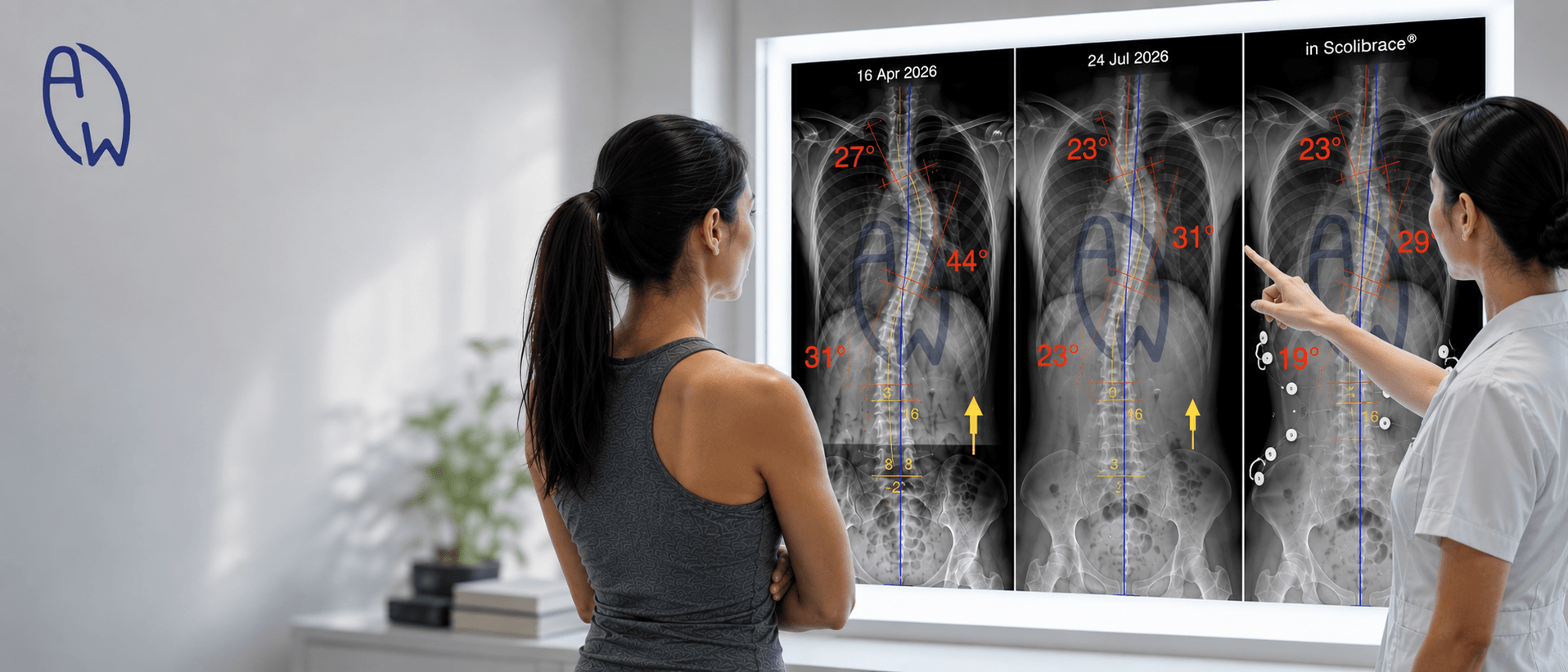
Her main thoracic curve measured approximately 44°, with additional compensatory curves above and below.
Suddenly, years of unexplained discomfort finally made sense.
The tight muscles.
The recurring mid-back pain.
The feeling that one side of her body always seemed to work harder than the other.
None of it was "just getting older."
Her spine had been compensating for years.
This Is Why We Always Recommend an X-Ray First
One of the most common questions we receive is:
"Can't you just assess me without an X-ray?"
Our answer is almost always the same.
We can assess your posture.
We can assess your movement.
But without seeing the spine itself...
We're still making educated guesses.
An X-ray doesn't just tell us if you have scoliosis.
It shows:
-
The size of the curves.
-
Where the curves begin and end.
-
How your spine rotates.
-
How your body compensates.
-
Whether your head, shoulders and pelvis are balanced.
-
How to design rehabilitation specifically for your spine.
Without this information, treatment becomes generic.
With it, treatment becomes personalised.
Strong People Can Still Have Significant Scoliosis
One of the biggest myths about scoliosis is that larger curves always cause severe disability.
They don't.
Many adults with moderate or even severe scoliosis continue to:
-
Go to work every day.
-
Exercise regularly.
-
Lift weights.
-
Run.
-
Play sports.
-
Raise families.
Their bodies become incredibly good at adapting.
Strong muscles can hide scoliosis for years.
But adaptation isn't the same as efficiency.
When the spine is asymmetrical, the body constantly compensates.
Some muscles work overtime.
Others become weak.
Certain joints become overloaded.
Over months and years, those compensations begin showing up as:
-
Recurring muscle tightness.
-
Persistent mid-back pain.
-
Neck stiffness.
-
Fatigue.
-
One shoulder always feeling tighter.
-
The same muscles becoming sore after every massage.
Sound familiar?
Why Massage, Stretching and Exercise Only Gave Temporary Relief
This is something we explain to many adult patients.
Massage isn't wrong.
Stretching isn't wrong.
Strength training isn't wrong.
They simply don't correct the underlying alignment by themselves.
Think of it like this.
Imagine driving a car with its wheels out of alignment.
You can wash it.
Polish it.
Inflate the tyres.
Even install new seats.
The car might feel better for a while.
But unless the alignment is corrected...
It will continue wearing unevenly.
Your spine works much the same way.
Many adults spend years treating the muscles.
Very few realise the muscles are reacting to the spine beneath them.
The Three X-Rays Tell a Bigger Story Than the Numbers
Many people immediately look at the Cobb angle.
And yes, measuring the curve is important.
But look beyond the numbers.
The first X-ray shows a body that has shifted away from the centre.
The second X-ray already begins showing improved balance.
By the third X-ray, while wearing her ScoliBrace®, the spine is gradually becoming more centred over the pelvis.
Notice how the body is moving closer towards the vertical blue line.
That blue line represents the body's centre of gravity.
The closer the body becomes to that centre, the more efficiently it can support itself.
Some people might look only at the Cobb angles and say,
"The numbers only changed a little."
But scoliosis rehabilitation is much more than chasing a number.
It is about improving the way the entire body functions.
Better balance.
Better posture.
Better muscle coordination.
Less compensation.
Less strain on the joints.
Better quality of life.
Sometimes the biggest improvement isn't measured in degrees.
It's measured in how someone feels every morning when they get out of bed.
Learning to Build Strength in the Right Position
Once she understood her X-ray, everything changed.
She stopped exercising blindly.
Instead, every exercise now had a purpose.
Her rehabilitation focused on:
-
Building muscle in a more corrective posture.
-
Retraining muscles that had been underused for years.
-
Reducing unnecessary compensation.
-
Improving body awareness.
-
Teaching her nervous system a healthier movement pattern.
Her ScoliBrace® became more than just a brace.
It became a guide.
It gently reminded her body what better alignment felt like while she trained the muscles responsible for maintaining it.
Over time, she didn't just become stronger.
She became more aware.
She understood how to engage her body more efficiently.
That awareness is something no massage can provide.
The Hardest Step Wasn't Wearing the Brace
It Was Accepting the Truth.
She admitted that taking the X-ray was frightening.
Part of her worried about what it might reveal.
Another part hoped there was nothing wrong.
But avoiding the truth doesn't make it disappear.
Facing it gave her something far more valuable.
Clarity.
Instead of asking,
"Why does my back always hurt?"
She could finally ask,
"What can I do about it?"
That single shift changes everything.
Vulnerability Can Become Your Greatest Strength
Receiving a diagnosis can feel overwhelming.
But it can also be incredibly empowering.
Because once you understand your body, you stop wasting energy guessing.
You stop chasing temporary relief.
You begin making decisions based on knowledge instead of hope.
Accepting scoliosis isn't giving up.
It's taking ownership.
And ownership creates progress.
Progress Requires Patience
Your body doesn't change overnight.
Muscles need time to strengthen.
Your brain needs time to learn new movement patterns.
Connective tissues adapt gradually.
Posture improves through thousands of small corrections—not one big moment.
Some improvements are measured on an X-ray.
Others are measured by:
-
Walking longer without discomfort.
-
Sleeping better.
-
Feeling stronger.
-
Sitting longer at work.
-
Having fewer muscle spasms.
-
Enjoying daily life again.
Trust the process.
Trust the repetition.
Trust your body's ability to adapt.
Could This Story Be Yours?
One of the saddest things we hear is:
"I wish I had known sooner."
Many adults discover scoliosis in their 30s, 40s, or even 50s.
Not because the scoliosis suddenly appeared.
But because no one ever looked.
If you've been living with recurring back pain that never seems to completely resolve...
If massage only helps for a few days...
If stretching temporarily relieves the tension but it always comes back...
If one side of your body constantly feels tighter than the other...
Perhaps it's time to stop guessing.
Perhaps it's time to actually see your spine.
An X-ray doesn't create fear.
It creates understanding.
And understanding gives you options.
The Biggest Change Wasn't Her Spine
Looking at these three X-rays, many people will naturally focus on the Cobb angle.
We don't.
What we see is a woman who finally understood her own body.
For years, she was fighting symptoms.
Today, she is addressing the cause.
She no longer fears movement.
She moves with purpose.
She trains with intention.
She understands how to engage her body instead of simply pushing through discomfort.
That is the true transformation.
At All Well Scoliosis Centre, our goal isn't simply to help people understand their X-rays.
Our goal is to coach them through the journey that follows.
Because when knowledge replaces uncertainty, and awareness replaces fear, lasting change becomes possible.
The first step isn't having all the answers.
Sometimes, it's simply having the courage to look at the truth—and deciding that from this day forward, you're going to build the strongest version of yourself.