I'm in My 30s. Can My Scoliosis Still Improve?
"I know my scoliosis won't get better."
"I just want the pain and tightness to stop."
Those were the first words this patient said when she walked into our clinic.
She was in her 30s.
Like many adults with scoliosis, she believed she had already missed her opportunity. She had always assumed that scoliosis only changed during adolescence and that once you reached adulthood, treatment could only help manage pain—not improve the curve itself.
She wasn't asking for a straighter spine.
She simply wanted to wake up without feeling stiff, tight, and uncomfortable every day.
What happened over the following months surprised even her.
Her X-ray Journey
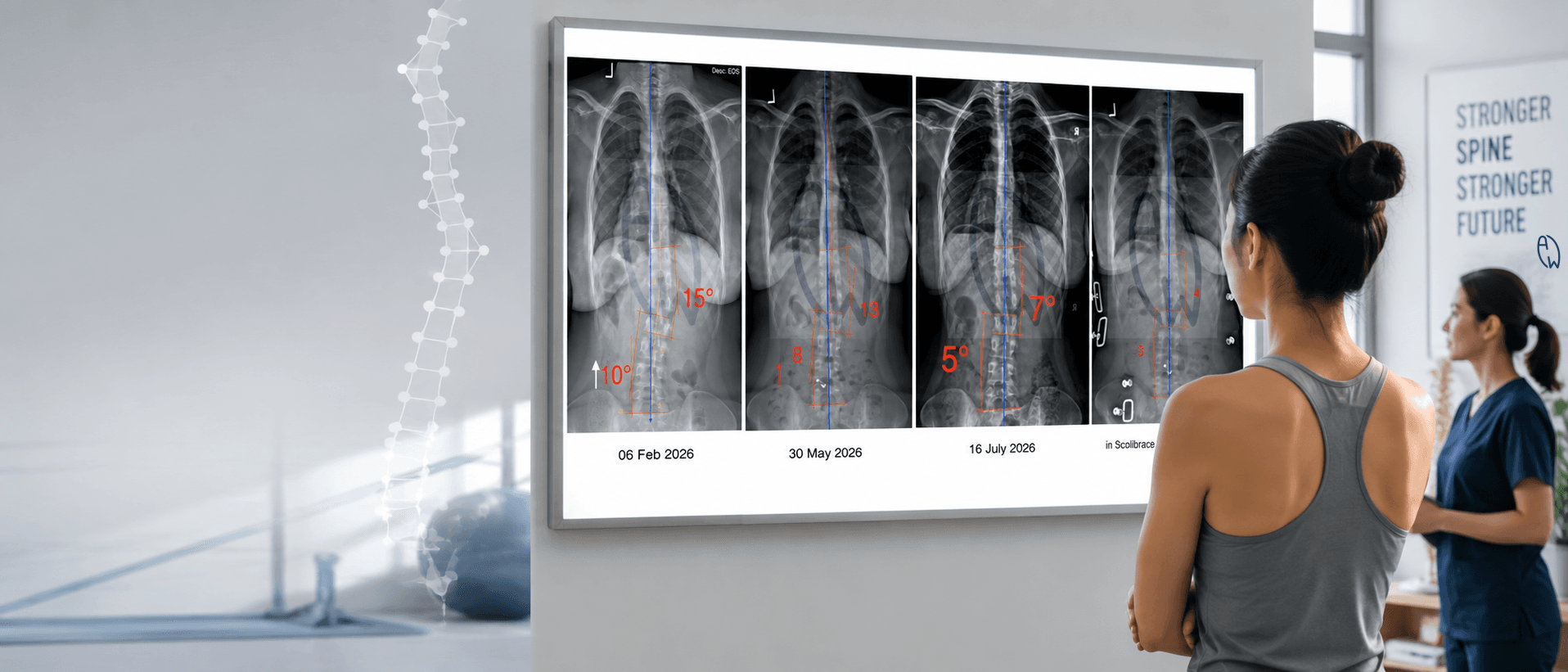
From left to right, these X-rays show her progress over time.
6 February 2026
-
Thoracic Cobb angle: 15°
-
Lumbar Cobb angle: 10°
30 May 2026
-
Thoracic Cobb angle: 13°
-
Lumbar Cobb angle: 8°
16 July 2026
-
Thoracic Cobb angle: 7°
-
Lumbar Cobb angle: 5°
In ScoliBrace®
-
Thoracic Cobb angle: 4°
-
Lumbar Cobb angle: 3°
At first glance, these may seem like small changes.
But in scoliosis rehabilitation, every degree matters.
Each improvement represents a spine that is becoming more balanced, muscles that are learning to work more efficiently, and less uneven stress being placed on the body.
More importantly, these X-rays tell a story that numbers alone cannot.
They tell the story of consistency.
Why Did Her Spine Respond?
One of the first questions people ask when they see these X-rays is:
"Why was she able to improve?"
The answer is that not every scoliosis behaves in the same way.
Some scoliosis curves are very rigid because the bones of the spine have developed structural changes over many years. These curves are generally much less flexible and are often more challenging to change.
Other curves remain much more flexible. They can be influenced by muscle imbalance, posture, movement patterns, pelvic alignment, or other factors affecting how the body supports the spine.
This is often referred to as functional scoliosis, or a flexible scoliosis.
Think of it like bending a young tree.
A flexible tree can still be gently guided as it grows.
A mature tree is much stiffer and far more difficult to reshape.
Likewise, some adult spines still retain enough flexibility to respond to rehabilitation, while others become much more rigid over time.
This patient's clinical presentation suggested that her spine still had meaningful flexibility, allowing it to respond well to a combination of rehabilitation, corrective exercises, and bracing.
That does not mean every adult will experience the same result.
Every scoliosis is unique.
💡 Did You Know?
Many adults believe scoliosis stops changing after adolescence.
While rapid progression is most common during growth, the adult spine is still a living, adaptable structure.
Muscles can become stronger.
Posture can improve.
Balance can improve.
Pain can decrease.
And in some adults with flexible curves, the Cobb angle may also improve with appropriate rehabilitation.
The first step is determining what type of scoliosis you have.
The Cobb Angle Is Only Part of the Story
When doctors diagnose scoliosis, one of the most important measurements is the Cobb angle.
The Cobb angle measures the size of the spinal curve on an X-ray and helps determine the severity of scoliosis.
It is an essential tool for monitoring whether a curve is stable, progressing, or responding to treatment.
But the Cobb angle only measures the curve.
It does not measure determination.
It does not measure discipline.
It does not measure consistency.
Those qualities cannot be seen on an X-ray.
Yet they often make the biggest difference.
Treatment Didn't Create These Results
It is easy to look at these X-rays and think,
"The treatment fixed her."
That isn't the whole story.
Treatment provides direction.
The therapist provides guidance.
The brace provides support.
The exercises provide the opportunity.
The patient creates the result.
She showed up.
She completed her exercises.
She changed daily habits that had contributed to years of muscle imbalance and poor movement patterns.
She continued even on days when motivation was low.
These X-rays are not simply a reflection of rehabilitation.
They are a reflection of her commitment.
"I'm Already in My 30s."
This is probably the sentence we hear most often.
Many adults assume they have missed their opportunity because they are no longer growing.
While adult scoliosis is different from adolescent scoliosis, age alone does not determine whether improvement is possible.
Some adult curves are very rigid.
Others remain surprisingly flexible.
That is why every patient deserves a proper assessment before being told what is or isn't possible.
Never let your age decide your outcome before your spine has even been evaluated.
A Few Degrees Can Change More Than You Think
Some people look at a Cobb angle reducing from 15° to 7° and ask,
"Is eight degrees really worth all that effort?"
Absolutely.
Those eight degrees represent:
-
Better muscle balance
-
Improved posture
-
More efficient movement
-
Less uneven loading through the spine
-
Greater confidence in daily activities
More importantly, they represent a person investing in her future.
The goal of rehabilitation is not to create a "perfect" spine.
The goal is to build the strongest, healthiest spine possible so it continues supporting you for years to come.
The Real Transformation Wasn't the X-ray
The most remarkable part of this patient's journey wasn't reducing her Cobb angle.
It was changing what she believed was possible.
She came to us convinced that her future had already been decided.
She left knowing that her body was still capable of adapting.
Still capable of becoming stronger.
Still capable of improving.
That confidence is something no X-ray can measure.
Your Future Self Is Watching
Every exercise she completed was a decision.
Every appointment she attended was a decision.
Every day she chose to work on herself instead of accepting pain as "just part of getting older."
These X-rays are not simply showing a reduction from 15° to 7°.
They are showing what months of consistent effort can achieve.
She didn't become healthier because life became easier.
She became healthier because she continued when it wasn't easy.
Doing something meaningful for yourself rarely is.
It takes discipline.
It takes patience.
It takes consistency.
Your spine doesn't know how old you are.
It responds to the forces you place on it every single day.
If your spine still has the potential to change, the best time to begin isn't next year.
It isn't when life becomes less busy.
It isn't when the pain becomes unbearable.
It's today.
Final Thoughts
Every scoliosis journey is different.
Not every adult will experience the same degree of improvement, and not every scoliosis is flexible enough to respond in the same way.
However, this patient's journey reminds us of an important truth:
Never assume it is too late simply because of your age.
The first step is understanding your scoliosis, identifying whether your spine still has the potential to respond, and building a treatment plan that is tailored to you.
Sometimes, the greatest transformation isn't measured by the Cobb angle.
Sometimes, it's measured by the moment someone stops saying,
"It's too late."
…and starts saying,
"I'm glad I began."
References:
-
Janicki JA, Alman B. Scoliosis: Review of diagnosis and treatment. Paediatr Child Health. 2007 Nov;12(9):771-6. doi: 10.1093/pch/12.9.771. PMID: 19030463; PMCID: PMC2532872
-
Langensiepen S, Semler O, Sobottke R, Fricke O, Franklin J, Schönau E, Eysel P. Measuring procedures to determine the Cobb angle in idiopathic scoliosis: a systematic review. Eur Spine J. 2013 Nov;22(11):2360-71. doi: 10.1007/s00586-013-2693-9. Epub 2013 Feb 27. PMID: 23443679; PMCID: PMC3886494
-
Negrini, S., Donzelli, S., Aulisa, A. G., Czaprowski, D., Schreiber, S., de Mauroy, J. C., … & Zaina, F. (2018). 2016 SOSORT guidelines: orthopaedic and rehabilitation treatment of idiopathic scoliosis during growth. Scoliosis and spinal disorders, 13(1), 3
-
Raczkowski JW, Daniszewska B, Zolynski K. Functional scoliosis caused by leg length discrepancy. Arch Med Sci. 2010 Jun 30;6(3):393-8. doi: 10.5114/aoms.2010.14262. PMID: 22371777; PMCID: PMC3282518
-
Fidler MW, Jowett RL. Muscle imbalance in the aetiology of scoliosis. J Bone Joint Surg Br. 1976 May;58(2):200-1. doi: 10.1302/0301-620X.58B2.932082. PMID: 932082