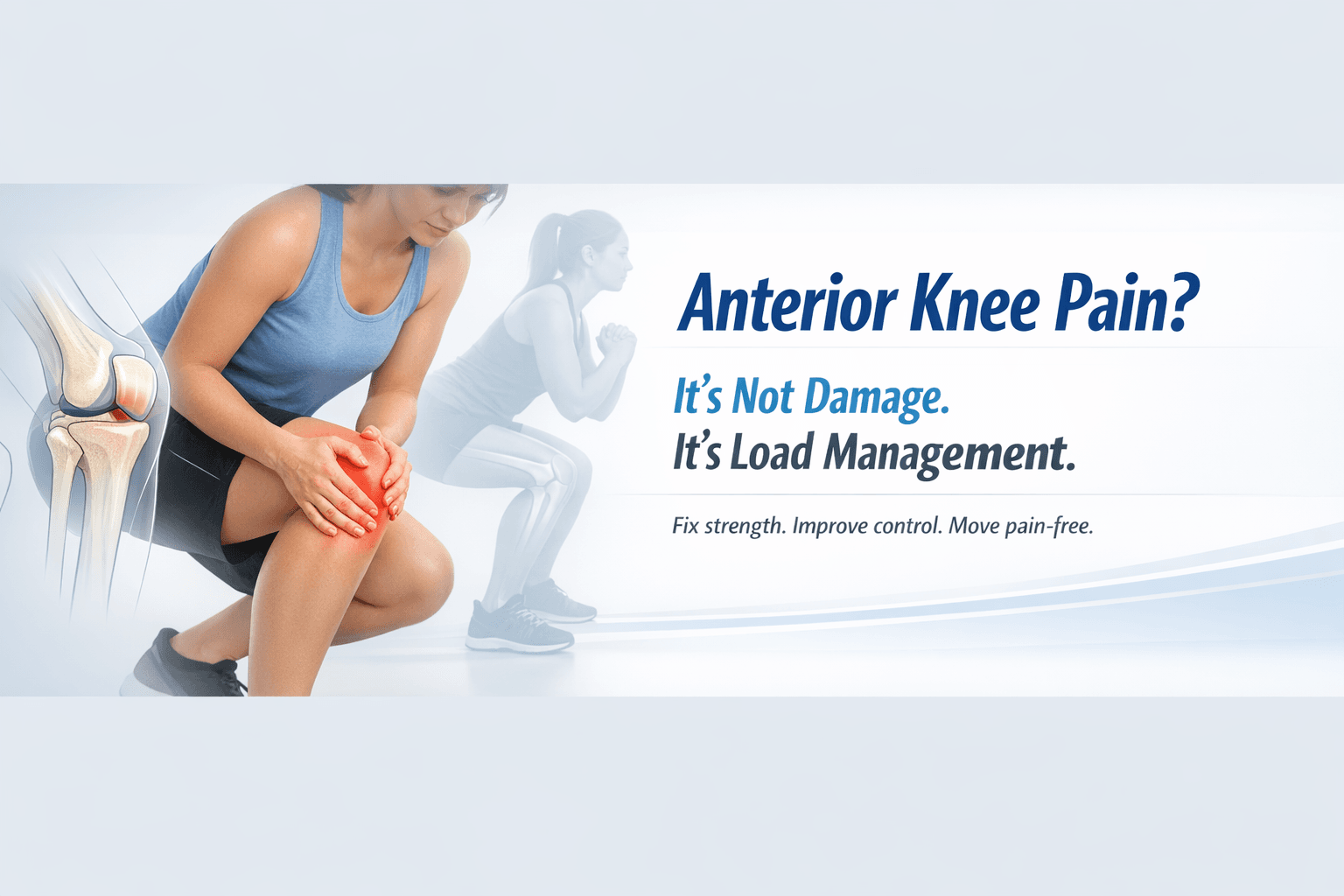
Anterior Knee Pain (Patellofemoral Pain Syndrome): Causes, Diagnosis & Proven Rehab Strategies
Anterior knee pain is one of the most common musculoskeletal complaints—especially among runners, active adults, and even office workers. In many cases, this pain is diagnosed as Patellofemoral Pain Syndrome (PFPS), often referred to as “runner’s knee.”
But here’s the key truth most people miss:
It’s not a tear.
It’s not usually structural damage.
It’s a load management problem.
What Is Patellofemoral Pain Syndrome (PFPS)?
Patellofemoral Pain Syndrome (PFPS) is pain felt around or behind the kneecap (patella) due to irritation of the patellofemoral joint—where the kneecap meets the thigh bone.
Instead of a single injury, PFPS develops when the joint is exposed to more stress than it can currently tolerate.
What Causes Anterior Knee Pain?
The exact cause varies from person to person, but PFPS is usually linked to poor load distribution and movement mechanics, not structural damage.
Common contributing factors:
-
Weak or tight muscles (quadriceps, hips, glutes)
-
Poor foot mechanics or walking/running gait
-
Knee misalignment or poor patellar tracking
-
Repetitive stress (running, jumping, stairs)
-
Previous trauma or direct blow to the kneecap
According to the American Academy of Orthopaedic Surgeons, treatment should focus on restoring strength, flexibility, and biomechanics—not just reducing pain.
How Is Patellofemoral Pain Diagnosed?
Here’s where many people (and even clinicians) get it wrong.
PFPS is NOT diagnosed by pressing on the kneecap alone.
It’s diagnosed based on how your knee responds to load and movement.
Key Clinical Signs I Look For:
1. Pain with Squatting (Most Sensitive Test)
A simple bodyweight squat often reveals everything.
If squatting reproduces your familiar anterior knee pain → PFPS becomes very likely.
Why?
As your knee bends, patellofemoral joint stress increases, especially between 45–90° of flexion.
It also reveals:
-
Knee collapse (dynamic valgus)
-
Hip control issues
-
Trunk stability
-
Depth tolerance
2. Pain with Stair Descent
Going down stairs loads the knee more than going up.
If descending hurts but ascending doesn’t:
→ Strong indicator of patellofemoral joint irritation
This highlights:
-
Poor eccentric quadriceps strength
-
Reduced load tolerance
-
Weak frontal plane control
3. Pain with Prolonged Sitting (“Movie Theater Sign”)
Sitting with bent knees for 10–30 minutes increases joint compression.
Pain here suggests:
- Compression intolerance, not instability
Combine this with squat pain, and the likelihood of PFPS rises significantly.
4. Patellar Compression Test (Clarke’s Test)
Use with caution.
-
High false positives
-
Low standalone value
If this test is positive without functional pain, it’s not reliable.
Functional loading tests matter more than isolated tests.
The Big Takeaway
Patellofemoral pain is diagnosed when:
-
You have anterior knee pain
-
Pain is reproduced during loaded knee bending
-
There’s a consistent pattern with daily activities
👉 It’s not just a kneecap issue.
👉 It’s a load tolerance problem.
Best Exercises for Patellofemoral Pain (Backed by Research)
Rehab should focus on improving strength, control, and progressive load capacity—not just “fixing tracking.”
Here are 3 of the most effective exercises I use clinically:
1. Spanish Squats
Why it works:
-
High quadriceps activation in the 45–90° range (where joint stress peaks)
-
Upright posture reduces strain on the knee
-
Safely builds quad strength and joint tolerance
2. Eccentric Step-Downs
Why it works:
-
Targets eccentric quadriceps strength
-
Mimics real-life stress (like going downstairs)
-
Improves control under load
3. Single-Leg Balance + Hip External Rotation
Why it works:
-
Strengthens hips and glutes
-
Reduces knee collapse (dynamic valgus)
-
Improves alignment and load distribution
The Rehab Formula That Actually Works
Forget chasing perfect “kneecap tracking.”
Focus on this instead:
Strong quads + strong hips + smart load progression = happier knees
Additional Treatment Options
Depending on severity, you may also benefit from:
-
Physiotherapy or guided rehab programs
-
Activity modification (reduce high-impact temporarily)
-
Low-impact exercises like cycling or swimming
-
Bracing or orthotics (in selected cases)
When Should You Seek Professional Help?
If your knee pain:
-
Persists for weeks
-
Limits your ability to exercise
-
Worsens with daily activities
It’s time to get assessed by a qualified clinician.
A personalized program will always outperform generic advice.
Final Thoughts
Anterior knee pain can be frustrating—but it’s highly manageable when approached correctly.
Don’t just rest it.
Rebuild it.
With the right combination of:
-
Strength
-
Control
-
Load management
You can return to pain-free movement—and stay there.
Save or share this article if you’re rehabbing anterior knee pain or know someone dealing with it.