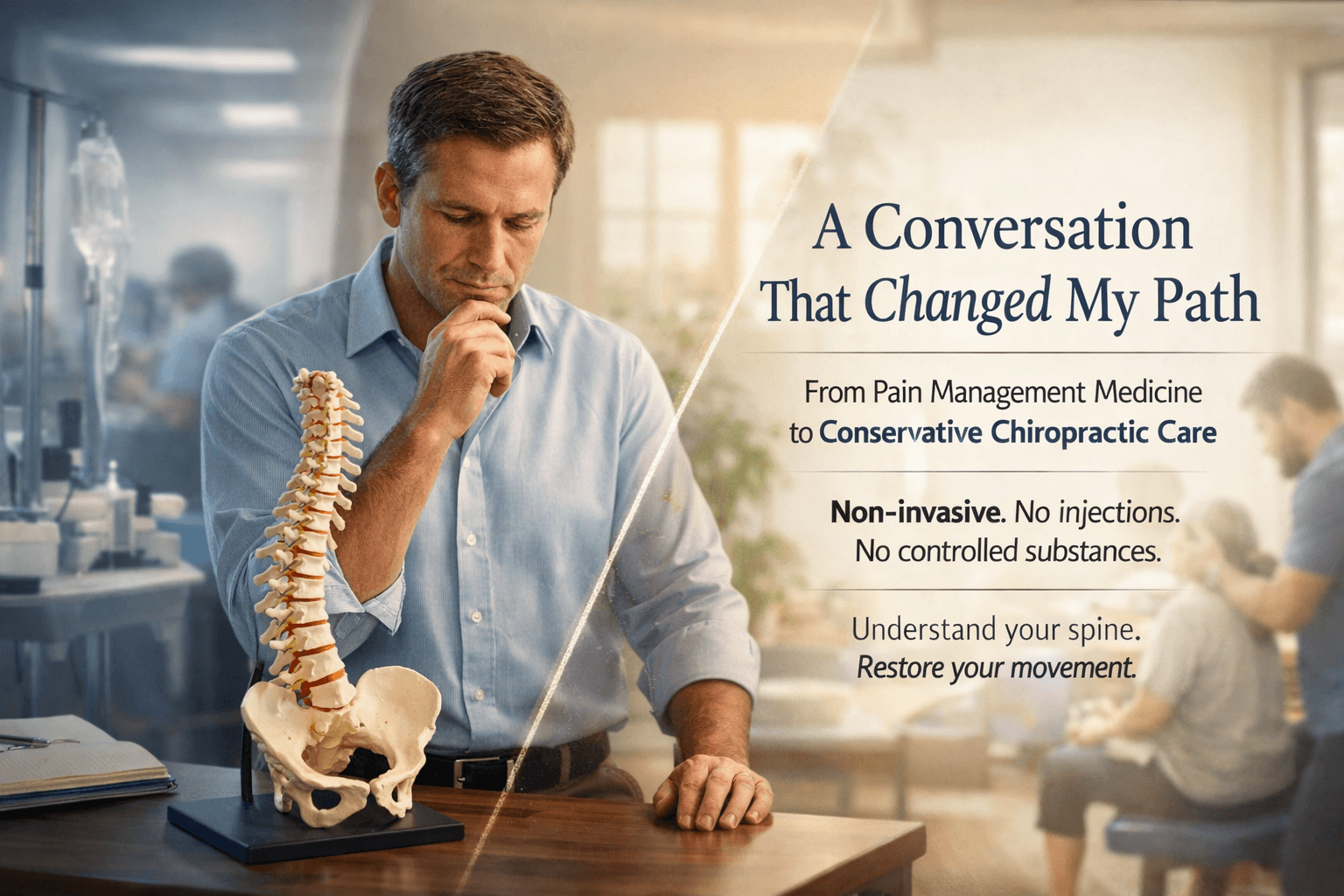
Introduction: A Conversation That Changed My Career Path
More than 20 years ago, I had the opportunity to interview one of the busiest pain management physicians in San Francisco.
At that time, I was deeply interested in science and pain management. I wanted to understand how chronic pain was treated at the highest clinical level, and how patients with severe spine and nerve pain were managed in real-world practice.
That interview became a turning point in my life.
It did not push me toward becoming a physician.
It helped me understand who I truly am—and ultimately led me toward chiropractic care as my chosen path.
I am not a medical physician and do not prescribe medications or perform injections. My work focuses on conservative, non-invasive chiropractic care centered on restoring movement and function.
Understanding How Pain Was Treated in Medical Pain Management
During that interview, I observed how a physician approached pain using a structured, medical model that may include:
1. Pharmacological Management
-
Use of medications to reduce pain sensitivity
-
In selected cases, controlled substances prescribed under strict supervision
-
Neuropathic pain agents for nerve-related conditions
2. Interventional Procedures
-
Nerve blocks
-
Image-guided injections
-
Diagnostic pain mapping through targeted anesthetic delivery
3. Functional Rehabilitation
-
Physical therapy
-
Movement-based recovery programs
-
Gradual return-to-function protocols
The core objective was not just pain relief—but pain control while preserving function and safety within a medical framework.
What Are Nerve Blocks (From a Clinical Perspective)
A nerve block is an interventional medical procedure where a physician injects a local anesthetic near a specific nerve or spinal structure responsible for pain.
It serves two main purposes:
-
Diagnostic: Identify the exact pain source
-
Therapeutic: Temporarily reduce pain to allow rehabilitation
This approach is part of modern pain medicine, especially in spine-related conditions.
Acute Pain vs Chronic Pain: The Clinical Framework
Acute Pain
Acute pain is sudden and usually related to tissue injury, such as:
-
Disc injury
-
Sports trauma
-
Post-surgical recovery
It typically resolves as healing occurs.
Chronic Pain
Chronic pain persists beyond 3 months and may involve:
-
Nerve sensitization
-
Altered pain signaling pathways
-
Central nervous system adaptation
At this stage, pain is no longer only structural—it becomes neurological and functional.
What I Learned That Changed My Perspective
What stood out most from that interview was not just the techniques used—but the reality of long-term pain care:
-
Many patients required ongoing management rather than complete resolution
-
Medication and procedures often focused on control, not correction
-
Chronic pain required long-term strategies across multiple disciplines
This was the moment I began questioning:
“Is there another way to help patients restore function without relying heavily on injections or controlled medications?”
That question ultimately changed my direction.
Why I Chose Chiropractic Care
After that experience, I chose to pursue chiropractic because it aligned with my belief in:
A Conservative, Non-Invasive Approach
-
No injections
-
No controlled substance prescriptions
-
Focus on structural and functional correction
Movement-Based Recovery
-
Restoring spinal mechanics
-
Improving mobility and stability
-
Supporting the body’s natural healing ability
Patient Participation
-
Education-driven care
-
Active rehabilitation
-
Long-term lifestyle correction
This approach is different from medical pain intervention—but it is complementary in philosophy.
Shared Principle: “Do No Harm”
Although I am not a physician, I deeply respect the principle that guides all healthcare professionals:
Primum non nocere — First, do no harm.
In chiropractic care, this translates into:
-
Avoiding unnecessary invasive procedures
-
Minimizing dependence on medication
-
Supporting natural recovery processes
-
Prioritizing long-term function over short-term suppression
My Clinical Belief Today
I believe pain management should not be about constant suppression.
It should be about:
-
Understanding the source of dysfunction
-
Restoring movement and stability
-
Reducing dependency on medication where possible
-
Helping patients regain control of their own bodies
Results are not instant—but they are often more sustainable when patients commit to the process.
Final Reflection: Why That Interview Still Matters Today
That conversation with a top pain management physician did not turn me into a doctor.
It helped me understand the reality of medical pain care—and clarified my own calling.
Today, I practice chiropractic care with a focus on:
-
Conservative spine treatment
-
Functional rehabilitation
-
Non-invasive pain management strategies
We share the same ethical foundation.
But we chose different tools to serve patients.
If you are struggling with persistent spine or sports-related pain, there are multiple pathways to recovery.
A conservative, non-invasive approach may help you better understand your condition and support long-term functional improvement.
👉 Book a consultation to explore chiropractic-based spine care and movement-focused pain management.