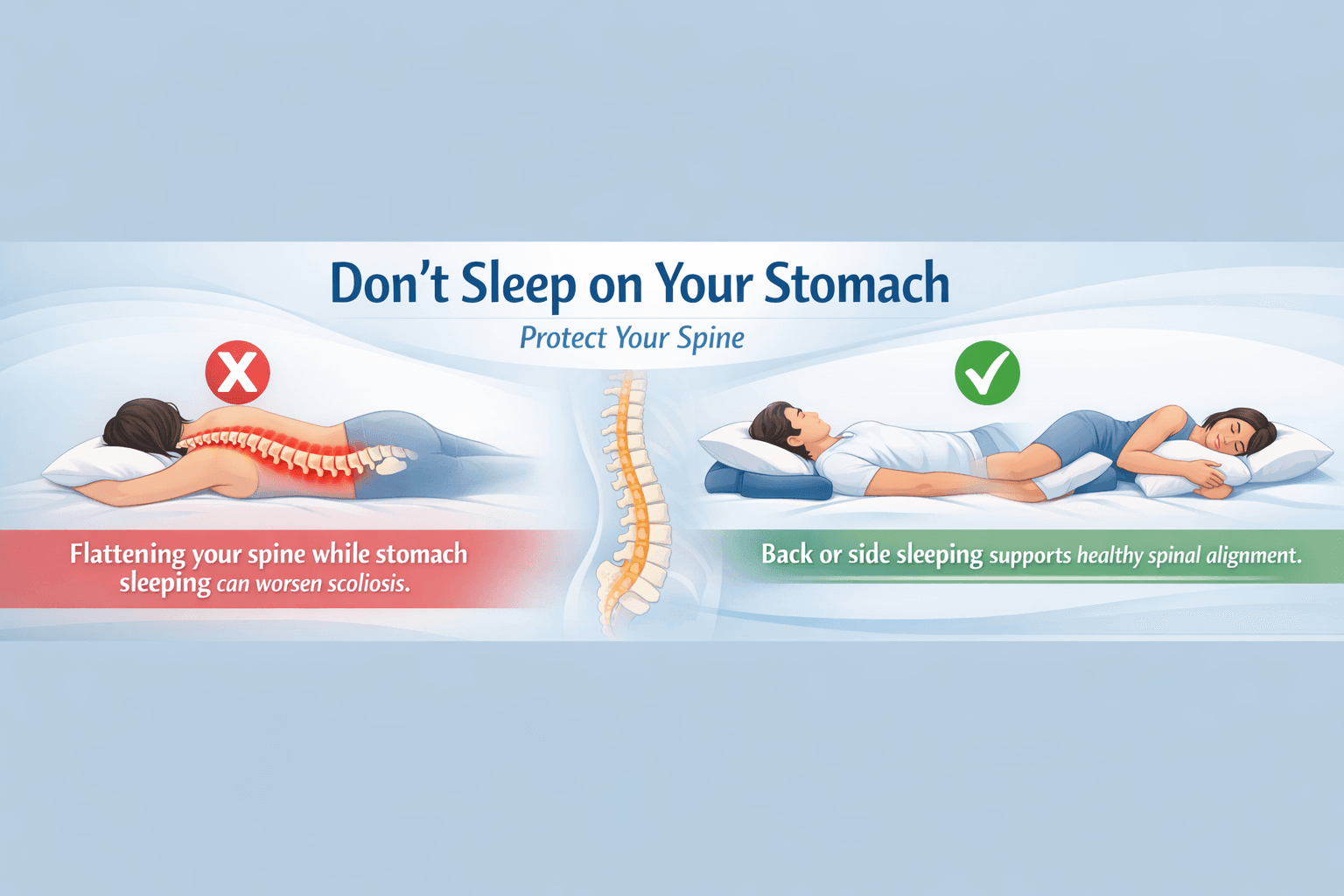
Don’t Sleep on Your Stomach: How Sleep Position Affects Scoliosis
Avoid sleeping on your stomach if you have scoliosis. Learn why back and side sleeping protect your spine, reduce pain, and support proper posture.
Why Sleeping on Your Stomach Is Harmful for Scoliosis
Sleeping may seem simple, but for individuals with scoliosis, your sleep posture plays a crucial role in spine health. One of the key scoliosis do’s and don’ts is never sleep on your stomach.
When you lie on your belly, your thoracic spine—the middle part of your back—is forced to flatten. Scoliosis is a three-dimensional spinal condition, meaning your spine curves sideways, rotates, and also has natural forward and backward curves. Flattening the thoracic curve can worsen your scoliosis over time and may also affect other parts of the spine, leading to discomfort and pain.
Turning your head to the side while stomach sleeping further twists your neck and spine, creating strain that can cause stiffness, muscular imbalances, and even headaches.
Best Sleep Positions for Scoliosis
To protect your spine while sleeping, focus on back or side sleeping:
-
Back Sleeping: Lie flat on your back with a supportive pillow under your head. Place a small cushion or pillow under your knees to maintain the natural curve of your lower back. This position evenly distributes weight and reduces stress on the spine.
-
Side Sleeping: Lie on your side with a pillow between your knees to keep your hips and spine aligned. For extra comfort, hug a small pillow to prevent your shoulder from collapsing forward and twisting your spine.
Tips for a Spine-Friendly Sleep
-
Choose a medium-firm mattress that supports spinal curves without sagging.
-
Use minimal or supportive pillows to keep your head aligned with your spine.
-
Perform gentle stretching or mobility exercises before bed to release tension in your back and neck.
-
Maintain a consistent sleep routine to support muscle recovery and spinal health.
Conclusion
Sleeping on your stomach may feel natural, but it can worsen spinal curvature and create strain in scoliosis patients. By adopting back or side sleeping, using supportive pillows, and maintaining proper alignment, you can protect your spine, reduce pain, and improve posture over time.
Scoliosis posture correction starts with knowing your spine. Imaging such as X-ray or EOS provides accurate insight for effective monitoring and long-term scoliosis management.
Takeaway: Sleep is not just rest—it’s a vital part of scoliosis management. Small changes in your sleep habits can have a significant impact on spinal health.
Keywords: scoliosis sleep position, stomach sleeping scoliosis, spine-friendly sleep, scoliosis do’s and don’ts, scoliosis posture, scoliosis pain relief
Medical Disclaimer
This article is for educational purposes only and does not constitute medical advice.
Scoliosis varies significantly between individuals. Always consult a qualified healthcare professional before starting any new sport or exercise program, especially if you have scoliosis, spinal conditions, pain, or previous injuries. Participation in sports should be guided by individual assessment and professional recommendation.
The image is shared for educational purposes with patient consent. Individual outcomes vary. Structural correction does not automatically restore full respiratory function. Clinical assessment is required.
Copyright & Content Protection Notice
© 2026 All Well Scoliosis Centre. All rights reserved.
This content is original and protected by copyright law.
No part of this article may be reproduced, distributed, copied, or reused in any form without prior written permission. Unauthorized use, duplication, or content scraping is strictly prohibited.