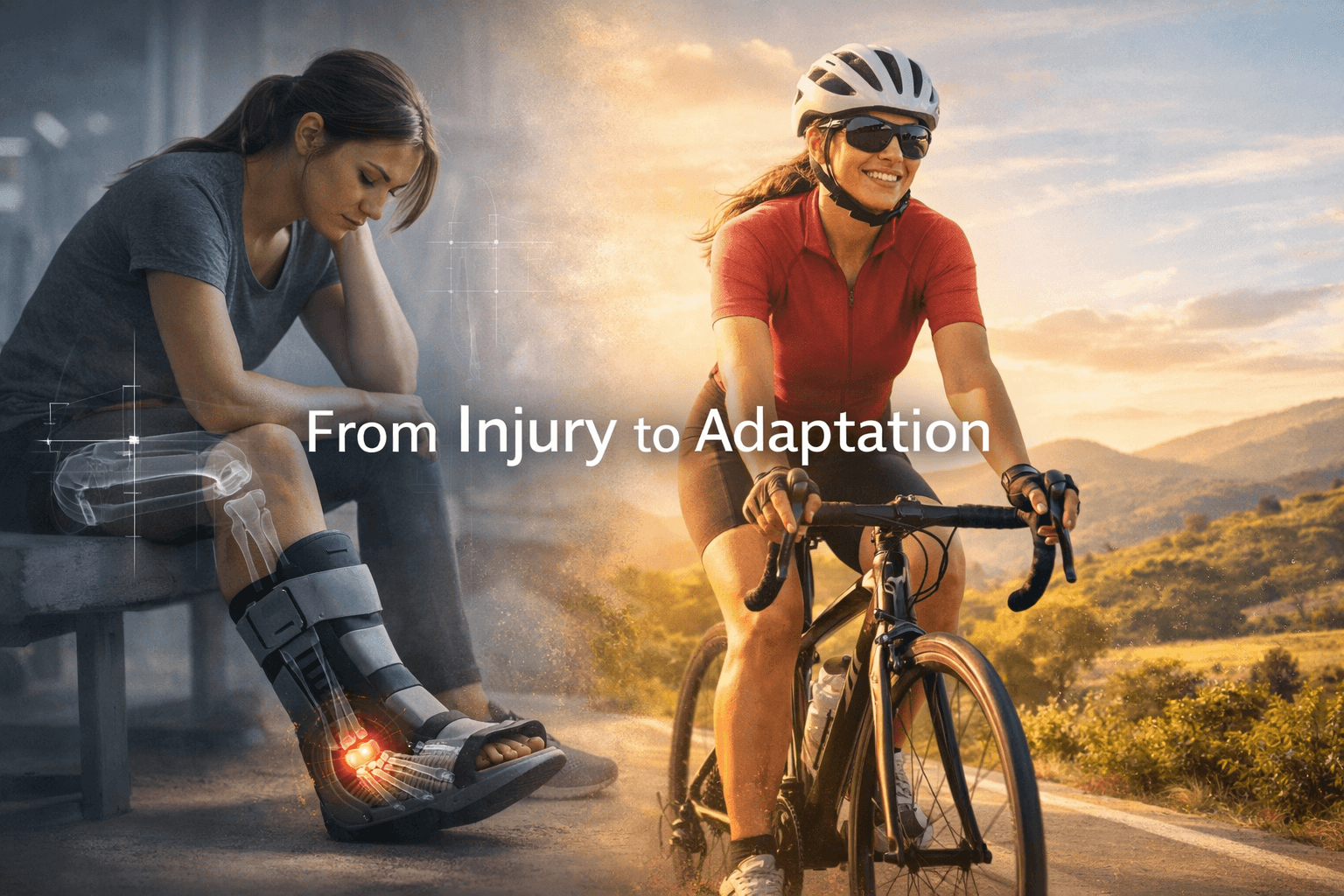
Bone Stress Injury Recovery: From Marathon Burnout to Stronger Comeback (Singapore Case Study)
What Is a Bone Stress Injury?
A bone stress injury (BSI) is not just a “minor overuse problem.” It is a progressive weakening of bone tissue caused by repetitive loading without enough recovery. It ranges from early stress reactions to high-grade injuries (Grade 3–4), where the bone is significantly compromised and at risk of fracture.
In runners—especially those training intensely for events like marathons—BSIs commonly affect the foot, tibia, and hip.
Case Study: “I Pushed Myself to the Limit”
A young runner walked into the clinic and said:
“16 weeks ago I was diagnosed with a Grade 3 bone stress injury in my foot… and low energy availability. I pushed myself hard preparing for a marathon.”
Her year had been dominated by:
-
Weeks on crutches and in a boot
-
Restricted movement
-
Declining mental health
-
Frustration from losing her identity as a runner
The Hidden Factor: Low Energy Availability
This is critical.
Low energy availability (LEA) occurs when:
-
You burn more energy than you consume
-
The body lacks fuel for repair, hormones, and bone health
This is strongly linked to:
-
Bone stress injuries
-
Hormonal imbalance
-
Delayed healing
Why Rest Alone Is Not Enough
Many patients are told: “Just rest.”
Yes—initial rest is necessary.
But prolonged inactivity creates a new set of problems:
-
Muscle loss
-
Joint stiffness
-
Reduced circulation
-
Poor mental health
She experienced this firsthand.
“The past few weeks, I was struggling.”
Movement Is Medicine (Even 15 Minutes)
Research consistently shows:
-
15 minutes of movement can improve mood and mental clarity
-
Light activity promotes blood flow and healing
-
Movement restores confidence and body awareness
Movement does NOT mean running.
It can be:
-
Walking
-
Mobility work
-
Gentle cycling
-
Stretching
A Holistic Chiropractic Approach to Bone Stress Injury
When she came in, the treatment was not just about her foot.
Step 1: Proper Diagnosis
-
X-ray imaging to assess bone healing and alignment
-
Understanding the root cause, not just symptoms
Step 2: Whole-Body Focus
Why the spine?
Because:
-
Poor spinal mechanics affect load distribution
-
Compensation patterns increase stress on the foot
Step 3: Multimodal Recovery Plan
Her program included:
-
Postural retraining
-
Balance and neuromuscular control
-
Spinal decompression
-
Muscle release therapy
This approach restores:
-
Movement efficiency
-
Load tolerance
-
Injury resilience
Gradual Return to Movement
Her progression was strategic:
After 2 sessions:
- Introduced static cycling
By the 4th session:
- Fully embracing her cycling phase
This was a turning point.
The Pivot: From Running to Cycling
Instead of forcing a return to running too soon, she adapted.
And that changed everything.
Benefits She Experienced:
-
Outdoor activity restored
-
Reduced foot impact
-
Improved glute and posterior chain strength
-
Exploration of Singapore’s landscapes
-
New community connections
She shared:
“There’s no feeling quite like cycling—the long rides, the climbs, the descents, and the coffee stops.”
The Psychology of Injury: Identity & Ego
One of the biggest barriers in recovery?
Identity.
-
“I am a runner.”
-
“I need to get back to running.”
But here’s the truth:
👉 You are not defined by one sport.
Trying new activities:
-
Builds new movement patterns
-
Challenges the brain and body
-
Prevents overuse injuries
You don’t have to be the best.
You just have to be willing.
The Power of Community & Exploration
She went from:
- Running solo
To:
-
Riding with others
-
Exploring new places
-
Even cycling internationally
Now, she’s spending time in Mallorca, one of the world’s most iconic cycling destinations.
And she feels:
-
Stronger
-
More capable
-
More connected
Could Surgery Have Been Avoided?
In many bone stress injury cases, conservative care works extremely well when:
-
Diagnosed early
-
Managed holistically
-
Progressed properly
Had she gone straight to surgery:
-
Recovery would be longer
-
Movement would be more restricted
-
Opportunities like cycling adventures might not exist
Key Takeaways for Bone Stress Injury Recovery
1. Don’t Ignore Early Pain
Pain during training is a signal—not something to push through.
2. Fuel Your Body Properly
Low energy availability delays healing and increases injury risk.
3. Movement Matters
Even small amounts of daily movement improve both physical and mental health.
4. Treat the Whole Body
Your injury is rarely isolated—address biomechanics globally.
5. Be Open to Pivoting
Your comeback may look different—and better—than before.
Final Thoughts: The Body Is Stronger Than You Think
This story is not just about recovery.
It’s about adaptation.
Humans are incredibly resilient.
We adjust, evolve, and grow—often in unexpected ways.
As a chiropractor, this is why the work matters.
Because sometimes:
-
Injury is not the end
-
It’s the beginning of something stronger
If you’re currently dealing with a bone stress injury and feel stuck, I can help you map out a safe, structured return to movement based on your condition.
Medical Disclaimer
This article is for educational purposes only and does not constitute medical advice.
Scoliosis varies significantly between individuals. Always consult a qualified healthcare professional before starting any new sport or exercise program, especially if you have scoliosis, spinal conditions, pain, or previous injuries. Participation in sports should be guided by individual assessment and professional recommendation.
The image is shared for educational purposes with patient consent. Individual outcomes vary. Structural correction does not automatically restore full respiratory function. Clinical assessment is required.
Copyright & Content Protection Notice
© 2026 All Well Scoliosis Centre. All rights reserved.
This content is original and protected by copyright law.
No part of this article may be reproduced, distributed, copied, or reused in any form without prior written permission. Unauthorized use, duplication, or content scraping is strictly prohibited.