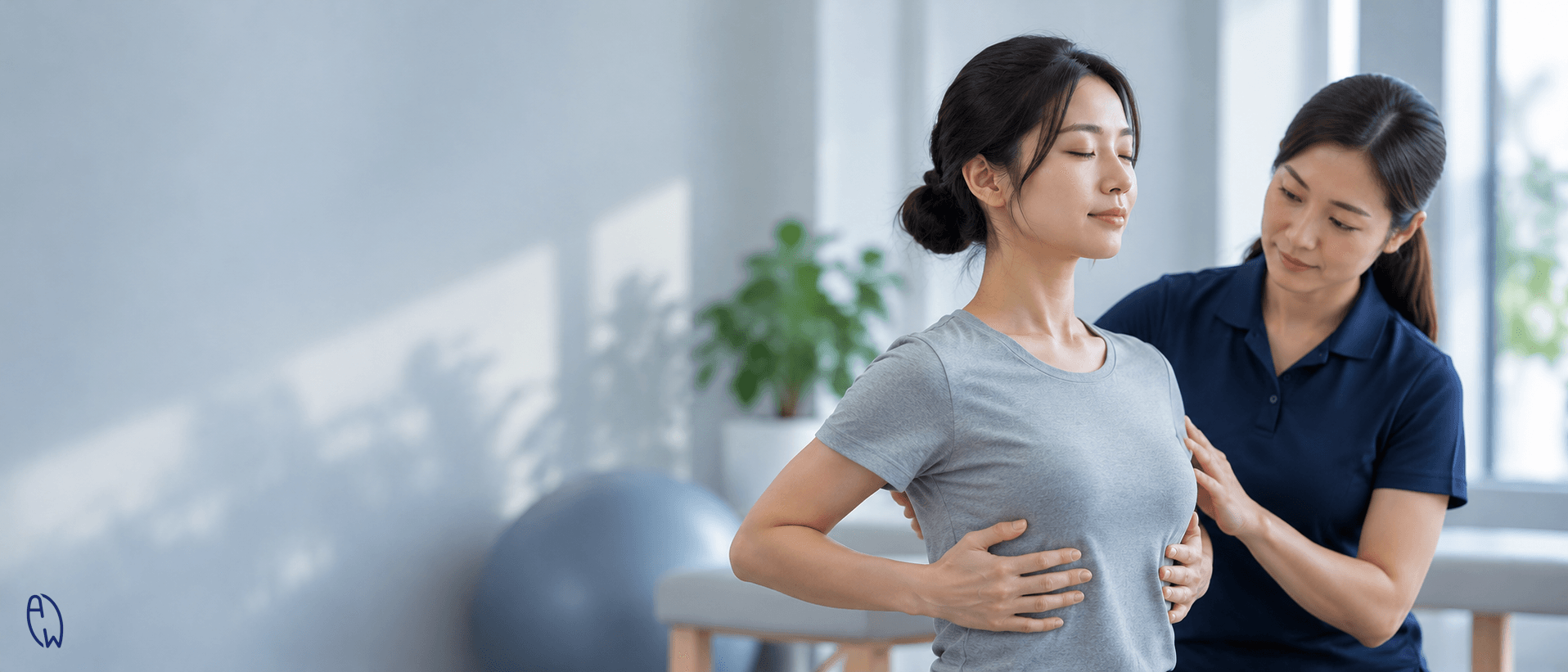
Breathing Techniques for Scoliosis: How ScoliBalance® and the Schroth Method Help Train Better Posture
Subtitle: Discover how corrective breathing, three-dimensional postural exercises and consistent movement practice can help people with scoliosis develop better body awareness, improve trunk control and carry corrected posture into everyday activities.
When we think about scoliosis, we often focus on the curve of the spine. But scoliosis can also affect the shape of the ribcage, the position of the trunk and the way the body moves.
This raises an important question: Can we train our bodies to breathe, move and maintain posture differently when we have scoliosis?
The answer is yes, to an extent. Although exercises cannot guarantee that a structural spinal curve will straighten, scoliosis-specific exercise programmes can help people practise active postural correction, improve trunk control and develop greater awareness of how they position their bodies.
Breathing is an important part of this process.
The Schroth Method uses corrective breathing alongside three-dimensional postural correction. ScoliBalance® builds on similar principles by incorporating individualised exercises that help patients practise corrected posture, strength, balance and functional movement.
The goal is not simply to perform an exercise correctly during a treatment session. It is to learn how to carry those movement skills into everyday life: when standing, walking, sitting, exercising and, where appropriate, wearing a prescribed scoliosis brace.
Why Does Scoliosis Affect Breathing?
Your spine and ribcage work together every time you breathe.
When you inhale, your diaphragm contracts and your ribcage expands. When you exhale, the ribcage returns towards its resting position.
In scoliosis, the spine may curve sideways and rotate. When the thoracic spine is involved, this rotation can change the shape of the ribcage and create differences between the two sides of the chest.
Depending on the severity and location of the curve, some people may experience:
-
Uneven ribcage movement during breathing.
-
Reduced mobility in certain areas of the chest wall.
-
Changes in lung function, particularly with more pronounced thoracic deformities.
-
Difficulty maintaining comfortable breathing during some physical activities.
However, not everyone with scoliosis has breathing difficulties. Many people with mild curves have normal lung function, and an uneven ribcage does not automatically mean that lung capacity is reduced.
This is why scoliosis care should be individualised. The aim is to understand how the person's spinal curve, ribcage, posture and movement work together rather than assume that everyone has the same problem.
What Is Rotational Angular Breathing in the Schroth Method?
The Schroth Method is a form of physiotherapeutic scoliosis-specific exercise. It combines three-dimensional postural correction, muscular activation, stabilisation and breathing techniques.
One of its distinctive features is Rotational Angular Breathing (RAB).
Rather than simply taking a deeper breath, the patient learns to direct the inhalation towards specific areas of the ribcage and trunk identified during an individual assessment.
For example, a practitioner may guide a patient to expand an area of the ribcage that has reduced movement while maintaining a more corrected trunk position.
The exercise generally involves three elements:
1. Establishing a corrected position
The patient learns to lengthen and reposition the trunk according to their individual scoliosis pattern.
2. Directing the breath
During inhalation, the patient practises expanding selected areas of the ribcage rather than breathing without awareness of trunk position.
3. Maintaining control
During exhalation, the patient works to maintain the corrected position and appropriate muscular engagement without unnecessary tension.
The direction of correction matters. A breathing strategy that is appropriate for one curve pattern may not be suitable for another.
Corrective breathing is therefore more than an instruction to breathe deeply. It is a way of coordinating respiration with posture and active self-correction.
How Does ScoliBalance® Help Train Corrected Posture?
Learning a corrected position during an exercise session is one thing. Maintaining that position when the body is moving is another.
This is where ScoliBalance® can play an important role in a broader scoliosis exercise programme.
ScoliBalance® incorporates individualised scoliosis-specific exercises to help patients practise three-dimensional postural correction, muscular control, balance and functional movement.
The objective is to help the patient become more aware of their habitual posture and learn how to actively reposition their body according to their individual correction strategy.
Breathing can be integrated into this process.
Instead of practising breathing in isolation, the patient learns to coordinate breathing with trunk positioning and muscular control. With appropriate instruction, these skills can then be practised in different positions and movement activities.
For example, a programme may progress through:
-
Postural awareness: Recognising habitual shifts, rotations or asymmetries in the trunk.
-
Active correction: Learning the appropriate individualised position rather than simply standing as straight as possible.
-
Breathing coordination: Maintaining comfortable breathing while practising the corrected position.
-
Strength and control: Developing the ability to maintain that position during suitable exercises.
-
Functional movement: Applying the correction during activities such as standing, sitting and walking.
The important point is that scoliosis-specific exercise is not only about how the body looks in a stationary position. It is also about how the person controls their posture during movement.
ScoliBalance® provides a structured way to practise these skills, with exercises selected and progressed according to the patient's needs and abilities.
Why Is Overcorrection Sometimes Used in Scoliosis Exercises?
In everyday life, we tend to move towards positions that feel familiar. Someone with scoliosis may habitually shift their weight, rotate their trunk or position their pelvis in a particular way without realising it.
Over time, these positions can become familiar movement habits.
Scoliosis-specific exercises may therefore ask the patient to actively move towards a prescribed corrective position that feels unfamiliar at first.
This is sometimes described as overcorrection.
However, overcorrection does not mean forcing the spine as far as possible in the opposite direction. It means practising an individually determined corrective position that addresses the person's specific three-dimensional pattern.
For some patients, this may involve adjusting the position of the pelvis, lengthening the trunk, reducing a habitual shift or coordinating ribcage movement with breathing.
The appropriate correction depends on the individual.
The purpose of repeated practice is to improve body awareness and control so that the patient can reproduce the intended position more consistently. It is not to assume that every person with scoliosis should lean in the opposite direction or force their body into perfect symmetry.
Training Your Body Beyond the Exercise Session
One of the most important parts of scoliosis-specific exercise is transferring the skills learned during treatment into everyday activities.
A patient may be able to maintain a corrected position while concentrating on an exercise. However, that position may be harder to maintain while walking, sitting at a desk or performing other activities that require attention elsewhere.
This is why practising functional movement matters.
Walking
Walking involves coordinated movement of the trunk, pelvis and limbs. Patients can practise the individualised postural cues taught during their exercise sessions while learning to walk comfortably and naturally.
The goal is not to make walking rigid or consciously control every movement. It is to develop better awareness and control without creating unnecessary tension.
Sitting
Many people spend hours sitting at work, studying or using electronic devices. Practising an appropriate sitting position can help patients recognise habitual trunk shifts and learn how to reposition themselves more comfortably.
The aim is not to maintain one perfectly upright position all day. Regular movement and changes of position remain important.
Standing
Standing exercises can help patients practise distributing their weight and positioning the trunk and pelvis according to their individual correction strategy.
Over time, this may help make the corrected position more familiar and easier to reproduce.
Breathing During Movement
Breathing should not stop when the patient begins moving. Learning to maintain comfortable breathing while practising postural control can help integrate the exercise into functional activities.
These practices do not guarantee that the spine will remain structurally corrected. They are intended to develop movement skills and postural awareness that can be used beyond the treatment room.
Can You Practise Corrected Posture While Wearing a ScoliBrace®?
For patients prescribed a ScoliBrace® or another scoliosis brace, exercise and bracing may have complementary roles within an individualised treatment plan.
A brace provides external support and applies forces intended to guide the trunk towards a prescribed correction. Scoliosis-specific exercises, meanwhile, can help the patient practise active postural control, muscular coordination and functional movement.
Where appropriate, the patient may practise breathing comfortably and maintaining the instructed corrective position while wearing the brace.
This can help them become more familiar with how to move and position themselves within the brace during daily activities.
For example, the patient may practise:
-
Sitting comfortably while following the brace and exercise instructions.
-
Standing with the prescribed postural cues.
-
Walking while maintaining comfortable breathing and natural movement.
-
Recognising unnecessary tension and avoiding forceful attempts to push against the brace.
The exact approach depends on the brace design, the prescribed correction and the patient's clinical needs. Some braces may restrict certain movements or alter the feeling of ribcage expansion, so exercises should be adapted accordingly.
Do not force your ribs outward, push against the brace or change how the brace fits in an attempt to achieve greater correction. Follow the brace provider's instructions about fit, wear time, exercise and any symptoms that require review.
The objective is to make bracing and functional movement work together as part of a coordinated care plan, rather than treating them as unrelated activities.
What Does the Research Say?
Research on the Schroth Method and other physiotherapeutic scoliosis-specific exercise programmes suggests that they may help improve certain outcomes, including trunk posture, trunk rotation and quality of life in some patients with adolescent idiopathic scoliosis.
A 2022 systematic review and meta-analysis published in the European Spine Journal found beneficial effects of Schroth exercises and core stabilisation exercises on selected outcomes. However, the results varied according to the outcome measured, and improvements in trunk rotation were not statistically significant in that particular analysis.
A 2024 systematic and critical review published in the Journal of Bone and Joint Surgery found good evidence that the Schroth Method can improve the angle of trunk rotation in adolescents with idiopathic scoliosis, with some evidence of improved posture. The review also highlighted that evidence remains insufficient for several other important outcomes.
These findings support the use of appropriately supervised scoliosis-specific exercises as one option in conservative scoliosis management. They do not establish that breathing exercises alone can correct structural scoliosis or that every patient will experience the same benefits.
It is also important to distinguish between improving the ability to maintain a corrected posture during exercise and demonstrating a lasting change in the structural spinal curve. These are different outcomes and should not be treated as interchangeable.
A Simple Breathing Practice to Begin With
If you have scoliosis, you can start by becoming more aware of your breathing and posture without trying to force a correction.
-
Sit comfortably with your feet supported and your shoulders relaxed.
-
Place your hands lightly on the sides of your lower ribcage.
-
Breathe in gently and notice how your ribs and abdomen move.
-
Exhale comfortably without holding your breath or tightening your shoulders.
-
Repeat for several comfortable breaths, then return to normal breathing.
This is a general breathing-awareness exercise, not a substitute for individualised Schroth or ScoliBalance® instruction.
If you want to practise rotational angular breathing or a specific overcorrected position, ask a trained practitioner to show you the appropriate technique for your curve pattern.
Stop if you feel dizzy, uncomfortable or more breathless. Persistent or worsening breathing difficulties should be assessed by a healthcare professional rather than assumed to be caused by scoliosis alone.
Frequently Asked Questions
Can breathing exercises straighten scoliosis?
Breathing exercises alone have not been established as a reliable way to straighten a structural spinal curve. Corrective breathing can form part of a broader scoliosis-specific exercise programme that works on postural control and movement.
What is the difference between Schroth breathing and ScoliBalance®?
Rotational angular breathing is a specific technique used in the Schroth Method to coordinate breathing with three-dimensional postural correction. ScoliBalance® incorporates individualised exercises that can include postural correction, muscular control, breathing and functional movement practice. The approaches have overlapping principles, but they are not interchangeable terms.
Why do scoliosis exercises sometimes involve overcorrection?
An individual may be taught to move towards a specific corrective position that feels unfamiliar compared with their habitual posture. This is intended to practise active self-correction and body awareness, not to force the spine into the opposite curve.
Can I practise my corrective posture while wearing a brace?
Depending on your brace prescription and exercise programme, you may be able to practise selected postural and breathing exercises while wearing it. Follow your treating practitioner's instructions, and do not force movements or change the brace fit yourself.
Should I keep my back perfectly straight all day?
No. The goal is not to maintain one rigid position continuously. Appropriate postural awareness, comfortable movement and regular changes of position are more practical than trying to hold a single posture all day.
Do all people with scoliosis need breathing exercises?
No. The need for specific breathing exercises depends on the person's symptoms, spinal curve, ribcage movement and treatment goals. Many people with scoliosis have normal respiratory function and do not need a specialised breathing programme.
Bringing Breathing, Posture and Movement Together
Scoliosis-specific exercise is not simply about performing a series of movements correctly during a treatment session. It also involves learning how to recognise and practise an appropriate corrective position, coordinate breathing and develop greater control during everyday activities.
The Schroth Method provides one approach to combining breathing with three-dimensional postural correction. ScoliBalance® can help patients practise individualised correction, strength, balance and functional movement. For those prescribed a ScoliBrace®, these skills may complement brace treatment when the programme is appropriately coordinated.
At All Well Scoliosis Centre, we recognise that every scoliosis journey is unique. The right exercise strategy depends on the individual's spinal curve, physical abilities, symptoms and treatment plan.
The goal is not to promise a perfect spine or force the body into a rigid position. It is to help each person understand their body better, practise appropriate movement strategies and make informed decisions about their scoliosis care.
Medical References
-
Berdishevsky H, et al. (2016). Physiotherapy scoliosis-specific exercises—a comprehensive review of seven major schools. Scoliosis and Spinal Disorders, 11, 20. Read the full article.
-
Dimitrijević V, et al. (2022). Effects of Schroth method and core stabilization exercises on idiopathic scoliosis: a systematic review and meta-analysis. European Spine Journal, 31, 3500–3511. Read the full article.
-
Baumann AN, et al. (2024). The impact of patient scoliosis-specific exercises for adolescent idiopathic scoliosis: a systematic review and meta-analysis of randomized controlled trials with subgroup analysis using observational studies. Spine Deformity, 12(3), 545–559. Find the article on PubMed.
-
(2024). The Schroth Method for Pediatric Scoliosis: A Systematic and Critical Analysis Review. Journal of Bone and Joint Surgery. Read the review on PubMed.