Can Scoliosis Be Corrected Without Surgery? What Patients and Parents Should Know
From observation and bracing to scoliosis-specific exercises, understanding what non-surgical treatment can—and cannot—achieve.
Being diagnosed with scoliosis can raise many questions.
Will the curve get worse? Will it affect everyday life? Is surgery inevitable? And perhaps the question many parents and patients want answered first: Can scoliosis actually improve without surgery?
The short answer is yes, some scoliosis curves can improve without surgery. However, improvement is not guaranteed, and the possibilities depend on several factors, including age, skeletal maturity, curve severity and flexibility.
For some people, the priority is preventing further progression. For others, treatment may help improve spinal alignment, postural control or physical function.
Understanding the difference is important because successful scoliosis management does not always mean achieving a perfectly straight spine.
What Does It Mean to Correct Scoliosis?
Scoliosis is more than a sideways curve of the spine. It is a three-dimensional spinal deformity that can involve rotation of the vertebrae and changes in the alignment of the rib cage and trunk.
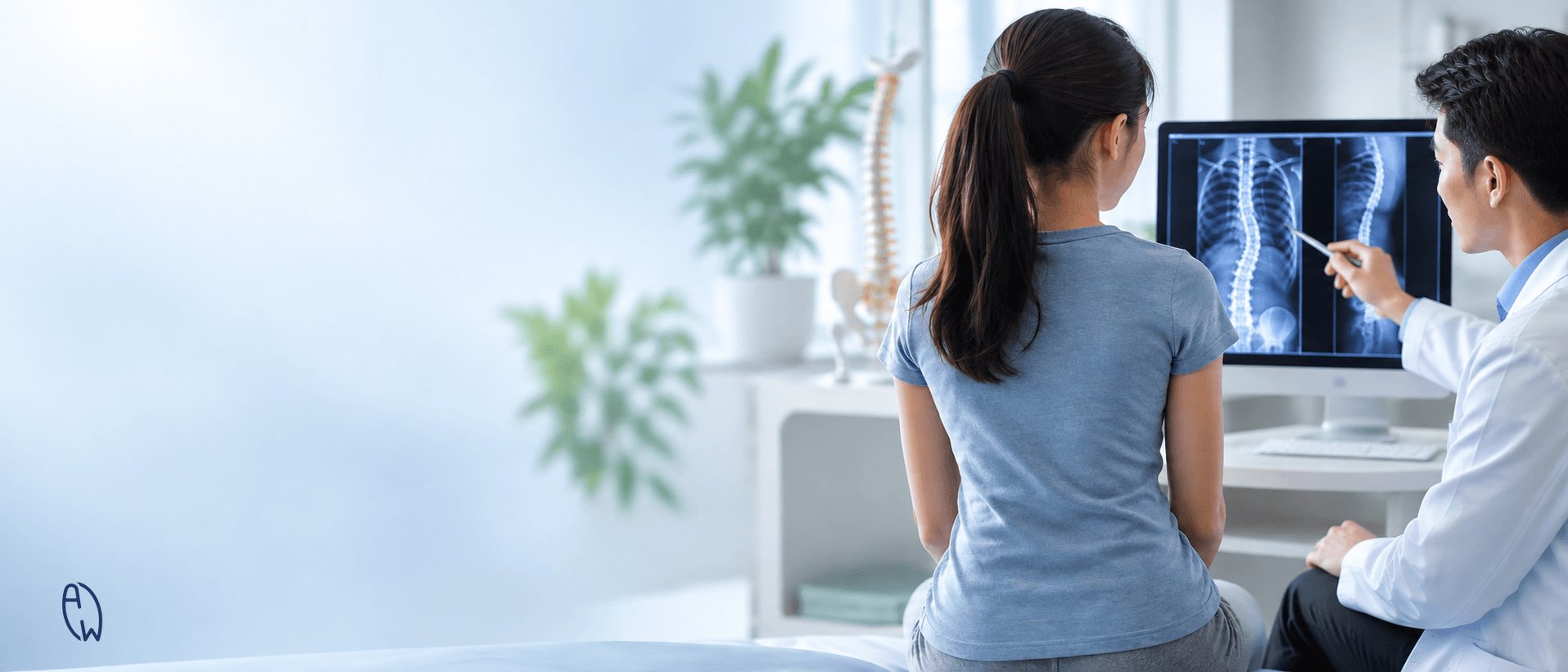
The severity of scoliosis is commonly assessed using the Cobb angle, measured on a standing spinal X-ray.
When discussing scoliosis correction, it helps to distinguish three possible treatment goals:
1. Preventing progression
For a growing child or teenager, keeping a spinal curve from becoming significantly worse can be an important treatment success.
2. Improving spinal alignment
Some patients may experience a measurable reduction in their Cobb angle with appropriate treatment. However, the amount of improvement varies, and not every curve will respond in the same way.
3. Improving physical function
Treatment may also focus on postural control, muscle endurance, mobility and the ability to perform everyday activities comfortably.
These goals are related, but they are not interchangeable.
For example, a person may develop better postural control without experiencing a substantial change in their Cobb angle. Similarly, a curve may remain stable while the person continues to work on strength and physical function.
The most appropriate goal depends on the individual—not simply the number on an X-ray.
Does Everyone With Scoliosis Need Surgery?
No. Many people with scoliosis never require surgery.
The decision depends on the type and severity of scoliosis, whether the curve is progressing, remaining skeletal growth, symptoms and the potential benefits and risks of different treatments.
For children and adolescents, growth is particularly important because scoliosis can progress more rapidly during growth spurts.
For adults, the considerations may be different. Pain, degenerative changes, spinal balance, neurological symptoms and the effect on daily activities may become more relevant.
The Scoliosis Research Society describes several approaches to scoliosis management, ranging from observation and bracing to surgery.
Surgery remains an important treatment option for some patients, particularly when curves are severe or progressive, or when spinal deformity causes significant functional problems.
However, having scoliosis does not automatically mean that surgery is necessary.
What Are the Non-Surgical Treatment Options for Scoliosis?
There is no single treatment suitable for everyone.
Depending on the individual, scoliosis management may involve observation, bracing, scoliosis-specific exercises or a combination of approaches.
1. Observation: When Monitoring Is the Right Approach
Not every spinal curve requires immediate active treatment.
For someone with a mild, stable curve, regular monitoring may be appropriate.
Observation allows healthcare professionals to assess whether the scoliosis is changing over time.
For children and teenagers, follow-up is especially important during periods of rapid growth.
The frequency of monitoring depends on factors such as age, curve severity and the estimated risk of progression.
Observation should not be confused with ignoring scoliosis. It is a deliberate management decision based on the individual's circumstances.
2. Bracing: Can a Brace Prevent Scoliosis From Getting Worse?
Bracing is one of the most extensively studied non-surgical treatments for adolescent idiopathic scoliosis.
Its main purpose is to reduce the risk of curve progression while the spine is still growing.
But how effective is it?
What Did the BrAIST Study Discover?
One of the most influential studies on scoliosis bracing is the BrAIST study, published in the New England Journal of Medicine in 2013.
Researchers studied adolescents with idiopathic scoliosis who were considered at increased risk of curve progression.
They compared outcomes between teenagers who wore a brace and those who were monitored without bracing.
The results were encouraging.
In the combined study group:
-
72% of adolescents treated with bracing reached skeletal maturity without their curve progressing to 50° or more.
-
48% of adolescents who were observed without bracing achieved the same outcome.
In other words, bracing significantly improved the likelihood of preventing progression to the study's surgical threshold.
The researchers also found that wearing the brace for longer periods was associated with better outcomes.
However, these results require careful interpretation.
The study did not show that bracing completely straightens the spine. It demonstrated that bracing can reduce the risk of significant curve progression in appropriately selected adolescents.
It also does not mean every child with scoliosis needs a brace.
Some curves have a relatively low risk of progression and may only require monitoring.
The important question is not simply whether a brace works, but whether bracing is appropriate for that particular patient.
Medical reference: Weinstein SL, et al. Effects of Bracing in Adolescents with Idiopathic Scoliosis. New England Journal of Medicine. 2013;369:1512–1521.
3. Scoliosis-Specific Exercises: More Than General Exercise
Exercise is beneficial for general health, but not all exercises are designed to address scoliosis.
Swimming, yoga, Pilates and strength training may help support fitness, mobility and muscular endurance.
However, general exercise is not the same as physiotherapeutic scoliosis-specific exercises (PSSE).
Scoliosis-specific exercises are individually adapted to a person's spinal curve and postural characteristics.
They may involve learning how to:
-
Recognise individual postural imbalances.
-
Actively correct trunk alignment in three dimensions.
-
Improve postural awareness and muscular control.
-
Use breathing and stabilisation techniques.
-
Apply corrected movement patterns during daily activities.
The aim is not simply to strengthen the back.
It is to help the person understand and manage their individual spinal alignment and movement patterns.
What Is the Schroth Method, and Does Research Support It?
The Schroth method is one of the best-known scoliosis-specific exercise approaches.
Rather than giving everyone the same exercises, Schroth programmes are adapted to the individual's spinal curve.
Patients learn techniques involving three-dimensional postural correction, targeted breathing and muscular stabilisation.
But can these exercises actually make a difference?
A randomised controlled trial published in PLOS ONE in 2016 studied 50 adolescents with idiopathic scoliosis.
Researchers compared two groups:
-
Adolescents receiving standard scoliosis care, such as observation or bracing.
-
Adolescents receiving the same standard care plus six months of Schroth exercises.
After six months, the group performing Schroth exercises had better average Cobb angle outcomes.
The largest spinal curve decreased by approximately 1.2° in the Schroth group, while it increased by approximately 2.3° in the standard-care group.
That represents an average difference of approximately 3.5° between the groups.
These findings suggest that Schroth exercises may provide additional benefits for some adolescents when combined with standard care.
However, the study was relatively small, and the findings should not be interpreted as a guarantee that every patient will experience curve reduction.
It is also important to understand that the researchers studied Schroth exercises alongside standard care, not as a replacement for bracing when bracing was indicated.
Medical reference: Schreiber S, et al. Schroth Physiotherapeutic Scoliosis-Specific Exercises Added to the Standard of Care Lead to Better Cobb Angle Outcomes in Adolescents with Idiopathic Scoliosis. PLOS ONE. 2016;11(12).
Read the Schroth clinical trial
How Does All Well Scoliosis Centre Approach Non-Surgical Treatment?
At All Well Scoliosis Centre in Singapore, our approach begins with understanding the individual rather than assuming that one treatment method is suitable for everyone.
Scoliosis varies considerably from person to person.
Two patients may have similar Cobb angles but different curve patterns, flexibility, skeletal maturity, physical capabilities and risks of progression.
These differences matter when considering treatment.
Our non-surgical approach may incorporate several methods according to individual clinical needs.
ScoliBalance®: Individualised Scoliosis-Specific Exercises
ScoliBalance is a scoliosis-specific exercise approach that focuses on individualised postural correction, muscular control and functional movement.
Like other PSSE approaches, it recognises that scoliosis involves three-dimensional changes in spinal alignment.
Exercises are adapted to the individual's curve characteristics and physical capabilities.
At All Well Scoliosis Centre, ScoliBalance is used to help patients develop awareness of their posture and practise corrective movement strategies.
Although research on scoliosis-specific exercises supports their potential role in conservative management, evidence from Schroth trials should not be interpreted as direct proof of ScoliBalance's effectiveness or superiority.
Different methods require their own clinical evaluation.
Learn more about our ScoliBalance approach.
CLEAR Institute Protocol: A Structured Non-Surgical Approach
The CLEAR Institute protocol is another approach incorporated into our scoliosis management programmes.
It uses a structured sequence commonly described as Mix, Fix and Set, involving preparatory activities, manual interventions and exercises.
At All Well Scoliosis Centre, elements of CLEAR may be combined with scoliosis-specific exercises according to the patient's assessment and treatment plan.
The intention is to address relevant aspects of spinal movement, postural control and physical function.
However, it is important to distinguish a treatment philosophy from established clinical evidence.
The evidence supporting bracing and certain scoliosis-specific exercise approaches cannot automatically be applied to the CLEAR protocol. High-quality comparative research is still needed to establish the effectiveness of specific combined protocols.
Learn more about the CLEAR Institute protocol.
ScoliBrace™: Individualised Three-Dimensional Bracing
For patients who may benefit from bracing, an individually designed brace may form part of the management plan.
ScoliBrace uses three-dimensional design principles intended to accommodate and influence the patient's individual spinal and trunk alignment.
The aim of bracing during growth is generally to reduce the risk of progression.
It is important to recognise that the BrAIST study evaluated bracing as a treatment category and did not specifically establish the superiority of ScoliBrace over other brace designs.
Brace selection, fit, prescribed wear time and follow-up all require careful clinical consideration.
Can Severe Scoliosis Improve Without Surgery?
This is one of the most difficult questions to answer because severe scoliosis is not the same in every patient.
Some curves are relatively flexible, while others are more rigid.
Age, skeletal maturity, curve location and structural characteristics may influence the possibilities for non-surgical improvement.
Although measurable improvement can occur in individual cases, severe scoliosis generally requires careful specialist assessment because the risk of progression and the potential consequences of deformity may be greater.
A Patient's Experience: From 49° to 21°
At All Well Scoliosis Centre, we have previously shared the experience of a patient who began treatment at age 17 with a primary scoliosis curve measuring 49°.
Over nearly two years of non-surgical management involving bracing and rehabilitation, the patient's reported Cobb angle changed to 21°.
This is an example of an individual outcome—not a prediction of what another patient can expect.
A single case cannot establish how frequently such improvement occurs, whether it will be maintained long term or how much of the change can be attributed to each component of treatment.
Nevertheless, patient experiences can help illustrate why careful assessment and individual circumstances matter when discussing treatment possibilities.
Read the full case: Severe Scoliosis Without Surgery: From 49° to 21°.
For a broader explanation, see our article: Can Scoliosis Improve Without Surgery? Why Some Curves Improve and Others Don't.
What About Scoliosis Surgery?
Scoliosis surgery can provide substantial correction and stabilisation for appropriately selected patients.
For some individuals, particularly those with severe or progressive curves, surgery may offer important benefits that conservative treatment cannot reliably provide.
Spinal fusion is a common surgical procedure used to correct and stabilise scoliosis.
During fusion, selected vertebrae are joined together, reducing movement between those spinal segments.
This is an intentional part of the procedure.
However, it also means that the fused portion of the spine will no longer move independently in the same way.
The effect on overall mobility varies depending on which spinal levels are fused and the individual's circumstances.
Like other major surgical procedures, scoliosis surgery carries potential risks, including infection, neurological complications, implant-related problems, nonunion and the possibility of additional surgery.
Long-term complications can also occur, although many patients experience durable correction and satisfactory outcomes.
Research continues to investigate issues such as rod fracture and junctional complications, particularly in adult spinal deformity surgery.
These risks deserve consideration, but they do not mean that complications are inevitable or that surgery should always be avoided.
The decision should involve an informed discussion with an appropriately qualified spinal surgeon.
For more information, read our article: Life After Scoliosis Surgery: Understanding Spinal Fusion.
Can Adults With Scoliosis Benefit From Non-Surgical Treatment?
Yes. Non-surgical care may help some adults manage symptoms, physical function and quality of life.
However, the treatment goals are often different from those for growing adolescents.
Once skeletal maturity has been reached, structural spinal curves are generally less responsive to conservative correction.
For adults, treatment may focus on:
-
Improving muscular strength and endurance.
-
Maintaining mobility and functional independence.
-
Addressing pain and movement limitations.
-
Supporting balance and postural control.
-
Managing the effects of age-related spinal degeneration.
Some adults may experience measurable changes in spinal alignment, but substantial structural correction should not be assumed.
Adults with worsening pain, progressive deformity, neurological symptoms or significant limitations in daily activities should undergo appropriate medical assessment.
Non-surgical treatment may be useful, but it is not necessarily a substitute for surgical evaluation when serious problems are present.
Why Early Detection Matters
Scoliosis can develop without pain, particularly in children and teenagers.
Parents may first notice uneven shoulders, an asymmetrical waist, one shoulder blade appearing more prominent or changes in the way clothing fits.
These signs do not confirm scoliosis, but they may justify further assessment.
Early detection matters because a growing child with a progressive curve may have treatment options that become less effective after skeletal maturity.
However, early detection does not mean every mild curve needs immediate intervention.
It means there is an opportunity to assess the curve, estimate progression risk and determine whether monitoring or treatment is appropriate.
The purpose of early assessment is to make informed decisions—not to create unnecessary fear.
How Do You Know Which Treatment Is Right for You?
A scoliosis diagnosis is only the beginning of understanding the condition.
Before deciding on treatment, patients and parents should feel comfortable asking:
-
What is the current Cobb angle, and how was it measured?
-
Is the curve progressing, or has it remained stable?
-
How much skeletal growth remains?
-
What are the realistic goals of treatment?
-
Is observation appropriate, or is active treatment recommended?
-
If bracing is suggested, what benefit is expected and what wear schedule is necessary?
-
What evidence supports the proposed exercise or rehabilitation programme?
-
What are the limitations and risks of each option?
-
Under what circumstances should surgery be considered?
-
How will progress be monitored over time?
These questions help distinguish between what is possible, what is probable and what remains uncertain.
For children and teenagers, decisions about bracing and surgery should be guided by an appropriately qualified scoliosis specialist.
A second opinion can also be valuable, particularly when considering major or irreversible treatment decisions.
Frequently Asked Questions About Non-Surgical Scoliosis Treatment
Can scoliosis be completely corrected without surgery?
Some patients experience measurable improvement in their spinal curvature with non-surgical treatment. However, complete structural correction is uncommon, particularly in mature or rigid curves, and cannot be guaranteed.
Can scoliosis improve naturally?
Some mild curves remain stable, and a small number may improve without active treatment. However, scoliosis can also progress, especially during periods of rapid growth. Regular monitoring is important when progression risk is present.
Can exercise straighten a scoliosis curve?
Scoliosis-specific exercises may improve postural control and, in selected patients, produce modest improvements in Cobb angle. They should not be expected to completely straighten every structural curve.
Is Schroth better than regular exercise for scoliosis?
Schroth is specifically designed around an individual's scoliosis pattern, unlike general fitness exercises. Clinical research suggests it can provide additional benefits for some adolescents when added to standard care. However, the results vary, and general exercise remains valuable for overall health.
Does wearing a scoliosis brace mean the spine will become straight?
Not necessarily. The primary goal of bracing in growing adolescents is usually to prevent the curve from becoming significantly worse. Some patients may experience curve improvement, but this is not guaranteed.
Can a 40° or 50° scoliosis curve improve without surgery?
Individual improvements have been reported, but large curves require specialist assessment. The likelihood of improvement depends on growth, flexibility, curve characteristics and other clinical factors. Non-surgical treatment should not delay necessary surgical evaluation.
Is scoliosis surgery always necessary for a severe curve?
No single Cobb angle determines treatment for every patient. Surgery may be recommended for severe or progressive scoliosis, but decisions also consider skeletal maturity, symptoms, spinal balance, overall health and patient preferences.
Can adults correct scoliosis without surgery?
Adults may benefit from non-surgical treatment for pain, strength, mobility and functional limitations. Significant structural curve correction is generally less predictable after skeletal maturity.
What happens if scoliosis is left untreated?
Some curves remain stable, while others progress. The risk depends on factors including age, curve size, skeletal maturity and scoliosis type. Severe progression can sometimes affect posture, function and, in certain circumstances, breathing.
When should someone with scoliosis seek medical attention?
A person should seek assessment if their spinal deformity appears to be progressing, pain becomes persistent or function deteriorates. New significant weakness, numbness, bowel or bladder dysfunction, or severe breathing difficulties require prompt medical attention; acute severe symptoms warrant urgent care.
Understanding Your Options Is the First Step
When someone is diagnosed with scoliosis, it is natural to want a clear answer about what should happen next.
But scoliosis is not the same for everyone.
Some curves remain stable with observation. Some growing adolescents benefit from bracing. Scoliosis-specific exercises may provide additional support, while surgery remains an important option for certain patients.
There is no single treatment that can guarantee the same outcome for every person.
At All Well Scoliosis Centre, we do not promise a perfectly straight spine, and we do not claim that every curve will improve.
Every person is different. Every treatment has possibilities and limitations.
What we believe is that people deserve to understand their scoliosis, learn about their options and make decisions based on clear information rather than fear or incomplete knowledge.
Our role is to explain, guide and support—not to pressure someone into a particular decision.
You may choose to explore non-surgical care, seek another opinion or discuss surgery with a specialist.
What matters is understanding why a particular approach may be appropriate for your circumstances.
You deserve to know your options before deciding what is right for you.
Medical References
1. Weinstein SL, Dolan LA, Wright JG, Dobbs MB. (2013).
Effects of Bracing in Adolescents with Idiopathic Scoliosis. New England Journal of Medicine, 369, 1512–1521.
2. Schreiber S, et al. (2016).
Schroth Physiotherapeutic Scoliosis-Specific Exercises Added to the Standard of Care Lead to Better Cobb Angle Outcomes in Adolescents with Idiopathic Scoliosis. PLOS ONE, 11(12), e0168746.
3. Negrini S, et al. (2018).
2016 SOSORT Guidelines: Orthopaedic and Rehabilitation Treatment of Idiopathic Scoliosis During Growth. Scoliosis and Spinal Disorders, 13, 3.
4. Scoliosis Research Society.
Diagnosis and Treatment: Patient Education Resources.
5. Proximal Junctional Failure After Surgical Instrumentation in Adult Spinal Deformity: Biomechanical Assessment of Proximal Instrumentation Stiffness. (2023).
Spine Deformity, 11, 59–69. A biomechanical modelling study exploring factors associated with junctional complications.
Medical disclaimer: This article is intended for general education and does not replace individual medical assessment, diagnosis or treatment advice. Treatment decisions should be made with appropriately qualified healthcare professionals.