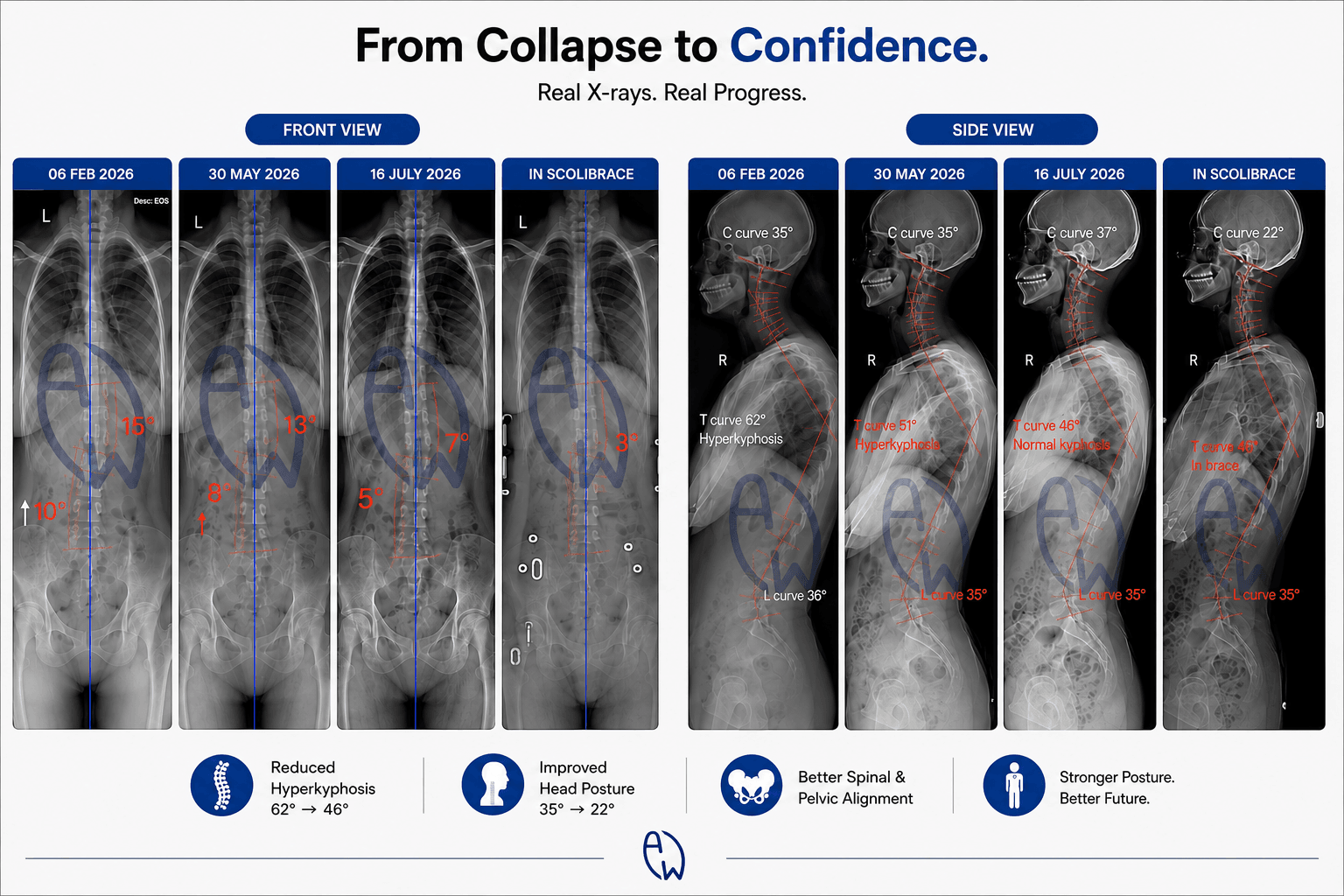
Sequential front and lateral X-rays of a 20-year-old university student with a 62° thoracic hyperkyphosis, forward head posture, mild scoliosis, pelvic rotation, and postural collapse. Images demonstrate progressive correction following intensive posture rehabilitation and a customized corrective ScoliBrace at All Well Scoliosis Centre, Singapore.
A 20-Year-Old Student Thought She Just Had Poor Posture. Her X-Rays Told a Very Different Story.
"I Thought I Just Had Bad Posture."
Many young adults believe slouching is simply part of student life.
Long lectures.
Late-night assignments.
Hours bent over a laptop.
Eventually, rounded shoulders and neck pain begin to feel normal.
That was exactly what our 20-year-old patient believed.
A bright, high-achieving university student, she assumed she simply had "bad posture."
What she didn't realize was that her body had already developed a 62° thoracic hyperkyphosis—a spinal deformity that was changing the mechanics of her entire body.
This wasn't just about looking slouched.
Her spine was affecting everything from her neck to her feet.
One Curve. A Whole Body of Compensation.
The human body is incredibly intelligent.
Whenever one part loses its ideal position, another part compensates to keep us standing upright and our eyes looking forward.
Think of it as a row of dominoes.
When the first domino falls, every domino behind it must adjust.
That is exactly what happened in her body.
Instead of seeing isolated problems, we saw one connected chain.
62° Thoracic Hyperkyphosis
↓
Forward Head Posture
↓
Rounded Mid Back
↓
Posterior Thoracic Translation
↓
Pelvic Rotation
↓
Mild Scoliosis
↓
Knock Knees
↓
Flat Feet
↓
Ankle Pain
↓
Constant Fatigue
Poor posture rarely stays in one place.
It spreads throughout the entire kinetic chain.
Why Hyperkyphosis Causes More Than Back Pain
Most people associate hyperkyphosis with a rounded upper back.
In reality, the consequences are much broader.
Forward Head Posture
As her thoracic spine rounded forward, her head shifted in front of her shoulders.
For every few centimetres the head moves forward, the neck muscles must work significantly harder to support its weight.
Instead of balancing effortlessly, her muscles spent every waking hour fighting gravity.
Posterior Thoracic Collapse
Her thoracic spine wasn't simply curved.
It had also translated backward.
This changed the position of her rib cage, limiting efficient breathing mechanics while making shoulder movement less stable.
Even standing still became more work than it should have been.
Pelvic Rotation
The body always tries to keep the eyes level.
When the upper body collapses forward, the pelvis often rotates in response.
This altered how she stood, walked, and distributed weight through both legs.
Mild Scoliosis
Although hyperkyphosis was her primary diagnosis, years of compensation had also produced a mild scoliosis.
Spinal deformities rarely occur alone.
One abnormal curve often encourages another.
Flat Feet, Knock Knees and Ankle Pain
The compensation continued all the way to the ground.
Her altered alignment increased stress through the knees, ankles and feet.
The result was:
-
Flat feet
-
Knock knees
-
Recurrent ankle pain
-
Early muscle fatigue
Many people treat these problems separately.
We see them as different symptoms of the same postural collapse.
Why Was She Always So Tired?
Interestingly, pain wasn't her biggest complaint.
Fatigue was.
Many people assume tiredness comes from lack of sleep.
Sometimes it comes from inefficient posture.
When posture collapses, muscles never truly rest.
Instead of your skeleton supporting your body efficiently, your muscles spend every minute trying to stop you from falling further forward.
Imagine carrying a heavy backpack from morning until night.
Now imagine that backpack is your own body.
That is how many people with significant postural collapse feel every day.
Genetics Loaded the Gun. Lifestyle Pulled the Trigger.
Many parents ask,
"Did studying cause this?"
Not entirely.
Her genetics likely made her more susceptible to developing excessive thoracic kyphosis.
However, genetics alone rarely explain the full picture.
As a high-achieving student, she spent years:
-
Studying for long hours
-
Reading textbooks
-
Looking down at notes
-
Working on a laptop
-
Sitting through lectures
The body is remarkably adaptive.
Unfortunately, it doesn't know whether the position you repeat is healthy or unhealthy.
It simply learns whatever you practice most.
Your body always adapts to the posture you repeat—not the posture you wish you had.
Your Brain Learns Posture
Many people think posture is simply about muscle strength.
It isn't.
Posture is controlled by the nervous system.
What people often call "muscle memory" is actually brain memory.
Every day, your brain reinforces the movements and positions you repeat.
After years of slouching, the brain begins to accept that posture as "normal."
That is why simply reminding yourself to "sit up straight" rarely works.
Within minutes, the brain returns to the pattern it knows best.
Real postural correction means teaching the brain an entirely new normal.
That requires repetition.
Consistency.
And purposeful rehabilitation.
Why She Chose Treatment Instead of a Holiday
When semester break arrived, she had the same choice many university students face.
Travel.
Relax.
Catch up with friends.
Instead, she made a decision that would benefit her long after graduation.
She chose to invest in her health.
For 12 intensive treatment days, she committed to rebuilding how her body moved.
Every session focused on retraining—not forcing—the body.
Her program included:
-
Postural rehabilitation
-
Mobility training
-
Balance retraining
-
Spinal stabilization
-
Muscle activation
-
Neuromuscular re-education
-
Walking mechanics
-
Functional strengthening
She wasn't simply exercising.
She was teaching her brain a completely new movement pattern.
The Golden Period for Postural Change
At just 20 years old, she was still within what we often describe as a golden period for rehabilitation.
Her nervous system remained highly adaptable.
Her muscles responded quickly.
Her movement patterns could still be reshaped before decades of compensation became deeply ingrained.
This doesn't mean older adults cannot improve.
They absolutely can.
However, changing twenty years of movement habits is generally easier than changing fifty.
The earlier intervention begins, the greater the opportunity to build healthier patterns for the future.
The Role of a Corrective ScoliBrace®
Exercise alone was never the goal.
To reinforce the changes achieved during rehabilitation, she was prescribed a customised ScoliBrace® designed specifically to address her excessive thoracic kyphosis.
Unlike traditional braces that simply immobilise the spine, a corrective ScoliBrace is designed to encourage three-dimensional postural correction while patients continue living their daily lives.
The brace complemented—not replaced—her rehabilitation.
It helped reinforce the posture her brain was learning during treatment.
Why Did She Improve So Much in Only 12 Days?
One question we are often asked is:
"Can a spine really change that quickly?"
The answer is more nuanced than many people expect.
Bones do not remodel dramatically in twelve days.
What changes first is something even more powerful.
The nervous system.
Her brain began recognising a healthier posture.
Her muscles activated differently.
Her balance improved.
Her breathing mechanics became more efficient.
The load through her spine changed.
As these changes accumulated, her posture improved—and the X-rays reflected that progress.
The images were not showing a miracle.
They were showing the result of purposeful, repetitive neurological and biomechanical retraining.
The X-Rays Told the Story
Her progress wasn't based on opinion.
It was measurable.
Follow-up X-rays demonstrated significant improvement.
-
Thoracic kyphosis improved from 62° to 46°, returning to a normal range.
-
Cervical alignment improved from 35° to 22°, reducing her forward head posture.
-
Pelvic alignment became more balanced.
-
Mild scoliosis reduced.
-
Her customised ScoliBrace® demonstrated excellent in-brace correction.
Perhaps even more importantly, she noticed improvements that no X-ray could fully capture.
Walking felt easier.
Standing required less effort.
Her ankles hurt less.
She had more energy.
Her body no longer felt like it was constantly fighting gravity.
At First, She Didn't Fully Believe It
She was like many young adults.
Sceptical.
Curious.
Unsure whether intensive rehabilitation could really make a difference.
We never expect patients to have blind faith.
Instead, we encourage them to trust the process, ask questions, and observe how their bodies respond.
As the days passed, she felt herself standing taller.
Moving more easily.
Breathing more comfortably.
Then the follow-up X-rays confirmed what she had already begun to feel.
From that moment, she never needed anyone to motivate her.
She simply kept showing up.
That is the kind of resilience we hope every patient develops—not because someone pushed them, but because they could see their own progress.
We Don't Push. We Walk Beside You.
Every patient begins their journey differently.
Some are ready immediately.
Others need time.
Our role is never to pressure anyone into treatment.
Our role is to educate, guide, and support.
When patients understand why they are doing something, they become active participants in their own recovery.
That is where lasting change begins.
Maintenance Is Where Transformation Becomes Permanent
Finishing an intensive program is not the finish line.
It is the beginning of a new chapter.
Just like learning a language or mastering a musical instrument, posture requires practice.
The body remembers what it repeats.
Maintenance includes:
-
Home rehabilitation
-
Regular reviews
-
Brace adjustments
-
Progressive strengthening
-
Ongoing posture awareness
Over time, these repeated movements become automatic.
Good posture is no longer something patients have to think about.
It becomes part of who they are.
The Real Lesson Isn't About Hyperkyphosis
This story isn't simply about correcting a 62° thoracic hyperkyphosis.
It is about making a decision.
A decision that many young adults postpone.
She gave up part of her holiday to invest in something far more valuable than a vacation.
She invested in the body that will carry her through the next sixty years.
Years from now, she may not remember the holiday she missed.
But every morning she stands taller, walks further, breathes easier, and lives with less pain, she will experience the return on that investment.
Because your twenties are not only for building a career.
They are also for building the body that will carry you through life.
Degrees may open doors.
But your posture determines how comfortably you walk through them.