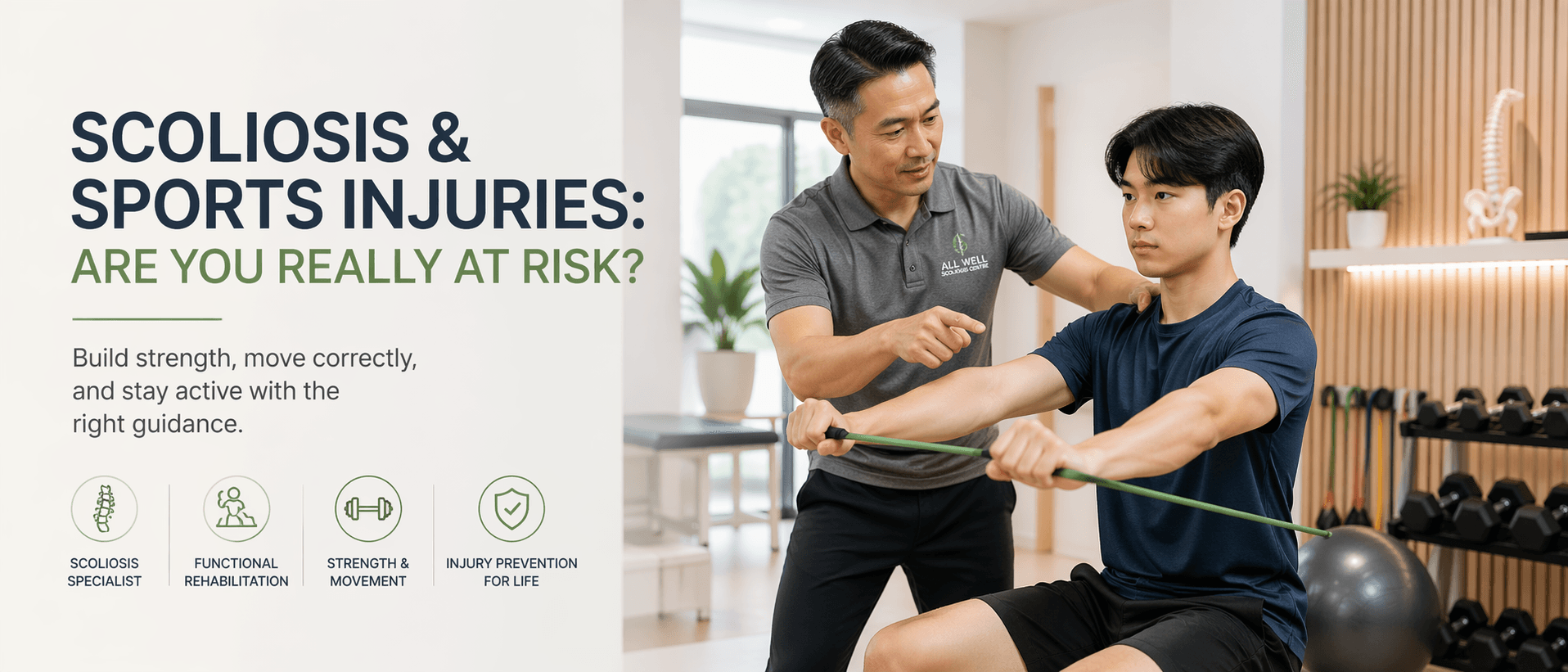
Scoliosis and Sports Injuries: Are You More at Risk?
Does Scoliosis Make You More Prone to Injury?
One of my scoliosis patients recently asked me a very honest question:
“Why do I see so many people here with sports injuries? Do they have scoliosis? Does scoliosis make them more prone to injury?”
It’s a good question—and one that many people are quietly wondering.
The answer is simple:
No, scoliosis alone does not make you more injury-prone.
What actually increases your risk of injury is:
-
Poor movement control
-
Muscle imbalances
-
Lack of proper conditioning
-
Training without proper guidance
These factors affect everyone—not just people with scoliosis.
Why Sports Injuries Are So Common
In reality, most sports injuries happen when the body is pushed beyond what it is prepared for.
It doesn’t matter whether you have scoliosis or not.
If your body lacks:
-
Stability
-
Strength
-
Coordination
You are at higher risk of injury.
This is why you see many active individuals—athletes, gym-goers, even young adults—ending up needing rehabilitation.
My Personal Journey Into Sports Rehabilitation
Movement has always been a big part of my life.
Growing up, I was extremely active. I spent more time moving than sitting still, which worried my family at one point. But despite that, I consistently performed well in school.
I was involved in many activities:
-
Skateboarding
-
Cycling
-
Volleyball
-
Basketball
-
Snowboarding
That lifestyle continued until I experienced a shoulder injury from a fall.
The Injury That Changed My Direction
That injury became a turning point.
At the time, I was in California, and the doctor I consulted made a decision that shaped my entire career.
Instead of recommending surgery or inserting any artificial hardware, he advised:
Rest and structured rehabilitation.
No unnecessary intervention—just allowing the body to heal properly.
Through sports rehabilitation, I didn’t just recover. I became stronger.
How Strength Training Changed My Perspective
After my recovery, I started training in the gym regularly.
Weight-bearing exercises became part of my daily routine, and I noticed:
-
Faster recovery
-
Improved joint stability
-
Better overall strength
This experience changed how I viewed the body.
I realised that movement, when done correctly, is one of the most powerful tools for healing.
That was the moment I decided to shift my career path—from pursuing orthopaedics to becoming a chiropractor.
My Training and Clinical Foundation
After completing my bachelor’s degree in biology (pre-med), I changed my path and enrolled in a six-year chiropractic program, where I earned my Doctorate in Chiropractic.
At the same time, I was working part-time as a personal trainer at 24 Hour Fitness while studying chiropractic.
To become a personal trainer in the United States, I had to be trained and licensed in:
-
Human anatomy and biomechanics
-
Nutrition
-
Geriatric care
-
First aid and sports injury management
This combination of academic training and hands-on experience gave me a strong foundation in movement, rehabilitation, and injury prevention.
During that time, I worked with a wide range of individuals:
-
People trying to lose weight
-
Clients building muscle
-
Individuals improving balance and coordination
-
Elderly patients maintaining mobility
That exposure deepened my interest in sports medicine and functional rehabilitation.
Why I Chose to Focus on Scoliosis
In chiropractic, there are postgraduate pathways to specialise in sports chiropractic and work with professional athletes.
I considered that path.
However, I made a conscious decision to focus on scoliosis instead.
I believed that with my background in chiropractic and personal training, I already had strong tools to manage movement, rehabilitation, and injury prevention.
Rather than going broader, I chose to go deeper—into scoliosis care.
What Scoliosis Patients Need to Understand About Exercise
Scoliosis does not mean you should avoid sports or physical activity.
In fact, avoiding movement often creates more problems.
What matters is how you move.
Scoliosis patients should focus on:
-
Proper movement patterns
-
Core stability and spinal control
-
Gradual progression in training
-
Structured, individualised exercise programs
With the right guidance, you can:
-
Go to the gym
-
Participate in sports
-
Build strength safely
When Should You Be Concerned?
You should consider a professional assessment if you experience:
-
Recurrent injuries
-
Persistent pain during or after activity
-
Uneven posture or movement
-
Lack of progress despite regular training
These are signs that your body is compensating—and needs proper guidance.
Scoliosis Treatment in Singapore: Why Proper Guidance Matters
Many patients in Singapore rely only on temporary pain relief or continue training without fully understanding their condition.
This often leads to repeated injuries.
At All Well Scoliosis Centre, the focus is on:
-
Non-invasive scoliosis treatment
-
Functional, movement-based rehabilitation
-
Addressing the root cause—not just symptoms
Final Takeaway
Scoliosis is not the reason people get injured.
Poor preparation is.
The goal is not to avoid activity—but to:
-
Build strength
-
Improve control
-
Move with awareness
-
Reduce injury risk
With the right approach, scoliosis patients can live active, strong, and confident lives.
Book an Assessment
If you or your child has scoliosis and wants to stay active safely, proper guidance is essential.
At All Well Scoliosis Centre, we focus on structured, non-invasive care designed for real-life movement—not just temporary relief.
Book an assessment today and take the first step toward safer movement and long-term spine health.