Can Scoliosis Improve Without Surgery?
The Discipline Most People Underestimate
When parents or adults come to us at All Well Scoliosis Centre, they usually ask the same question:
“Can scoliosis really improve without surgery?”
The honest answer?
Yes — but not casually.
And that is where most skepticism begins.
Why 1 Hour a Week Is Usually Not Enough
Scoliosis is not just a posture issue. It is a three-dimensional spinal adaptation. The body has learned a certain pattern over years.
Relearning that pattern requires:
-
Repetitive neuromuscular retraining
-
Targeted muscle activation
-
Structural guidance
-
Consistency
One or Three hours of general exercise per week — even Pilates — may be beneficial for overall wellness. But it is rarely intensive enough to reverse years of spinal compensation.
That is not criticism.
That is physiology.
What Makes Structured Programs Different
There are only two medically recognised pathways for scoliosis:
-
Surgery
-
Conservative structured intervention (e.g., bracing and specific corrective training)
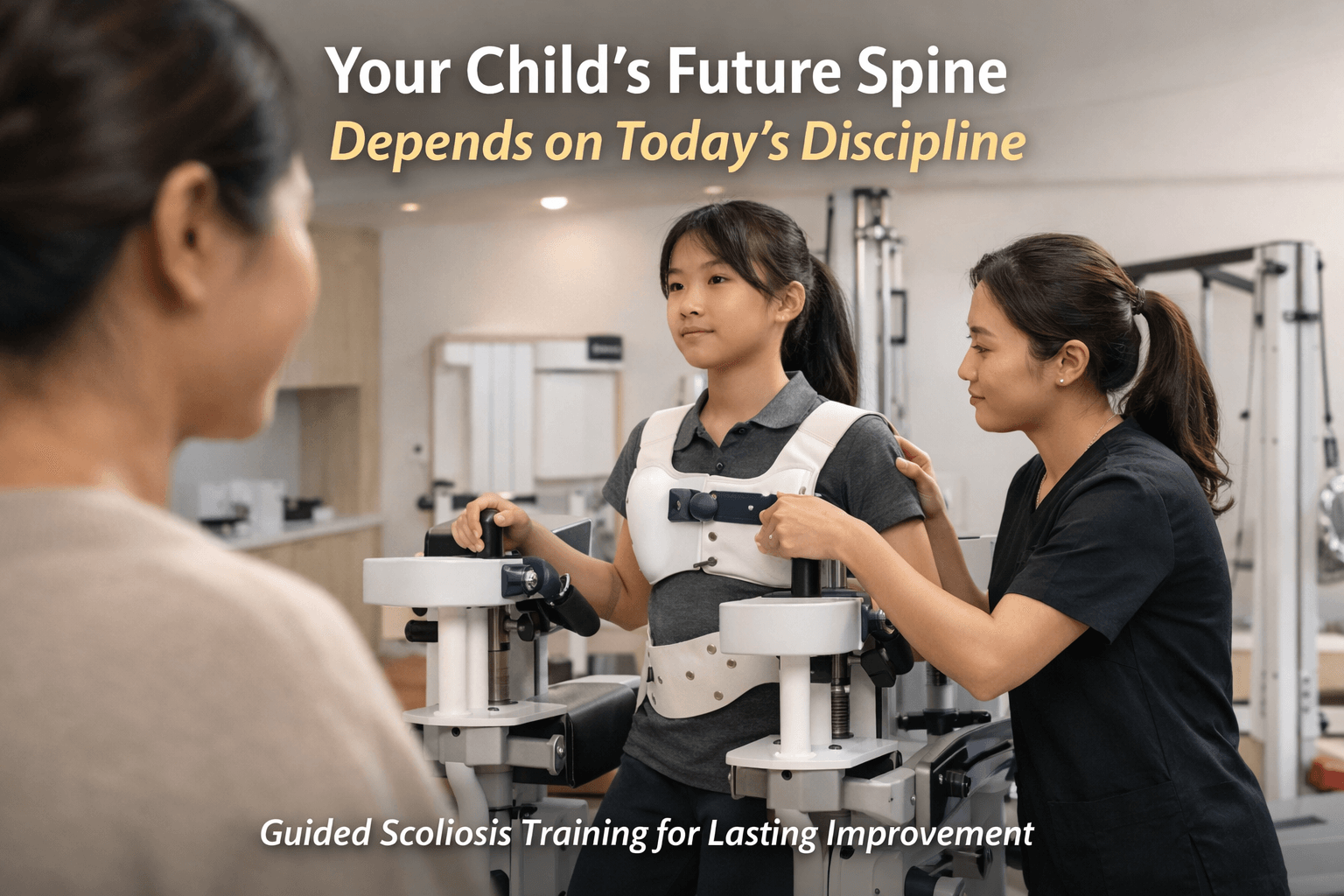
At our centre, we integrate structured rehabilitation with systems like ScoliBrace, supported by assisted training machines and a 14-day intensive programme designed to accelerate neuromuscular adaptation.
The purpose is simple:
To help the body relearn alignment faster and more effectively than passive exercise alone.
And yes — we have seen measurable improvement.
Not sometimes.
Consistently.
But improvement does not happen because of a machine.
It happens because of discipline.
Why Skepticism Is Natural
Singapore is efficient. Structured. Results-driven.
Parents and professionals want proof — not promises.
We understand that.
That is why we track progress with objective measurement and imaging. That is why we show before-and-after data carefully and responsibly.
But here is where we are cautious:
Results are not a competition.
Every spine is different.
Every lifestyle is different.
Every commitment level is different.
We do not compare patients against one another.
We measure each individual against their own baseline.
The real competition is not between patients.
It is between consistency and excuses.
The Part Nobody Likes to Hear
Some people do not improve as much as they hoped.
Not because the structure failed.
But because showing up consistently is harder than expected.
Fourteen days of intensive retraining requires priority shifts:
-
Time management
-
Lifestyle adjustment
-
Nutrition support (especially adequate protein)
-
Sleep correction
-
Posture awareness outside the clinic
Scoliosis is dynamic. Curves can increase. Curves can decrease.
Stabilisation is the foundation. Improvement builds on top of that.
But none of it works without disciplined participation.
Reducing Skepticism Without Bragging
We do not believe in exaggerated claims.
Instead, we invite observation.
If you are skeptical, that is healthy.
But skepticism should lead to investigation — not dismissal.
That is why we encourage trial sessions.
Not to convince you with words.
But to let you experience:
-
The assisted corrective system
-
The muscle activation process
-
The structural guidance
-
The intensity required
Once you understand what your spine is actually doing during training, the logic becomes clearer.
Discipline Is Not Punishment — It Is Structure
When people hear “discipline,” they imagine restriction.
In reality, discipline is structure.
Structure reduces uncertainty.
Structure accelerates adaptation.
Structure protects long-term outcomes.
Without structure:
-
Curves may progress quietly.
-
Muscles continue compensating.
-
The body defaults to imbalance.
With structure:
-
The spine receives consistent corrective input.
-
Muscles relearn balance.
-
Stabilisation becomes achievable.
Freedom in movement later requires discipline now.
Education, Not Blind Following
We do not ask patients to “just trust.”
We encourage:
-
Asking questions
-
Understanding pros and cons
-
Learning the science behind each method
-
Thinking critically
Scoliosis is not rigid. Nothing in the human body is permanent.
That is exactly why intervention matters early.
And exactly why discipline changes outcomes.
So What Is the Real Question?
It is not:
“Does this work?”
The better question is:
“Am I ready to commit to a structured approach?”
Because this program is not for everyone.
It is for families and individuals who:
-
Want measurable progress
-
Understand that intensity creates adaptation
-
Value realistic expectations
-
Are ready to prioritise their spine
If you are curious — come for a trial.
See the structure.
Feel the activation.
Understand the difference.
Then decide.
Because discipline is not about being extreme.
It is about being intentional.
And intentional action is what shapes your future spine.
Medical Disclaimer
This article is for educational purposes only and does not constitute medical advice.
Scoliosis varies significantly between individuals. Always consult a qualified healthcare professional before starting any new sport or exercise program, especially if you have scoliosis, spinal conditions, pain, or previous injuries. Participation in sports should be guided by individual assessment and professional recommendation.
The image is shared for educational purposes with patient consent. Individual outcomes vary. Structural correction does not automatically restore full respiratory function. Clinical assessment is required.
Copyright & Content Protection Notice
© 2026 All Well Scoliosis Centre. All rights reserved.
This content is original and protected by copyright law.
No part of this article may be reproduced, distributed, copied, or reused in any form without prior written permission. Unauthorized use, duplication, or content scraping is strictly prohibited.