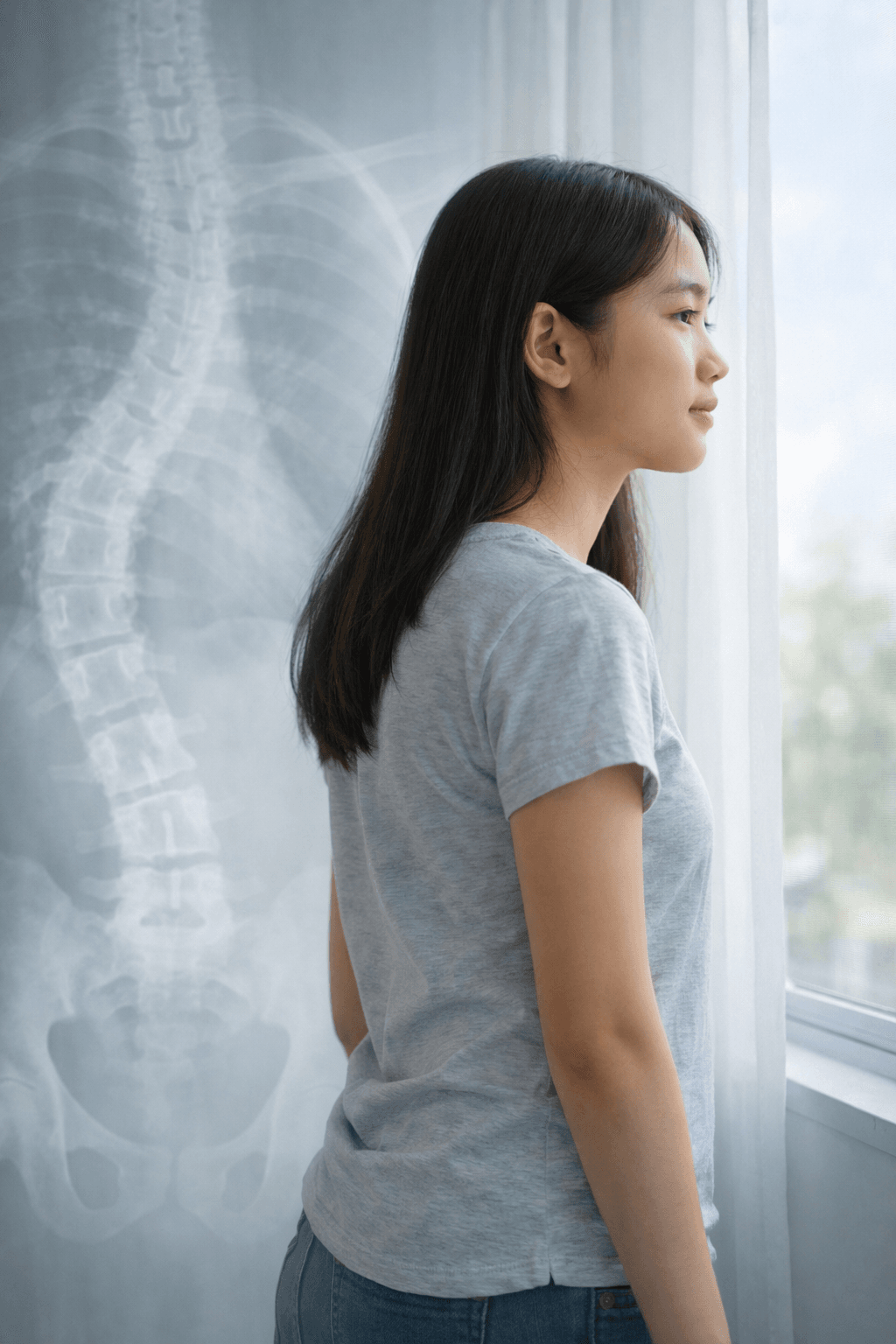
How Fast Does Scoliosis Progress in Teenagers?
What Every Parent in Singapore Needs to Know
One of the most common questions I receive during a first consultation is:
“How fast will my teenager’s scoliosis get worse?”
The honest answer?
There is no fixed number.
Scoliosis progression is not a straight-line prediction. It depends on multiple biological and lifestyle factors — and that is why regular monitoring and informed decision-making are critical.
Understanding Adolescent Scoliosis
Most teenage cases fall under Adolescent Idiopathic Scoliosis (AIS) — the most common type of scoliosis diagnosed between ages 10–18.
Research published in the journal Spine and other orthopedic literature shows that:
-
Curves below 20° may remain stable
-
Curves between 20°–40° have a higher risk of progression
-
Curves above 40°–50° during growth spurts are more likely to worsen and may require surgical discussion
However, progression risk is strongly influenced by:
-
Skeletal maturity (Risser sign)
-
Puberty stage
-
Growth velocity
-
Curve pattern and location
-
Family history
-
Overall body condition
According to the Scoliosis Research Society, curves in adolescents can progress 1–2 degrees per month during peak growth periods in high-risk individuals. But this is not universal. Some curves remain stable for years.
That is why we always emphasize:
Nothing in scoliosis is fixed. Everything must be monitored.
Why Yearly (Sometimes 6-Monthly) X-Rays Matter
Numbers guide decisions.
Scoliosis is measured using the Cobb angle via X-ray imaging. Without periodic imaging:
-
You won’t know if the curve is stable
-
You won’t know if intervention timing is appropriate
-
You may miss a rapid growth phase progression
For growing teenagers, yearly X-rays — and sometimes every 6 months during growth spurts — are essential to track progression objectively.
Monitoring is not fear-based.
It is clarity-based.
“Will It Definitely Get Worse?”
Not necessarily.
Some teenagers experience minimal progression. Others may worsen rapidly during puberty. Studies published in The Journal of Bone and Joint Surgery show that the greatest risk of curve progression occurs:
-
During early puberty
-
In patients with low skeletal maturity
-
In curves already above 25°
But here is something equally important:
While structural curvature progression follows biological rules, functional well-being is lifestyle-influenced.
Breathing quality
Sleep quality
Postural awareness
Muscle conditioning
Stress levels
Mental resilience
All of these affect how the body adapts to the curve.
Anything that helps your child:
-
Breathe better
-
Sleep better
-
Focus better in school
-
Improve mental headspace
… is moving in the right direction.
Nothing Is Instant — Even Surgery Is Not “Permanent”
There is a dangerous myth in scoliosis management:
“Once you fix it, it’s fixed.”
That is not how biology works.
Even in surgical cases using titanium instrumentation, long-term follow-up studies show that spinal rods can experience:
-
Mechanical fatigue
-
Micro-bending
-
Rod breakage (rare but documented)
Research published in Spine and European Spine Journal has documented cases of rod deformation and mechanical complications over time due to repetitive biomechanical stress.
For example:
-
A 2012 study in Spine reported mechanical failure rates in adolescent scoliosis instrumentation over long-term follow-up.
-
A 2018 review in European Spine Journal discussed implant fatigue and rod strain under repetitive loading conditions.
Titanium is strong — but it is not immune to physics.
The spine continues to experience:
-
Daily loading
-
Gravity
-
Movement
-
Growth changes (in younger patients)
This is not meant to scare you.
It is meant to remind you:
Nothing in healthcare is “magic.” Everything has consequences.
Be Proactive — Even If You’re Not Ready to Commit to a Program
If you are not ready to commit to a structured scoliosis program, that is okay.
But do not be passive.
You can:
-
Study reputable online preventive tools
-
Learn breathing mechanics
-
Improve ergonomic setup for study
-
Strengthen core stability
-
Improve sleep posture
-
Maintain healthy body composition
Just make sure you use common sense.
Not every trending exercise is suitable.
Not every coach understands spinal deformity.
Not every doctor communicates thoroughly.
Do your research.
Ask questions.
Cross-check information.
Healthcare decisions should never be based on one opinion alone — especially when someone promises a “complete fix.”
It would be unethical to guarantee that.
Do Not Be Dependent on One Option
Scoliosis management should be:
-
Informed
-
Multidisciplinary
-
Monitored
-
Disciplined
Not emotional.
Not fear-driven.
Not blind trust.
Speak to:
-
Your orthopedic doctor
-
Your rehabilitation provider
-
Your exercise professional
Then reflect.
Make your own decision after understanding:
-
Risks
-
Benefits
-
Long-term commitment
-
Possible consequences
And once you decide — commit with discipline.
Because nothing works without consistency.
Why Regular Checks Reduce Fear
Scoliosis feels scary because it feels uncertain.
But uncertainty reduces when you:
-
Check regularly
-
Understand your numbers
-
Track growth
-
Track posture
-
Track symptoms
Clarity replaces fear.
That is our role — not to pressure you into treatment,
but to ensure you fully understand what you are dealing with.
Final Thoughts: Think Wisely
Scoliosis progression in teenagers can be slow, moderate, or rapid.
It depends on growth, biology, and monitoring.
There is no shortcut.
There is no instant fix.
There is no permanent guarantee.
Even titanium rods can bend over time under mechanical stress.
So think wisely.
Do your research.
Ask many questions.
Make your own informed decision.
Commit to the process.
And monitor consistently.
Because when it comes to scoliosis —
knowledge and discipline are more powerful than fear.
Medical Disclaimer
This article is for educational purposes only and does not constitute medical advice.
Scoliosis varies significantly between individuals. Always consult a qualified healthcare professional before starting any new sport or exercise program, especially if you have scoliosis, spinal conditions, pain, or previous injuries. Participation in sports should be guided by individual assessment and professional recommendation.
The image is shared for educational purposes with patient consent. Individual outcomes vary. Structural correction does not automatically restore full respiratory function. Clinical assessment is required.
Copyright & Content Protection Notice
© 2026 All Well Scoliosis Centre. All rights reserved.
This content is original and protected by copyright law.
No part of this article may be reproduced, distributed, copied, or reused in any form without prior written permission. Unauthorized use, duplication, or content scraping is strictly prohibited.