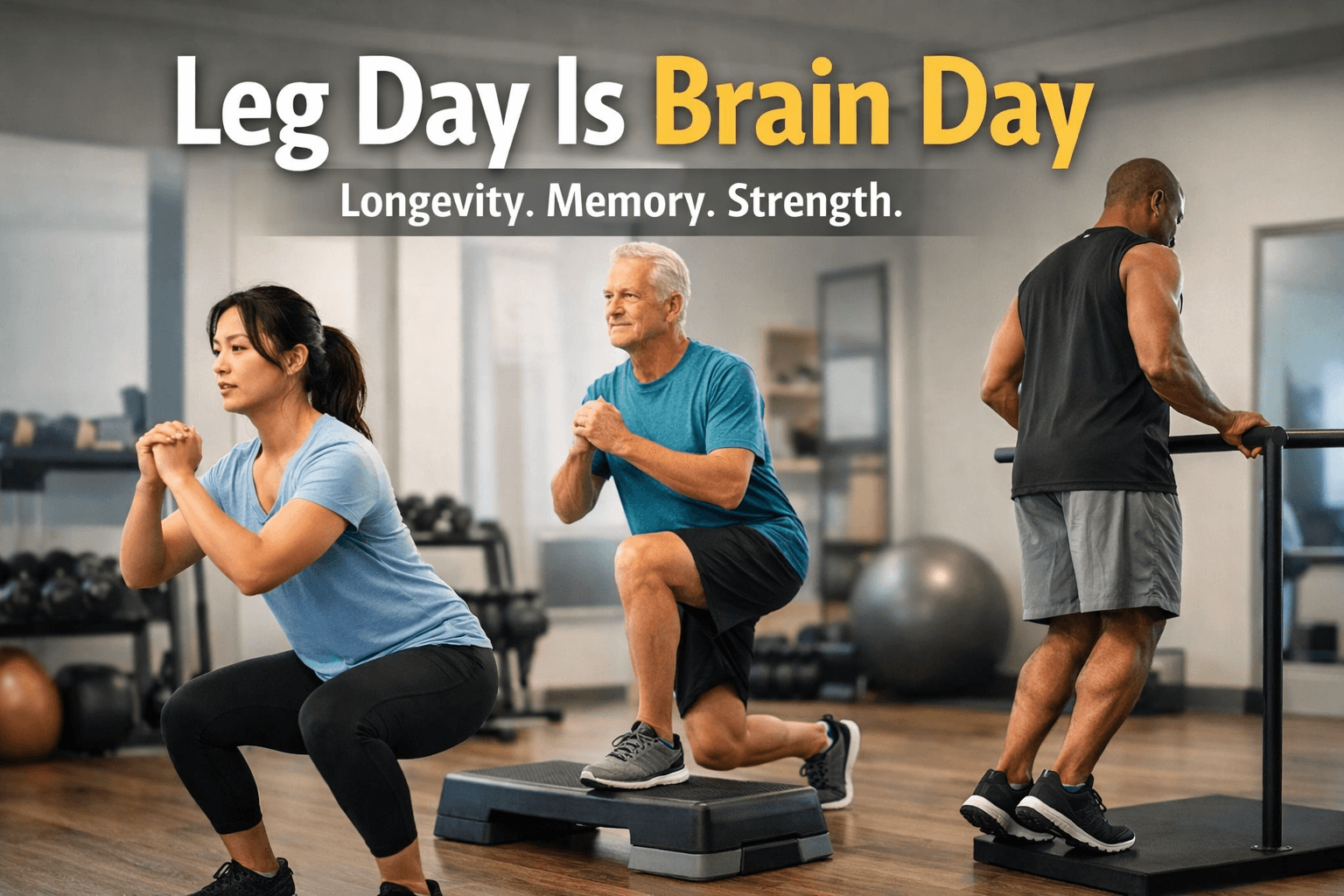
Leg Day Benefits: Why Lower Body Strength Is Critical for Longevity, Brain Health & Independence
Most people treat leg day as optional.
Upper body gets the attention. Core gets the focus. But legs? Skipped when time is tight.
That’s a mistake — and not just for fitness goals.
Science is now clear: lower-body strength is one of the strongest predictors of how long you live, how well your heart functions, and even how well your brain ages.
Leg Strength Predicts How Long You Live
Your lower body contains the largest muscle groups in your body — glutes, quadriceps, hamstrings, and calves.
These muscles are not just for movement. They are deeply connected to your survival.
A large-scale meta-analysis involving nearly 2 million people, aligned with research referenced by the American Heart Association, found:
👉 Higher muscular strength is strongly associated with lower all-cause mortality
And more importantly:
👉 Lower-body strength plays a disproportionately large role in this effect
Your Legs Are Your Second Heart
Your calves function as a powerful muscle pump, pushing blood back toward your heart.
Researchers like C Recek and M Halkar demonstrated that:
-
Strong calf muscles improve venous circulation
-
Poor calf pump function is linked to higher mortality risk
In modern lifestyles — especially in Singapore’s sedentary work culture — this becomes critical.
Weak legs don’t just reduce strength. They reduce circulation efficiency across your entire body.
Strong Legs, Strong Heart
According to the 2024 update from the American Heart Association:
-
Resistance training improves blood pressure
-
Enhances vascular health
-
Reduces cardiovascular risk
Lower-body exercises like squats and lunges activate large muscle groups, creating stronger cardiovascular adaptations than isolated upper-body workouts.
Quadriceps Strength Predicts Survival
In cardiology research led by K Kamiya:
Quadriceps strength was identified as a powerful predictor of mortality in patients with coronary artery disease
This reveals something profound:
👉 Your ability to generate force through your legs reflects your body’s overall resilience.
Leg Strength Prevents Falls and Protects Independence
A 2025 meta-analysis by RTL Zhu confirmed:
-
Lower limb weakness significantly increases fall risk
-
Stronger legs reduce both past and future falls
This is especially important as we age.
Because the real threat isn’t just disease — it’s loss of independence.
🧠 The Missing Link: Leg Strength and Brain Health
Here’s where things become even more powerful.
Neurology research now shows that leg strength is directly linked to brain function and dementia risk.
Neurologists: Leg Training Can Reduce Alzheimer’s Risk
Neurologists like Ayesha Sherzai and Dean Sherzai highlight that:
👉 Stronger leg muscles are associated with significantly lower risk of Alzheimer’s disease
Twin studies (which control for genetics) suggest:
- Individuals with stronger legs had up to 47% lower risk of cognitive decline
The Muscle–Brain Connection
Your muscles — especially in the legs — act like an endocrine organ.
When you train your legs, your body releases brain-protective chemicals such as:
-
BDNF (Brain-Derived Neurotrophic Factor) → supports neuron growth
-
Irisin → linked to improved cognitive function
-
IGF-1 → enhances brain plasticity
These compounds:
-
Improve memory
-
Protect against neurodegeneration
-
Reduce inflammation in the brain
👉 In simple terms:
Training your legs sends protective signals directly to your brain.
Movement Fuels the Brain
There is a deep neurological connection between movement and cognition.
Lower body training:
-
Increases blood flow to the brain
-
Improves oxygen delivery
-
Stimulates neural pathways linked to coordination and memory
This is why early signs of cognitive decline often include:
-
Slower walking speed
-
Poor balance
-
Reduced leg strength
👉 Before memory loss becomes obvious, movement declines first.
Exercise Improves Cognitive Function in Alzheimer’s Patients
Clinical studies show that structured exercise programs (including leg training):
-
Improve memory and executive function
-
Increase brain repair markers like BDNF
-
Enhance overall quality of life
At the same time, patients who lose lower limb strength tend to experience faster cognitive decline.
The Hidden Cost of Skipping Leg Day
When you neglect your legs, you’re not just losing muscle.
You’re accelerating:
-
Poor circulation
-
Reduced brain stimulation
-
Increased fall risk
-
Faster aging — both physically and cognitively
This creates a dangerous cycle:
Weak legs → less movement → reduced brain activity → higher dementia risk
How to Train Leg Day (Safely and Effectively)
You don’t need extreme workouts — you need consistent, intentional movement.
Foundational Exercises
-
Squats (or assisted squats)
-
Lunges
-
Step-ups
-
Hip hinges (deadlifts, bridges)
-
Calf raises
Key Principles
-
Train 2–3 times per week
-
Focus on control and alignment
-
Progress gradually
-
Prioritize quality over intensity
Special Consideration: Spine Health & Scoliosis
For patients with spinal conditions:
-
Avoid generic symmetrical loading
-
Use targeted, asymmetrical exercises
-
Focus on pelvic alignment and controlled activation
👉 The goal is not just strength — but balanced, functional strength that supports the spine.
The Bottom Line
Leg day is not about aesthetics.
It is one of the most powerful tools you have to:
-
Live longer
-
Protect your heart
-
Maintain independence
-
Prevent falls
-
Preserve your brain
Train your legs, and you are training your future — physically, neurologically, and functionally.