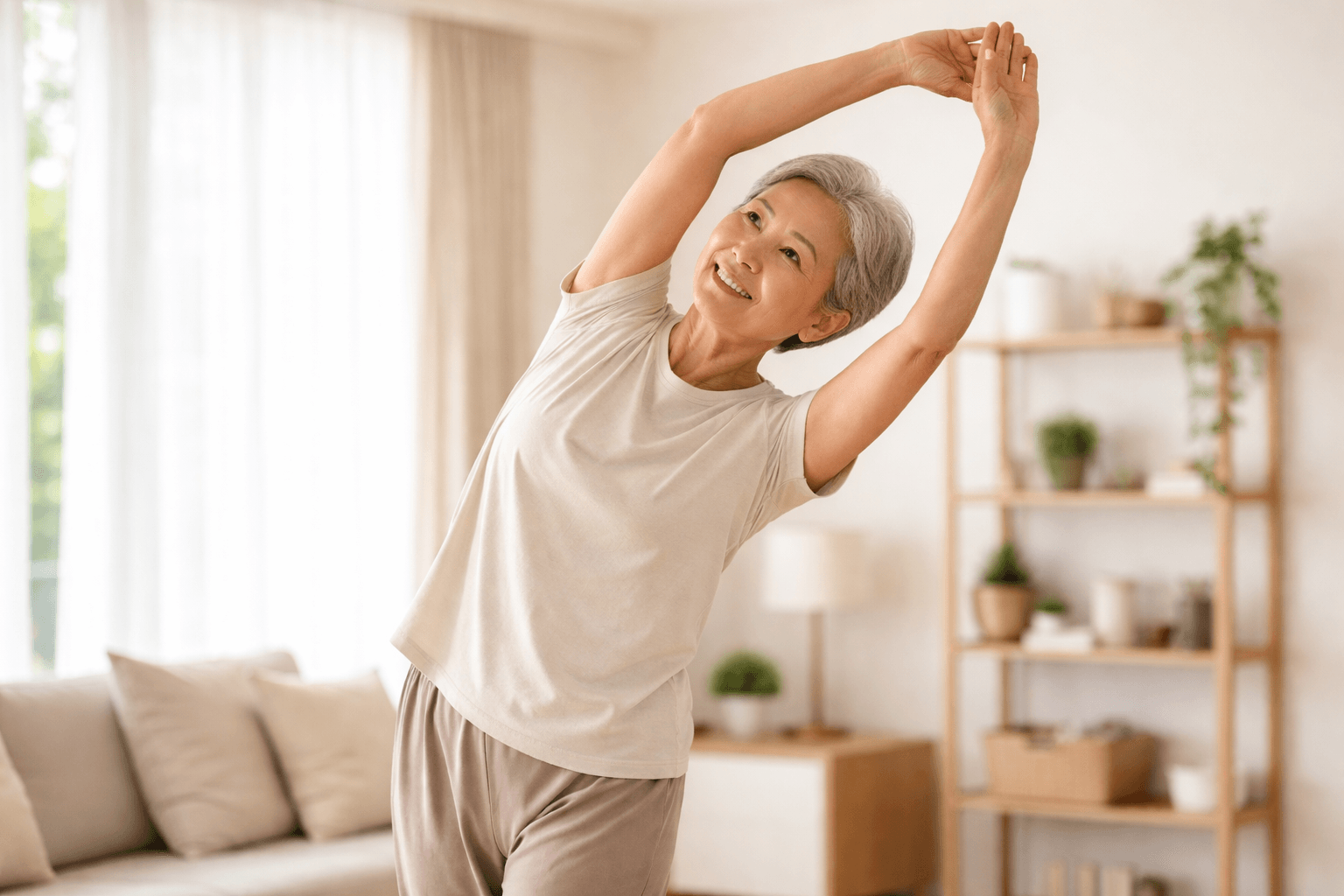
Coordination, Flexibility, Mobility & Strength:
The Real Recipe for Longevity and Independent Living
Longevity is not just about living longer — it’s about living well.
Being able to move with confidence, take care of yourself, and participate fully in daily life is what truly defines healthy aging.
In clinical practice, the most common frustrations patients share are rarely about pain alone. They are about loss of independence.
-
“I can’t pull my luggage after a long flight.”
-
“Washing dishes manually feels exhausting.”
-
“I struggle to wash my own hair or clean my body properly.”
-
“I want to help care for my grandchildren, but I can’t lift them.”
-
“I feel stiff, slow, and afraid of falling.”
These are not sudden problems.
They are the result of years of gradual decline in coordination, flexibility, mobility, and muscle strength — systems that must work together to support longevity.
Longevity Is a Brain–Body Conversation
Movement is not just mechanical.
It is neurological.
Every intentional movement you make — bending, lifting, reaching, walking — begins in the brain. Your brain sends a command, your nerves transmit it, your muscles execute it, and your joints move through space.
When this communication weakens, movement becomes:
-
Slower
-
Less precise
-
More energy-consuming
-
Higher risk for injury or falls
This is why coordination matters just as much as strength.
Longevity depends on how well your brain waves understand and execute the commands you give your body.
Why Strength Alone Is Not Enough
Many people believe that building muscle alone is the key to aging well.
Strength is essential — but strength without mobility and coordination is incomplete.
To function well in daily life, you need four pillars working together:
1. Coordination
Coordination allows movements to be smooth, efficient, and safe.
It’s what helps you:
-
Catch yourself when you trip
-
Adjust your grip when lifting groceries
-
Transition from sitting to standing without hesitation
Without coordination, even strong muscles can fail you in real-life situations.
2. Flexibility
Flexibility allows muscles and connective tissues to lengthen appropriately.
When flexibility declines:
-
Movements become restricted
-
Compensation patterns develop
-
Daily tasks feel harder than they should
Simple activities like washing your hair, reaching your back, or bending to clean become uncomfortable or impossible.
3. Mobility
Mobility is active control through range of motion.
It’s the difference between:
-
Being able to move a joint
versus
-
Being able to control that movement with strength and balance
Good mobility allows you to:
-
Squat safely
-
Rotate your spine
-
Reach overhead without strain
4. Muscle Strength (and Bone Health)
Muscle and bone loss accelerates with age — especially if movement is limited.
This affects:
-
Posture
-
Balance
-
Joint protection
-
Metabolic health
Weight-bearing and resistance exercises are non-negotiable for longevity.
Aging Makes the Body Less Communicative — Unless You Train It
As we age:
-
Nerve signaling slows
-
Muscle mass decreases
-
Bone density reduces
-
Reaction time lengthens
This makes the body less responsive to the brain’s commands.
The solution is not to avoid movement —
it is to practice intentional movement daily.
Longevity is built gradually, not instantly.
Daily Movement Is Not Optional — It Is Medicine
To maintain independence, the body needs consistent input:
✅ Daily Movement
-
Walking
-
Gentle transitions
-
Purposeful use of joints through full ranges
✅ Daily Stretching
-
Keeps tissues hydrated
-
Preserves joint range
-
Reduces stiffness and pain
✅ Cardio Exercise
-
Supports heart and brain health
-
Improves endurance for daily tasks
✅ Weight-Bearing & Resistance Exercise
-
Preserves muscle and bone
-
Protects joints
-
Improves balance and confidence
✅ Proper Nutrition
-
Supports muscle repair
-
Maintains bone health
-
Fuels neurological function
✅ Quality Sleep
-
Essential for tissue repair
-
Restores brain–body communication
✅ Brain Challenge
-
Learning new movements
-
Balance training
-
Coordination exercises
This combination is what rejuvenates the body, not shortcuts or passive treatments.
Independence Is Built Long Before You Need It
Many patients wish they had started earlier.
Longevity is not something you activate at retirement age.
It is built daily, through intentional choices.
The ability to:
-
Care for your hygiene
-
Travel confidently
-
Lift your grandchildren
-
Be useful, present, and independent
All of this depends on how well you move — not just how long you live.
Our Role — And Yours
We can:
-
Assess
-
Educate
-
Guide
-
Correct movement patterns
-
Support you through the process
But we cannot move your body for you.
You must take ownership.
Change happens at the pace of your commitment — fast or slow, that choice is yours.
We are facilitators.
We strive to be your confidant and guide.
But you are the decision-maker for your body and your future.
Final Thought: Longevity Is a Skill You Practice
Movement is a language.
If you stop speaking it, the body forgets.
The goal is not perfection —
the goal is consistent, intentional movement for life.
Medical Disclaimer The information provided in this article is for general educational purposes only and does not constitute medical advice, diagnosis, or treatment. Individual conditions and responses to exercise may vary. This content is not a substitute for professional medical consultation, diagnosis, or treatment by a qualified healthcare professional. Always seek advice from your doctor or a licensed healthcare provider before starting any new exercise, movement, or rehabilitation programme, especially if you have pre-existing medical conditions. In accordance with Singapore Ministry of Health (MOH) guidelines, results are not guaranteed and outcomes depend on individual compliance, health status, and lifestyle factors.