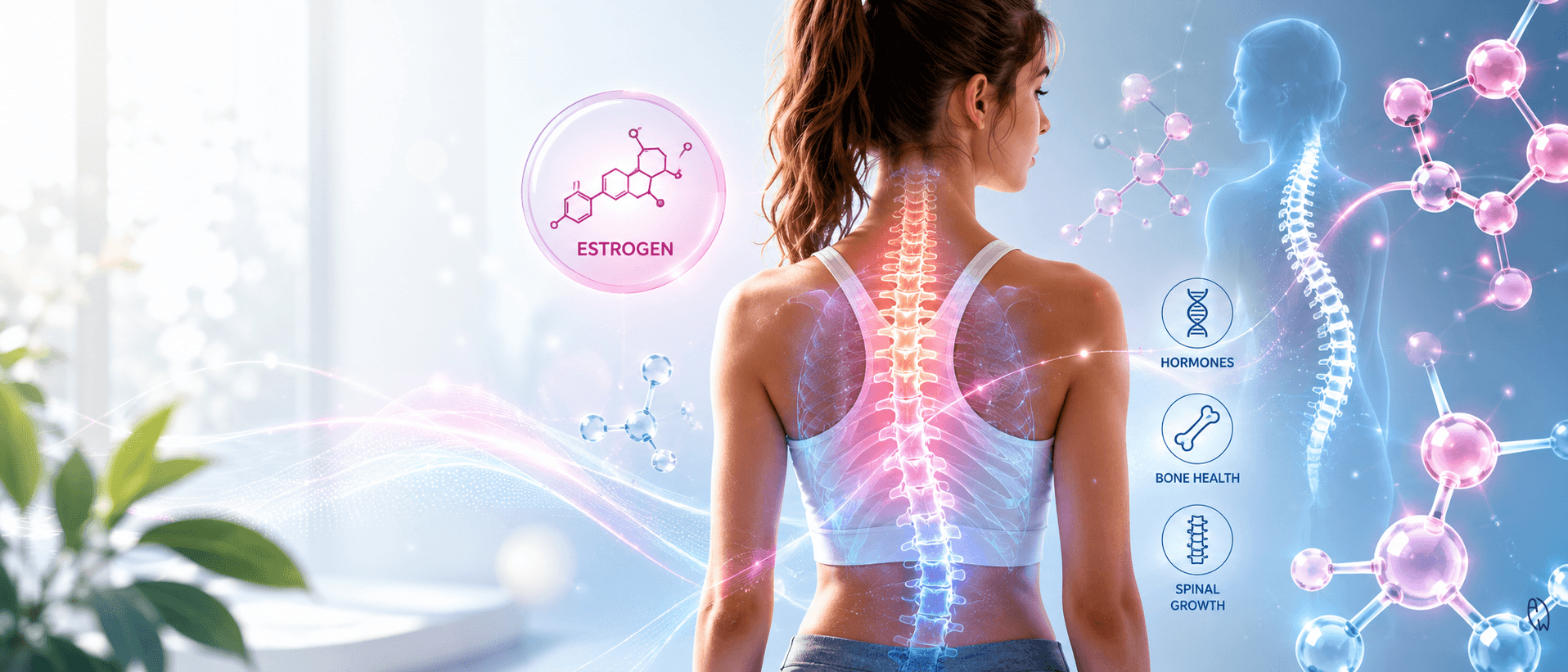
The Estrogen–Scoliosis Connection: Can Hormones Influence Spinal Curvature?
Many parents notice that scoliosis seems to appear or worsen during puberty, especially in girls. This often leads to an important question:
Can estrogen cause scoliosis?
The answer is not as simple as yes or no.
Current research suggests that estrogen does not directly cause scoliosis. However, estrogen may play an important role in how scoliosis develops, progresses, and affects growing adolescents. Scientists have been studying this connection for decades because adolescent idiopathic scoliosis (AIS) is significantly more common in girls than boys.
Let's explore what current research tells us about the relationship between estrogen and scoliosis.
What Is Estrogen?
Estrogen is a hormone primarily produced by the ovaries in females, but men naturally produce estrogen as well, although in much smaller amounts.
In the male body, testosterone can be converted into a form of estrogen called estradiol through the action of an enzyme known as aromatase. This estrogen plays important roles in men's:
-
Bone health
-
Brain function
-
Sexual health and well-being
Estrogen helps regulate:
-
Puberty and sexual development
-
Bone growth and bone density
-
Menstrual cycles
-
Muscle and ligament function
-
Growth plate maturation
-
Nervous system development
Because estrogen influences many systems involved in spinal growth and stability, researchers have investigated whether hormonal changes may contribute to scoliosis progression.
Why Is Scoliosis More Common in Girls?
One of the biggest clues pointing toward a hormonal connection is that girls are much more likely to experience curve progression than boys.
While mild scoliosis affects both genders, girls are several times more likely to develop curves severe enough to require treatment.
Researchers believe this difference may be influenced by:
-
Hormonal changes during puberty
-
Differences in skeletal growth patterns
-
Bone metabolism
-
Connective tissue characteristics
-
Neurological development
Estrogen is believed to interact with all of these factors.
Why Does Scoliosis Often Progress During Puberty?
Puberty is one of the fastest growth periods in human life.
During this time:
-
Bones lengthen rapidly
-
Growth plates remain active
-
Hormones fluctuate significantly
-
Muscle development may lag behind skeletal growth
For adolescents already predisposed to scoliosis, this rapid growth can create a window where spinal curves progress more quickly.
This is why many scoliosis specialists closely monitor children during growth spurts.
Parents often notice that a curve appears to worsen shortly before or after the first menstrual period, a time when estrogen levels rise dramatically.
Because the male growth spurt lasts longer and occurs later than in females, boys with idiopathic scoliosis often develop their curves later but can experience progression over a longer period. This difference in growth timing may partly explain why scoliosis patterns can vary between boys and girls during adolescence.
Does Estrogen Cause Scoliosis?
At present, researchers do not believe estrogen alone causes scoliosis.
Instead, estrogen may be one piece of a much larger puzzle involving:
-
Genetics
-
Growth regulation
-
Bone development
-
Neurological control
-
Connective tissue health
-
Hormonal signaling
Think of estrogen as a factor that may influence how scoliosis behaves rather than being the root cause.
Estrogen Receptors Have Been Found in Scoliosis Research
Researchers have identified estrogen receptors in spinal tissues and bone cells.
Estrogen receptors act like communication stations that allow cells to respond to hormonal signals.
Some studies have found differences in estrogen receptor activity among adolescents with scoliosis compared to those without spinal curves.
This has led scientists to investigate whether certain individuals may respond differently to normal estrogen levels, potentially affecting spinal growth and alignment.
The Link Between Estrogen and Bone Health
Estrogen plays a major role in maintaining healthy bones.
It helps:
-
Increase bone mineral density
-
Reduce excessive bone breakdown
-
Support healthy skeletal development
-
Promote balanced bone remodeling
When estrogen signaling is disrupted, bone quality may be affected.
Some researchers have observed that adolescents with scoliosis may have lower bone mineral density than their peers.
Lower bone density could potentially make the spine more vulnerable during periods of rapid growth.
Could Hormonal Imbalances Make Scoliosis Worse?
Hormones rarely work alone.
The body functions through a complex network involving:
-
Estrogen
-
Progesterone
-
Growth hormone
-
Thyroid hormones
-
Melatonin
-
Cortisol
-
Insulin-like growth factor (IGF-1)
Researchers have proposed that imbalances within this network may influence scoliosis progression.
For example:
-
Delayed puberty
-
Early puberty
-
Growth abnormalities
-
Bone metabolism disorders
may all affect spinal development.
However, no single hormone has been proven to be the direct cause of adolescent idiopathic scoliosis.
Estrogen Dominance and Scoliosis: Is There a Connection?
Many people search online for "estrogen dominance and scoliosis."
Currently, there is limited scientific evidence showing that estrogen dominance directly causes scoliosis.
While hormonal imbalances can affect overall health, posture, muscle function, and bone metabolism, scoliosis is considered a multifactorial condition.
This means multiple factors work together rather than one hormone being solely responsible.
What About Adult Scoliosis and Menopause?
The estrogen-scoliosis discussion doesn't end after adolescence.
During menopause, estrogen levels naturally decline.
Lower estrogen levels can contribute to:
-
Reduced bone density
-
Osteopenia
-
Osteoporosis
-
Increased risk of spinal degeneration
For women with pre-existing scoliosis, these changes may contribute to curve progression later in life.
This is one reason why bone health becomes increasingly important for adults living with scoliosis.
Supporting Spine Health During Hormonal Changes
Although hormones cannot be completely controlled, several strategies may help support spinal health:
Stay Physically Active
Movement helps maintain:
-
Muscle strength
-
Joint mobility
-
Postural control
-
Bone density
Prioritize Bone Health
Ensure adequate intake of:
-
Calcium
-
Vitamin D
-
Protein
-
Magnesium
A healthy diet supports skeletal development during growth years and adulthood.
Monitor Growth Spurts
Children experiencing rapid growth should undergo regular scoliosis evaluations if a curve has already been identified.
Focus on Spinal Stability
Exercises that improve:
-
Core strength
-
Thoracic mobility
-
Postural awareness
-
Neuromuscular control
may help support overall spinal function.
The Bottom Line
Estrogen does not appear to directly cause scoliosis. However, research suggests that estrogen may influence several biological systems involved in spinal growth, bone health, and curve progression.
The reason scoliosis develops is likely much more complex, involving genetics, growth patterns, nervous system function, connective tissue characteristics, and hormonal influences working together.
For parents of adolescents and adults with scoliosis, understanding the role of hormones can provide valuable insight into why curves often change during puberty, pregnancy, or menopause.
The most important takeaway is that scoliosis should be monitored proactively during periods of significant hormonal and physical change. Early assessment, regular monitoring, appropriate exercise, and attention to bone health can all play important roles in supporting long-term spinal health.