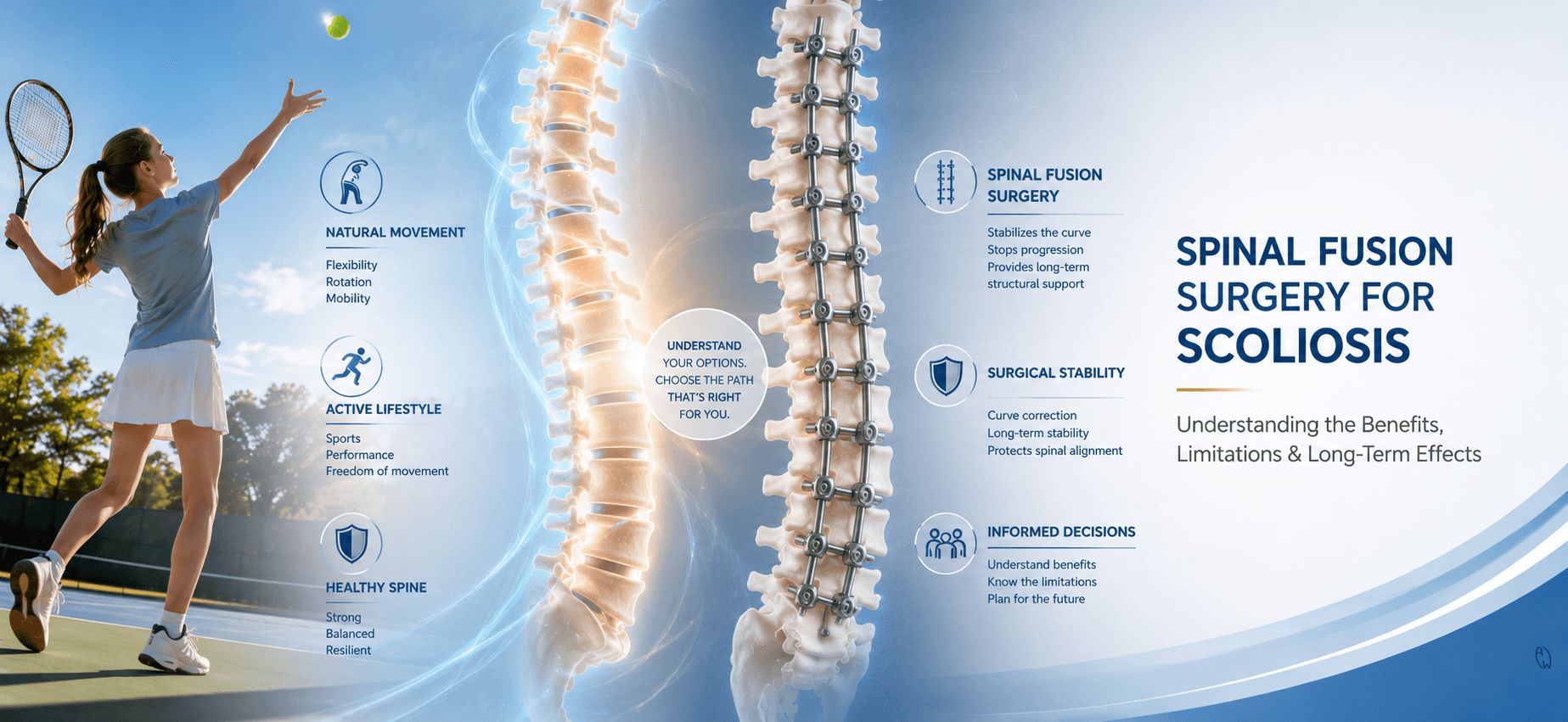
Spinal Fusion Surgery for Scoliosis: Understanding the Benefits, Limitations, and Long-Term Considerations
When a child or teenager is diagnosed with scoliosis, one of the biggest fears many families have is hearing the words "spinal fusion surgery."
For some patients with severe and progressive curves, spinal fusion can be a highly effective treatment that prevents further worsening and improves spinal alignment.
However, before making any treatment decision, it is important to understand both the benefits and the long-term implications of the procedure.
Understanding how spinal fusion works can help families make informed decisions and explore all available options for scoliosis management.
What Is Spinal Fusion Surgery?
Spinal fusion is a surgical procedure designed to stop scoliosis progression by permanently joining two or more vertebrae together.
During surgery, the surgeon typically places:
-
Metal rods
-
Screws
-
Hooks
-
Bone graft material
along the curved portion of the spine.
Over time, the bone graft encourages the vertebrae to grow together into a single solid structure.
The goal is to:
-
Reduce the spinal curve
-
Prevent future progression
-
Improve spinal balance
-
Protect heart and lung function in severe cases
For many patients with large curves, spinal fusion can provide significant benefits and lasting correction.
Why Is Spinal Fusion Recommended?
Most scoliosis patients never require surgery.
However, surgery may be recommended when:
-
Curves continue progressing despite treatment
-
Cobb angles become severe
-
Significant spinal deformity develops
-
Breathing or organ function may be affected
In these situations, surgery can help prevent further deterioration and improve quality of life.
For some families, spinal fusion is the right choice.
For others, understanding conservative treatment options early may help reduce the likelihood of reaching surgical thresholds.
What Does "Changing Spinal Mechanics" Mean?
One phrase commonly used when discussing spinal fusion is:
"Spinal fusion permanently changes spinal mechanics."
But what does this actually mean?
The human spine is designed to move.
Each vertebra contributes a small amount of motion that allows us to:
-
Bend
-
Twist
-
Reach
-
Jump
-
Run
-
Lift
-
Rotate
When multiple vertebrae are fused together, those segments can no longer move independently.
The spine becomes straighter and more stable, but it also becomes less flexible in the fused region.
This changes how movement and forces travel through the body.
Example 1: Reduced Spinal Flexibility
Imagine bending down to tie your shoes.
A healthy spine distributes that movement across many vertebral segments.
After fusion, the fused segments no longer contribute to that movement.
The body compensates by using the remaining mobile segments.
Many patients return to normal activities after surgery, but some notice reduced flexibility during:
-
Gymnastics
-
Dance
-
Yoga
-
Martial arts
-
Golf
-
Tennis
-
Baseball
The amount of movement loss depends largely on how many vertebrae are fused and where the fusion occurs.
Example 2: Increased Workload on Neighboring Segments
Think of the spine as a chain made of multiple moving links.
If several links become permanently fixed together, the remaining links must move more to compensate.
This is known as increased stress on adjacent segments.
For example:
If a fusion extends from T4 to L2, the neck and lower lumbar spine often take on additional movement demands.
Over many years, these areas may experience:
-
Increased mechanical stress
-
Joint irritation
-
Disc wear
-
Stiffness
This process is commonly referred to as adjacent segment degeneration.
Not every patient develops these problems, but it is an important long-term consideration.
Example 3: Changes in Shock Absorption
The natural spine functions like a flexible suspension system.
Each motion segment helps absorb and distribute forces generated during activities such as:
-
Walking
-
Running
-
Jumping
-
Carrying loads
When part of the spine becomes fused, force distribution changes.
Most patients continue to live active lives after surgery, but the biomechanics of movement are no longer exactly the same as before.
Example 4: Athletic Performance
Many athletes successfully return to sports after spinal fusion.
However, some sports rely heavily on spinal rotation and flexibility.
Examples include:
-
Golf
-
Tennis
-
Swimming
-
Gymnastics
-
Dance
-
Figure skating
A golfer, for example, may notice reduced rotational range during a golf swing because part of the spine is no longer moving.
The body often adapts remarkably well, but certain movements may feel different.
Example 5: Pregnancy After Spinal Fusion
One question many young female patients ask is:
"Can I still have children?"
The answer is yes.
Most women who have undergone spinal fusion experience healthy pregnancies and deliveries.
However, some may notice:
-
Increased back stiffness
-
Reduced spinal mobility
-
Greater discomfort during late pregnancy
Depending on fusion levels, certain medical procedures such as epidural placement may occasionally be more technically challenging.
Future Spine Care May Be More Complex
As we age, the spine naturally undergoes wear and tear.
These changes can include:
-
Disc degeneration
-
Arthritis
-
Joint stiffness
When fusion hardware is present, future spine treatments sometimes require additional planning because portions of the spine are already immobilized.
Again, this does not mean problems will occur.
It simply means that the long-term management of spinal health may be different.
A Personal Perspective From Clinical Practice
As a chiropractor who works with scoliosis patients, I often receive consultations from people who had spinal fusion surgery years ago and are now experiencing discomfort, stiffness, or movement restrictions.
I genuinely wish I could help them more.
Unfortunately, once a section of the spine has been fused, there is very little that can be done to restore movement to those segments. The only areas I can work with are the portions of the spine and body that remain mobile.
While we may be able to improve function in the surrounding joints and muscles, many of the complaints patients experience are directly related to the loss of motion in the fused area. In those situations, my ability to help is limited.
Over time, I have found that many of these patients benefit more from physiotherapy focused on localized pain management, strengthening, and rehabilitation strategies.
In chiropractic, we generally believe in treating the body as a whole rather than focusing only on a small area of pain. That is why I encourage families to carefully consider surgery when the primary motivation is cosmetic appearance alone or simply the desire to "feel straighter."
I say this from a place of genuine care, not criticism.
Your body has to go through a tremendous amount during spinal fusion surgery, and the decision deserves careful thought.
Is Spinal Fusion a Bad Option?
Absolutely not.
For some scoliosis patients, spinal fusion is life-changing.
It can:
-
Stop curve progression
-
Improve appearance
-
Restore balance
-
Prevent severe deformity
-
Protect cardiopulmonary function
The purpose of understanding the procedure is not to create fear.
The purpose is to help families make informed decisions.
Every treatment has benefits, limitations, and trade-offs.
Spinal fusion is no exception.
Why Early Conservative Treatment Matters
One reason many families seek scoliosis-specific rehabilitation early is because they hope to preserve as much natural spinal mobility as possible.
Conservative management may include:
-
Scoliosis-specific exercises
-
Postural rehabilitation
-
Strength training
-
Neuromuscular retraining
-
Lifestyle modification
-
Nutritional support
The earlier a curve is identified, the more opportunities there may be to influence spinal health before progression becomes severe.
I have also seen teenagers become interested in surgery after hearing stories on social media about someone gaining 2 or 3 centimeters in height following spinal fusion.
While it is true that some patients may appear taller after surgical correction, it is important to understand why.
Many teenagers are still in their growth phase. If scoliosis is addressed early using appropriate conservative approaches, growth can often continue naturally. In simple terms, the spine may just need a clearer path to grow and develop more efficiently.
Height alone should never be the reason to choose surgery.
This is one of the reasons I am so passionate about early intervention. When we identify scoliosis early and manage it proactively, we often have more opportunities to influence posture, function, and growth before the curve becomes severe.
The Goal Is More Than a Straighter Spine
Whether a patient chooses observation, rehabilitation, bracing, or surgery, the ultimate goal remains the same:
A strong, functional, healthy body.
Scoliosis treatment is not simply about changing an X-ray.
It is about helping patients maintain movement, confidence, physical function, and quality of life for decades to come.
For some individuals, spinal fusion may be the best path forward.
For others, early conservative care may help preserve mobility and reduce the likelihood of requiring surgery.
It is also important to remember that conservative treatment has its own challenges. Progress can be slow. It requires consistency, discipline, patience, and active participation from both the patient and family.
However, many people appreciate that they remain actively involved in the process and retain control over how they care for their bodies.
Whatever path you choose, make sure you fully understand both the benefits and the consequences before making a decision.
Please do not rush into any treatment simply because of social media, cosmetic concerns, or pressure from others.
Be kind to your spine.
In many cases, scoliosis is manageable, especially when it is detected early and addressed with the right guidance.
The key is understanding your options and making informed decisions based on your unique situation.