Don't Stretch a Torn Muscle: Why the Right Rehabilitation Matters More Than Rest
We've all heard the advice:
"Stretch it out."
But when it comes to a fresh muscle tear, that advice can actually make things worse.
A muscle isn't simply "tight." It's injured.
Understanding the difference can make the difference between a faster recovery and months of lingering pain.
Imagine a Resistance Band
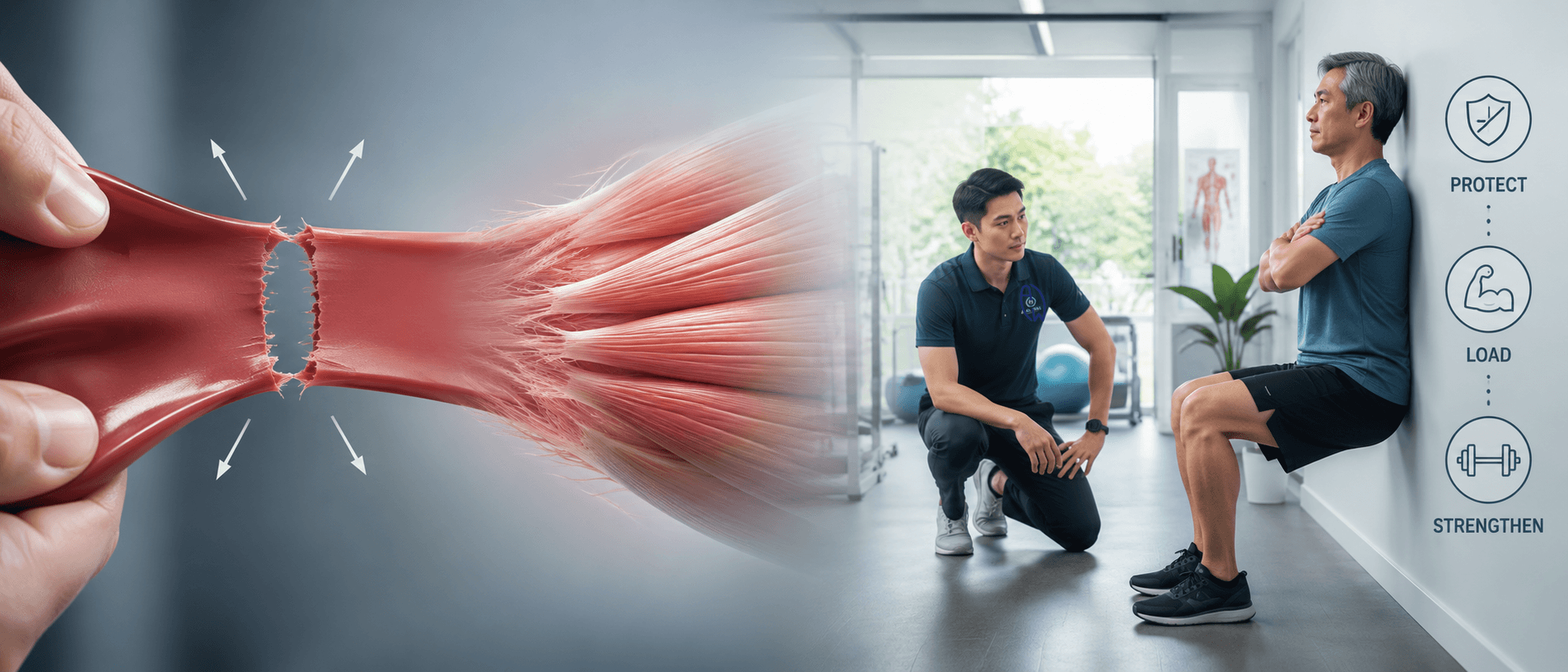
Think of your muscle like a resistance band.
Now imagine there's a small tear in the middle.
If you pull on that band, what happens?
The force doesn't spread evenly across the entire band anymore.
Instead, it concentrates at the weakest point—the tear.
The tear becomes larger.
That's exactly why we don't aggressively stretch a freshly torn muscle.
Early after an injury, the new repair tissue is the weakest part of the muscle. It needs time to become strong enough to handle force before being stretched.
Stretch too soon, and you risk pulling apart the very tissue your body is trying to rebuild.
But Here's Where the Resistance Band Analogy Ends
Unlike a resistance band...
Your muscle heals.
The human body is remarkable.
Muscle fibers repair themselves.
Scar tissue forms.
New collagen is laid down.
But healing doesn't automatically mean healing well.
Without the right kind of movement, the new tissue can become stiff, weak, and disorganized.
That's why complete rest isn't usually the answer.
The body is designed to move.
The challenge is knowing how to move safely.
Movement Is Medicine—When It's Done Correctly
Over the past few weeks, I've seen several patients return after major medical procedures.
Some underwent heart surgery to repair a valve or heart murmur.
Others had breast biopsies or breast surgery.
Every one of them wanted the same thing:
"When can I exercise again?"
The answer is almost never:
"Just stay in bed."
Of course, every person needs medical clearance from their surgeon or physician first.
But once it's safe to begin rehabilitation, the goal isn't endless rest.
The goal is progressive movement.
As a chiropractor working in rehabilitation, I don't simply resume someone's previous exercise program.
I modify it.
I adapt it.
I respect what the body has been through.
Even Healthy People Can Need Rehabilitation
Many people believe that if they eat perfectly, walk every day, exercise regularly, and follow every piece of health advice, they'll never experience illness or injury.
Unfortunately, life doesn't work that way.
Disease can still happen.
Accidents can still happen.
Surgery may become necessary.
Our bodies sometimes force us to slow down.
That isn't failure.
It's simply part of being human.
What matters most isn't avoiding every obstacle.
It's how we recover from them.
Why We Start With Tension, Not Stretching
One of the biggest mistakes after injury is confusing movement with stretching.
They're not the same thing.
Early rehabilitation focuses on teaching tissues to tolerate force—not increasing flexibility.
That usually means beginning with isometric exercises.
Examples include:
-
Wall sits
-
Static glute squeezes
-
Quad sets
-
Gentle abdominal bracing
-
Isometric calf raises
During these exercises, the muscle contracts, but the joint barely moves.
This allows the tissue to experience load without repeatedly pulling apart the healing fibers.
Think of it as teaching the muscle:
"It's safe to work again."
Then We Add Gentle Movement
Once pain begins to settle and healing progresses, movement gradually returns.
This doesn't mean pushing into discomfort.
It means using small, controlled ranges of motion.
Examples include:
-
Heel slides
-
Assisted squats
-
Supported bridges
-
Controlled shoulder mobility
-
Stationary cycling with minimal resistance
The goal isn't to chase flexibility.
The goal is simply to keep the body moving.
Motion improves circulation.
Movement stimulates healing.
And confidence begins returning.
Finally, We Build Strength
Only after the tissue can tolerate movement do we begin rebuilding real strength.
This is where slow, controlled resistance becomes powerful.
Examples include:
-
Goblet box squats
-
Slow eccentric calf raises
-
Tempo squats
-
Step-ups
-
Romanian deadlifts with light loads
-
Progressive resistance training
Eccentric exercises—where the muscle lengthens while producing force—are especially valuable because they help restore strength and resilience.
Progress isn't based on the calendar.
It's based on what your tissues can tolerate.
Everyone heals at a different pace.
Research Supports Early Loading
Interestingly, research in elite athletes has shown that rehabilitation emphasizing progressive loading and lengthening exercises can significantly shorten recovery.
In one well-known study of acute hamstring injuries, athletes following a rehabilitation program built around controlled lengthening exercises returned to sport in an average of 49 days, compared with 86 days using a more conventional rehabilitation program.
The lesson isn't that everyone should immediately perform aggressive lengthening exercises.
The lesson is this:
Appropriately loading healing tissue works better than simply resting it.
Early rehabilitation prepares the tissue to tolerate force before progressing to greater muscle length and higher demands.
Stretching Isn't the Hero
Stretching isn't bad.
It simply isn't the first priority.
Stretching doesn't rebuild muscle fibers.
Exercise does.
Loading does.
Strengthening does.
Stretching has its place later in rehabilitation, once healing tissue is strong enough to tolerate it safely.
Think of recovery in this order:
-
Protect the injury.
-
Load the tissue safely.
-
Restore movement.
-
Build strength.
-
Regain flexibility.
-
Return to full activity.
Skip the early steps, and recovery often takes longer.
Surgery Changes How We Exercise
One of the most important things you can do before returning to exercise is tell your healthcare practitioner about any recent procedure.
Many people only mention major surgeries.
But even smaller procedures can influence rehabilitation.
Examples include:
-
Heart surgery
-
Breast surgery or biopsy
-
Hernia repair
-
Knee or shoulder surgery
-
Dental or gum surgery
-
Cataract surgery
-
Cosmetic procedures
-
Botox or injectable treatments
Why?
Because every procedure changes the way your body heals.
Even if the surgery wasn't on your spine, it may temporarily affect posture, breathing, movement patterns, muscle activation, balance, or tissue healing.
Your rehabilitation program should reflect those changes.
Everything in the Body Is Connected
Our bodies don't function as isolated parts.
A surgical incision in the chest may change the way someone breathes.
A sore foot may change how someone walks.
A painful shoulder may alter spinal movement.
Even something as seemingly minor as gum surgery may affect nutrition, inflammation, or overall recovery during the early healing phase.
That's why we always ask about your medical history before progressing exercises.
It isn't being overly cautious.
It's good rehabilitation.
Healing Doesn't Mean Giving Up
If you've recently had surgery, don't think your fitness journey has ended.
It has simply entered a new chapter.
Your body still needs movement.
Your muscles still need challenge.
Your scar tissue still benefits from carefully prescribed exercise.
With patience and the right progression, your body often becomes stronger than you imagined possible.
The goal isn't simply to heal.
The goal is to return with confidence.
Our Philosophy at All Well
At All Well, rehabilitation is never a one-size-fits-all program.
Every patient's history matters.
Every surgery matters.
Every injury matters.
As chiropractors working alongside rehabilitation principles, we continually adjust your exercises based on your healing stage, symptoms, medical history, and functional goals.
Whether you've experienced a muscle injury, spinal condition, surgery, or simply want to move better again, our passion is helping you return safely to the activities you love.
Because human performance isn't about perfection.
It's about continually adapting, recovering, and moving forward.
Final Thoughts
Don't stretch a fresh muscle tear.
Protect it.
Load it appropriately.
Then strengthen it.
Stretching isn't forbidden forever—it simply isn't the tool that rebuilds damaged tissue in the early stages of healing.
If you've recently had any surgery or medical procedure, no matter how small, please let your healthcare provider know before returning to exercise. Always wait for clearance from your surgeon or physician before beginning rehabilitation.
Your body is designed to move.
Give it the right kind of movement, and it has an incredible ability to recover.
We'd Love to Be Part of Your Recovery
Thank you for trusting us to be your partner in health.
Rehabilitation and human performance are at the heart of what we do, and we're passionate about helping people move with confidence again.
If you found this article helpful, consider subscribing to our newsletter. We regularly share practical, evidence-informed tips on injury recovery, scoliosis, movement, rehabilitation, and healthy aging.
Have a question about a specific condition or injury? We'd love to hear from you. Feel free to send us an enquiry—we're always happy to point you in the right direction.
Because no question is too small when it comes to your health.