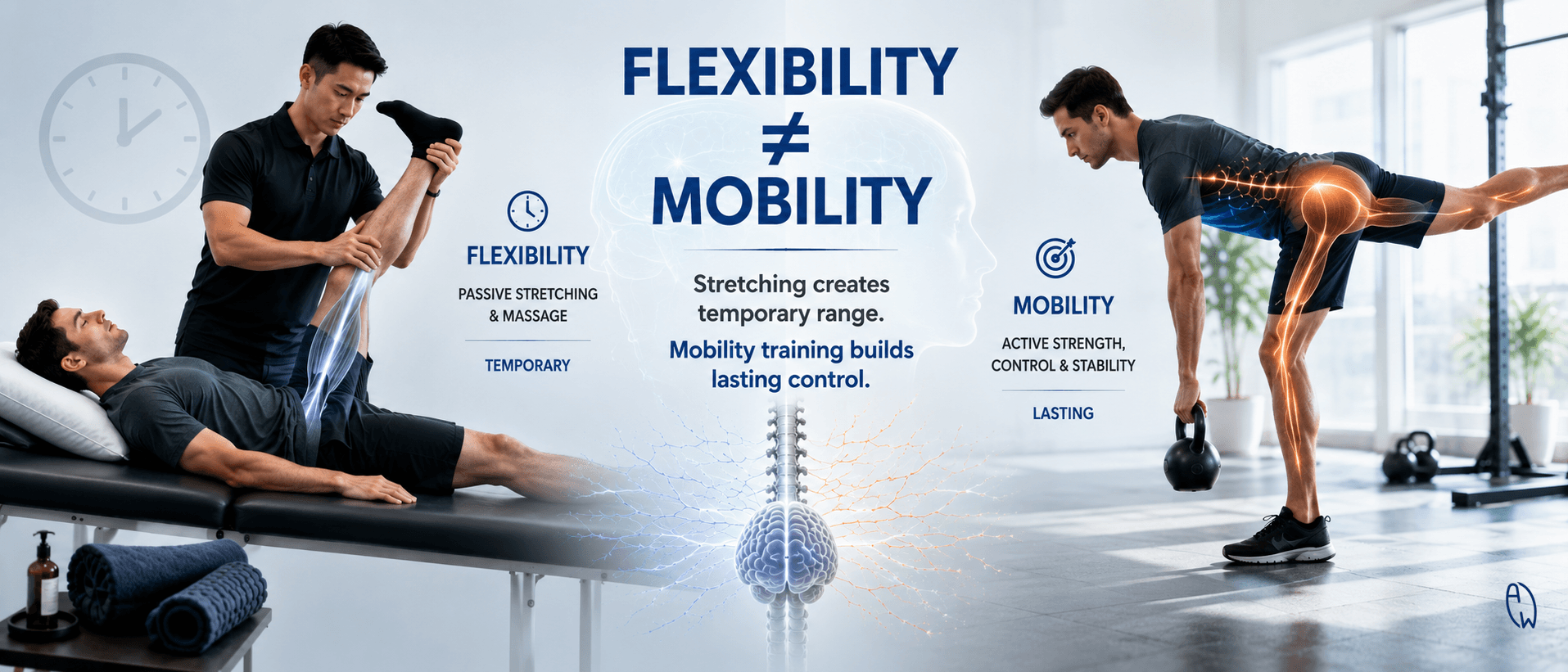
Flexibility vs. Mobility: Why Stretching Alone Won't Improve Your Movement
Flexibility vs. Mobility: They're Not the Same. Here's Why.
One of the biggest myths in fitness and rehabilitation is this:
"If I'm stiff, I just need to stretch more."
Or perhaps you've heard:
"I just need a massage every week."
While stretching and massage certainly have their place, they don't automatically improve mobility.
They may help you feel looser for a short period, but they don't teach your body how to keep that new range of motion.
That's because lasting mobility isn't just about your muscles.
It's about your brain, nervous system, muscles, and joints working together.
If your nervous system doesn't trust a new position, it won't let you keep it.
Let's break down why.
Flexibility vs. Mobility: What's the Difference?
Although people often use these words interchangeably, they're actually describing two very different things.
Flexibility
Flexibility is how far a muscle or joint can move passively.
Someone else can move your arm.
Gravity can pull you into a stretch.
A massage therapist can stretch your muscles.
You may even be able to fold yourself into impressive yoga poses.
But that doesn't necessarily mean you can actively control those positions.
Think of flexibility as available range.
Mobility
Mobility is how far you can actively move into a range with strength, stability, and control.
Mobility requires your:
-
Muscles
-
Nervous system
-
Balance
-
Coordination
-
Joint stability
to work together.
Think of mobility as usable range.
A gymnast doesn't just have flexible hips.
A dancer doesn't just have flexible hamstrings.
They've trained their nervous system to control those positions with strength.
Flexibility gives you access. Mobility lets you OWN it.
Stretching Gives You a Window—Not a Permanent Change
Have you ever noticed that immediately after stretching you feel taller, looser, and freer?
That's completely normal.
Stretching often creates a temporary window of increased range of motion.
But notice what happens a few hours later...
You're stiff again.
What happened?
Your nervous system simply returned to the movement pattern it already trusts.
Stretching changes how you feel temporarily.
Mobility training changes how your body moves permanently.
Your Nervous System Is the Real Gatekeeper
Many people think muscles become "tight."
In reality, your nervous system is often making a protective decision.
Your brain constantly asks one important question:
"Can I trust this position?"
If the answer is no...
It limits your movement.
Not because your body wants to annoy you.
Because it's trying to protect you.
Your nervous system only gives you long-term access to the ranges you can actively control.
And there's a very good reason for that.
Meet the Stretch Reflex: Your Built-In Safety System
Hidden inside every muscle are tiny sensory receptors called muscle spindles.
Their job is to monitor:
-
Muscle length
-
Speed of stretching
-
Changes in movement
The moment you move into an unfamiliar range, the muscle spindle alerts your nervous system.
Your nervous system responds by contracting that same muscle.
This automatic response is called the stretch reflex.
Its purpose is simple:
Protect you from entering a position you may not be able to control safely.
Your body isn't trying to make you stiff.
It's trying to keep you safe.
Understanding Viscoelasticity
Another reason stretching doesn't create permanent changes is because muscles are viscoelastic.
That means they behave in two ways.
Viscous
They temporarily change shape when stretched.
This is why you feel looser after stretching.
Elastic
Like an elastic band, muscles naturally return toward their habitual resting shape.
Soon after you stop stretching, your tissues gradually drift back to where your nervous system feels comfortable.
This is why passive stretching usually creates temporary change, not lasting change.
Why Stretching Alone Doesn't Work
Imagine someone stretches their hamstrings every morning.
They can touch their toes afterwards.
Great.
But they never strengthen that new range.
They never control that new range.
They never load that new range.
So the nervous system says:
"Interesting... but we don't actually use this."
And gradually, the extra movement disappears.
Your body keeps what it needs.
It lets go of what it doesn't use.
The SAID Principle: Your Body Adapts to What You Practice
One of the most important concepts in rehabilitation is the SAID Principle:
Specific Adaptation to Imposed Demands.
Your body adapts specifically to the stresses you repeatedly place upon it.
If all you ever do is passive stretching...
You'll become better at passive stretching.
If you strengthen muscles through greater ranges of motion...
Your nervous system begins trusting those positions.
That's when mobility improves.
Why Loading and Control Matter
The secret isn't stretching farther.
The secret is loading and controlling the range you want to keep.
When you actively move through a new range, your brain learns:
"I can control this."
Over time, that position becomes familiar.
Your nervous system no longer sees it as dangerous.
That's when lasting mobility develops.
Example: Improving Hip Extension
Suppose you want better hip extension for walking, running, climbing stairs, or sports.
Many people simply stretch their hip flexors.
That may temporarily feel good.
But lasting improvement comes from teaching the body to use that range.
A better approach would be:
-
Position yourself so the correct muscles can engage with minimal compensation.
-
Keep your pelvis stable instead of arching your lower back.
-
Actively contract your gluteal muscles to drive the hip backward.
-
Allow the hip flexors to lengthen under control.
-
Progressively strengthen the movement over time.
Your nervous system gradually recognizes that position as safe.
Now you've earned mobility—not just borrowed flexibility.
Think Weekly Massages Will Fix Your Mobility? Think Again.
Here's a cheeky truth...
If you think booking a massage every week is going to permanently fix your stiffness or pain...
Sorry... probably not.
And yes...
Even if it's a sport massage or deep tissue massage or Thai massage.
Even if someone stretches you until you're making faces and wondering why you paid for the privilege.
You'll probably walk out feeling fantastic.
Looser.
Lighter.
Less sore.
Massage therapy can absolutely help reduce muscle tension, improve circulation, and temporarily improve your range of motion.
That's why so many people love it.
But here's the catch...
Your nervous system hasn't actually learned anything new.
If your body can't actively control that new movement, it simply goes back to the pattern it already trusts.
It's like borrowing flexibility instead of owning it.
Massage is a fantastic tool for helping you feel better.
But it's not a substitute for mobility training.
Lasting Mobility Is Earned—Not Given
A therapist can move your body.
A massage therapist can stretch your body.
Gravity can pull your body into a position.
But only you can teach your nervous system to keep that position.
That happens when you:
-
Load the tissues
-
Build strength through the range
-
Improve coordination
-
Practice controlling the movement
-
Repeat it consistently
That's what creates lasting mobility.
So next time someone tells you,
"You just need to stretch more."
or
"Go get another massage."
Remember this:
Mobility isn't earned by being pulled into a position.
It's earned by loading, strengthening, and controlling your ranges.
That's the difference between feeling better for an hour...
...and moving better for years.
💡 Did You Know?
Research shows that passive stretching and massage therapy can temporarily improve flexibility and reduce muscle tension. However, long-term improvements in mobility are more likely when these are combined with strength training, active movement, and motor control exercises. Your nervous system keeps the ranges that it trusts you can control—not simply the ones you've been stretched into.
Why Mobility Matters
Better mobility isn't just for athletes.
It benefits everyone.
Good mobility can improve:
-
Walking efficiency
-
Squatting and lifting
-
Sports performance
-
Balance
-
Posture
-
Joint health
-
Everyday movement
-
Confidence during daily activities
For people recovering from injury or living with conditions such as scoliosis, arthritis, or chronic back pain, improving mobility can also reduce unnecessary compensations and help movement become more efficient when guided by an appropriate rehabilitation program.
Common Myths
Myth 1: Tight muscles only need stretching.
Not always.
Sometimes muscles feel tight because they're weak, overloaded, fatigued, or protecting an unstable joint.
Myth 2: Flexibility equals mobility.
Not true.
You can be extremely flexible but still lack strength and control.
Myth 3: Painful stretching creates faster results.
Nope.
Stretching harder doesn't teach your nervous system anything.
Control does.
Myth 4: Mobility is only important for athletes.
Everyone benefits from moving better—from office workers to older adults.
How to Build Lasting Mobility
The best mobility programs combine:
-
Dynamic warm-ups
-
Active mobility drills
-
Strength training through full ranges of motion
-
Balance exercises
-
Stability training
-
Progressive loading
-
Consistent practice
Stretching can still be a valuable part of your routine.
Massage can help you recover.
But neither replaces active movement.
The goal isn't simply to become more flexible.
The goal is to become stronger within your flexibility.
The Bottom Line
Stretching and mobility are not the same.
Stretching may temporarily increase your range of motion.
Massage may help you feel looser.
But neither teaches your nervous system to permanently keep those improvements.
Your brain only grants long-term access to the ranges you can actively control.
That's why lasting mobility isn't earned by stretching.
It isn't earned by painful Thai massages.
It isn't earned by someone else forcing you deeper into a stretch.
It's earned by loading, strengthening, and controlling your movement.
When your body learns that a position is both strong and safe, your nervous system stops guarding it—and that's when real, lasting mobility begins.
Frequently Asked Questions
Does stretching improve mobility?
Stretching can temporarily increase your range of motion, but lasting mobility requires active strength, motor control, and progressive loading.
Can massage permanently improve mobility?
Massage can reduce muscle tension and provide short-term improvements in comfort and flexibility. However, lasting mobility is developed through active movement, strengthening, and control.
Can you be flexible but not mobile?
Absolutely. Many people can passively move into large ranges but lack the strength and stability to actively control them.
Why do muscles tighten again after stretching?
Because muscles are viscoelastic and your nervous system protects ranges it doesn't trust. Without active training, your body usually returns to familiar movement patterns.
What's the best way to improve mobility?
Combine stretching with active mobility exercises, strength training, balance work, and progressive loading. The ranges you strengthen are the ranges you're most likely to keep.