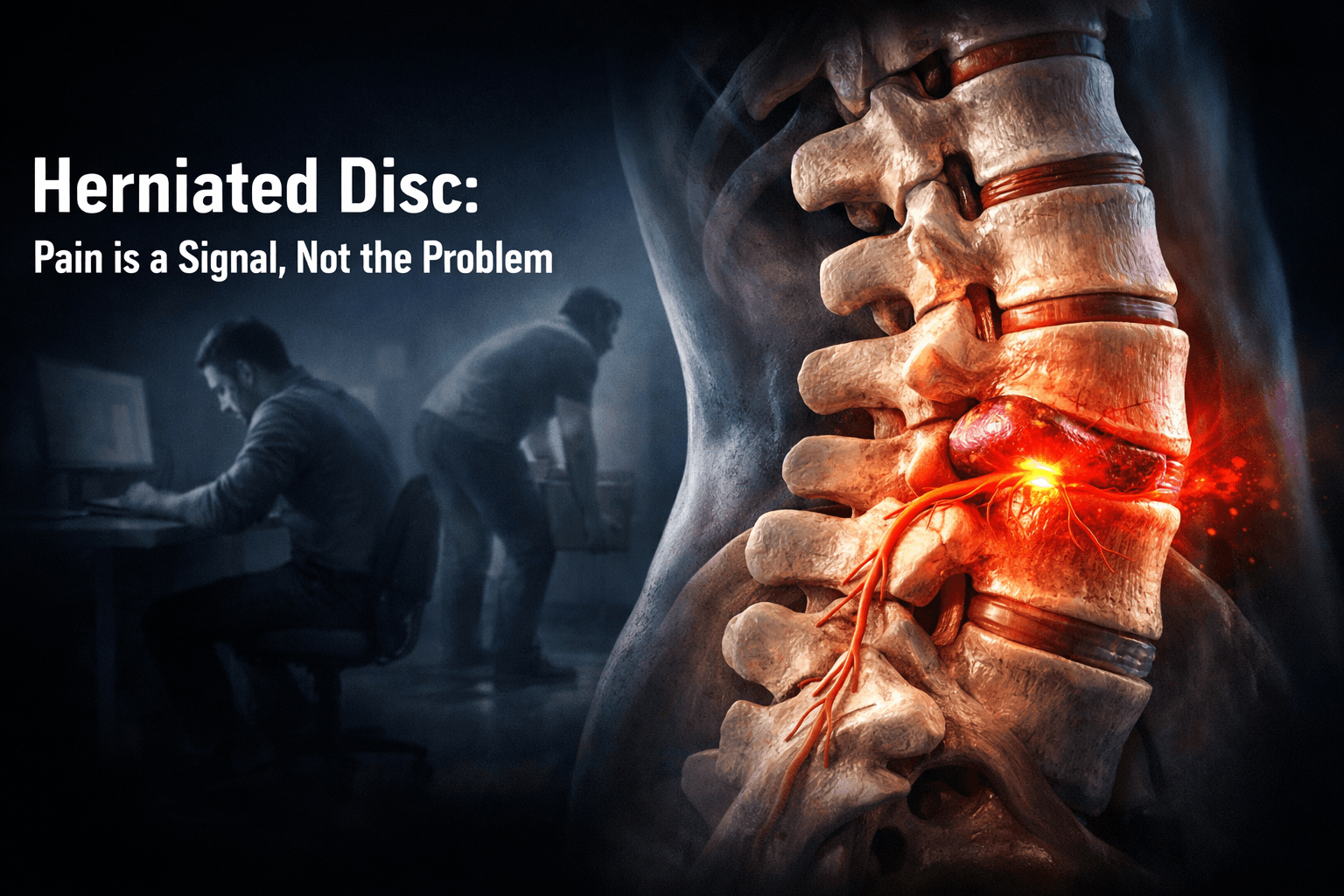
Herniated Disc: Causes, Symptoms, Stages of Pain & How to Prevent Long-Term Damage
A herniated disc is one of the most common causes of back pain, yet it’s also one of the most misunderstood. Many people ignore early warning signs—until the condition begins to affect movement, nerves, and even basic bodily functions.
If you’ve ever felt persistent back discomfort, sharp radiating pain, or numbness down your leg, your body may already be telling you something important.
What Is a Herniated Disc?
Your spine is made up of bones called vertebrae, and between each vertebra sits a disc that acts like a shock absorber.
Each disc has two main parts:
-
Nucleus pulposus: a soft, gel-like center
-
Annulus fibrosus: a tough outer ring that holds everything in place
When the outer ring weakens or tears, the inner gel can push outward into the spinal canal. This is known as a disc herniation.
When this happens, the disc can press on nearby nerves—leading to pain, numbness, or weakness.
What Causes a Herniated Disc?
A herniated disc is rarely caused by one single event. It’s usually the result of repetitive stress + poor habits over time, followed by a trigger.
Common causes include:
-
Sudden twisting movements of the spine
-
Heavy lifting (especially with poor form)
-
Long-term poor posture (e.g. sitting incorrectly, prolonged driving)
-
Lack of movement or sedentary lifestyle
-
Dehydration (discs lose elasticity without proper hydration)
Key risk factors:
-
Aging (natural disc degeneration)
-
Obesity (extra load on the spine)
-
Pregnancy
-
Weak connective tissue
-
Poor physical conditioning
Symptoms of a Herniated Disc
Not all disc herniations are painful. But when a nerve is compressed, symptoms can become severe.
Common symptoms:
-
Localized back or neck pain
-
Radiating pain (e.g. down the leg—commonly called “sciatica”)
-
Numbness or tingling
-
Muscle weakness
-
Reduced mobility
Most herniated discs occur in the lumbar spine (lower back), causing pain that travels into:
-
Buttocks
-
Thighs
-
Calves
-
Feet
The 3 Stages of Herniated Disc Pain (Real Clinical Insight)
From clinical experience, many patients don’t understand how pain evolves—and this is where problems begin.
Stage 1: Sensory Warning
-
Mild discomfort or occasional pain
-
Tightness that comes and goes
-
Often ignored
This is your body whispering.
Stage 2: Functional Limitation
-
Stiffness and reduced mobility
-
Difficulty sitting, standing, or walking for long
-
Needing frequent breaks (e.g. sitting every 100 meters)
This is when most patients finally seek help.
Stage 3: Neurological Deficit (Serious Stage)
-
Numbness spreading down the limb
-
Loss of sensation
-
Difficulty controlling bladder (loss of urgency)
-
Severe nerve compression
This is your body shouting—and sometimes, it’s already close to irreversible damage.
Why Early Treatment Matters
One of the biggest mistakes people make is waiting too long.
Many patients only come in when the pain becomes unbearable—but by then:
-
The nerve may already be compromised
-
Recovery takes longer
-
Treatment becomes more complex
Diagnostic tools such as:
-
X-rays
-
MRI scans
-
CT scans
can confirm whether a nerve is being compressed and how severe the condition is.
A Chiropractor’s Perspective: The Everyday Reality
As a chiropractor, this is something seen daily—not just in clinics, but everywhere:
-
At the gym: poor lifting mechanics
-
On the MRT: slouched posture
-
In restaurants: uneven sitting positions
-
In meetings: prolonged static posture
You start to notice patterns:
-
One shoulder higher than the other
-
Weight shifted unevenly
-
Poor spinal control
And the reality is this:
people continue to push through pain until the body forces them to stop.
The Hard Truth: You Are Not Built Like Steel
Your body is organic, not mechanical.
-
Your muscles fatigue
-
Your discs dehydrate
-
Your nerves get irritated
-
Your joints wear down
But many people operate on adrenaline and dopamine—masking pain just to keep going.
That’s not resilience.
That’s delayed damage.
Prevention: The Smarter Approach
Instead of waiting for breakdown, focus on protecting your spine early.
Key strategies:
-
Maintain proper posture (especially when sitting)
-
Stay active with regular movement
-
Strengthen core and stabilizing muscles
-
Hydrate consistently
-
Practice proper lifting techniques
-
Avoid prolonged static positions
Do You Need Surgery?
Surgery is sometimes necessary—but it should not be your first option.
Most herniated disc cases can be managed with:
-
Conservative care
-
Movement correction
-
Targeted rehabilitation
The goal is always to:
-
Reduce nerve pressure
-
Restore movement
-
Prevent recurrence
Final Thoughts: Take Ownership of Your Body
You only have one spine.
Every time you ignore discomfort, push through poor mechanics, or delay care—you are not building strength.
You are borrowing from your future health.
The question is simple:
Do you want to wait until your body breaks down…
or start taking care of it before it does?
Be proactive.
Be aware.
And most importantly—be responsible for your own body.