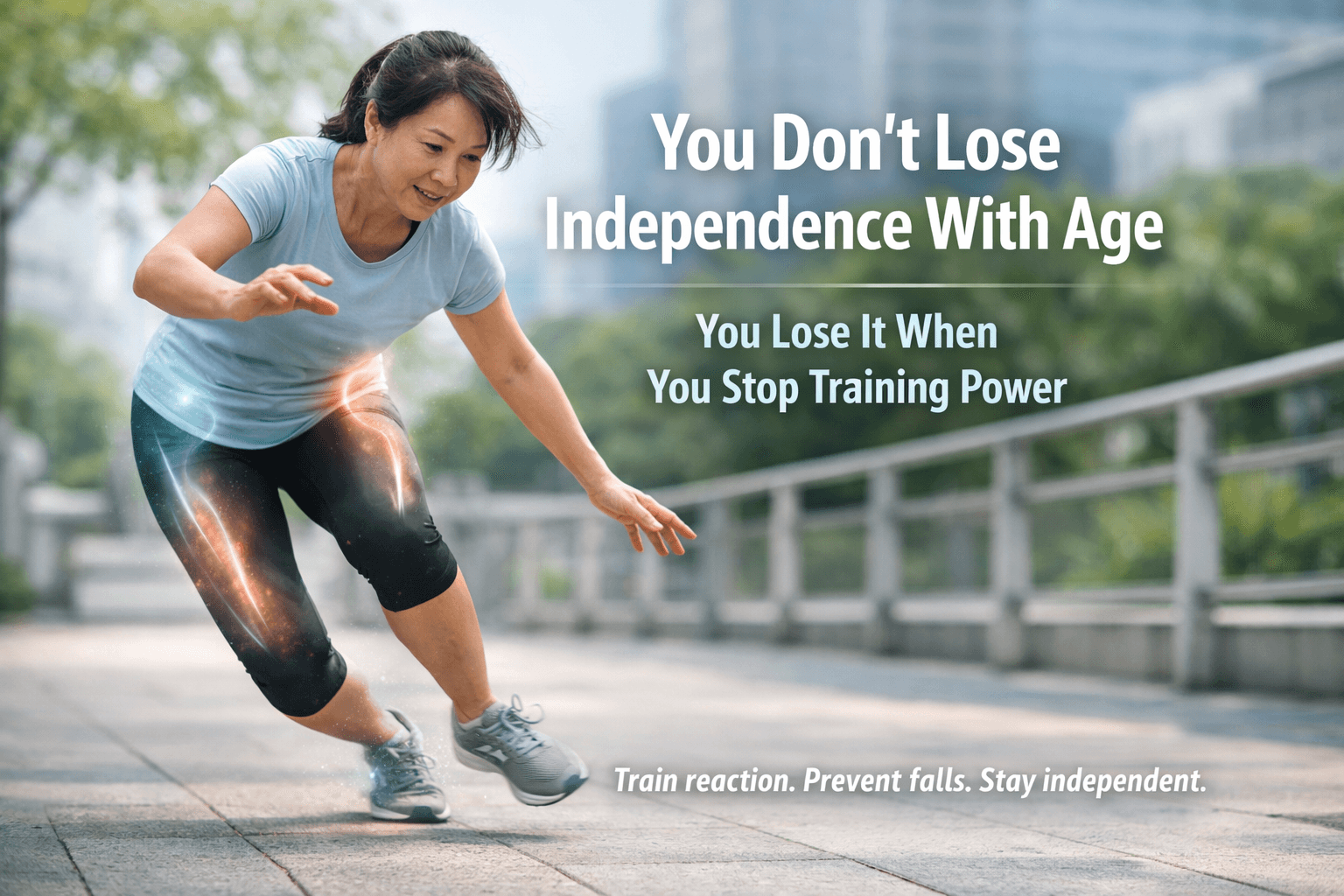
You Don’t Lose Independence Because You Get Old — You Lose It Because You Stop Training for This
Most people believe aging automatically leads to weakness, slower movement, and eventually loss of independence. But that’s not entirely true.
What actually disappears first isn’t your strength or even your endurance.
It’s your power.
And if you’re not training it, you’re silently increasing your risk of falls, fractures, and long-term dependency.
What Is “Power” — And Why It Matters More Than You Think
In exercise science, power isn’t just about strength. It’s defined as:
Force × Speed
Power = Force × Velocity
This means it’s not just about how much you can lift — but how fast you can react and produce force.
That quick reaction is exactly what saves you when you:
-
Trip on uneven ground
-
Miss a step on the stairs
-
Slip on a wet floor
Strength helps you carry groceries.
Power helps you catch yourself before you fall.
The Missing Link in Most Fitness Routines
Most people focus on:
-
Strength training (weights, resistance bands)
-
Cardio (walking, jogging, cycling)
These are important — but they don’t fully prepare your body for real-life unpredictability.
There’s a third component that’s often ignored:
👉 Explosive, reactive movement
Without it, you may still be “fit” — but not resilient.
The Role of Muscle Fibers in Aging
Your muscles are made up of two main fiber types:
Type I Fibers (Slow-Twitch)
-
Built for endurance
-
Help you walk, stand, and sustain activity
-
Fatigue-resistant
Type II Fibers (Fast-Twitch)
-
Built for speed and power
-
Activate during sudden, explosive movements
-
Critical for balance recovery
Here’s the problem:
👉 Fast-twitch (Type II) fibers decline earlier and faster with age
And if you don’t train them, your body starts to lose:
-
Reaction speed
-
Coordination
-
Ability to generate force quickly
Why This Matters: Falls, Fractures, and Independence
Loss of muscle power is strongly associated with:
-
Increased risk of falls
-
Higher chance of fractures
-
Reduced ability to live independently
In fact, many people who “feel fine” during daily activities are still at risk — simply because they can’t react fast enough when something goes wrong.
Women: The Hidden Risk in Midlife
For women, this decline can accelerate during midlife due to hormonal changes.
This is where we start to see:
-
Faster muscle loss
-
Reduced neuromuscular efficiency
-
Increased fall risk
You may still be doing yoga, Pilates, or even strength training — but without power work, your protective reflexes are undertrained.
Why Strength Alone Isn’t Enough
You can:
-
Lift weights
-
Do regular cardio
-
Stay active
…and still struggle to catch yourself when you trip.
Because strength builds capacity, but power builds responsiveness.
👉 Strength = moving objects
👉 Power = saving yourself
The Good News: Power Is Trainable at Any Age
The body adapts remarkably well — even later in life.
You don’t need long, exhausting workouts.
You need short, intentional, explosive efforts with full recovery.
Best Exercises to Train Power Safely
Start simple and progress gradually. Focus on speed, coordination, and control.
Beginner to Intermediate Options:
-
Jump rope (low impact variations)
-
Kettlebell swings
-
Medicine ball throws
-
Sled pushes or pulls
-
Short sprints (bike or walking uphill if needed)
-
Low-level plyometrics (small hops, step jumps)
How to Structure Your Training
-
Frequency: 2–3 times per week
-
Sets: 3–5 sets per exercise
-
Reps: 3–8 explosive reps
-
Rest: Full recovery between sets (important)
Quality matters more than quantity.
If speed drops — stop.
A Clinical Perspective on Longevity and Movement
From a spine and musculoskeletal standpoint, maintaining independence isn’t just about avoiding pain.
It’s about preserving:
-
Reaction time
-
Neuromuscular control
-
Dynamic stability
This is especially important for individuals with:
-
Postural imbalances
-
Scoliosis
-
Previous injuries
Power training — when done correctly — enhances how the body coordinates and protects itself under stress.
The Bottom Line
You don’t suddenly lose independence because of age.
You lose it because:
-
Your muscles stop responding quickly
-
Your body stops adapting to unpredictability
-
Your training stops preparing you for real life
If longevity matters to you:
👉 Train your fast-twitch fibers
👉 Move with intention
👉 Build not just strength — but reactive power
Because at the end of the day:
Strength helps you move through life.
Power helps you stay in it.
Medical Disclaimer
This article is for educational purposes only and does not constitute medical advice.
Scoliosis varies significantly between individuals. Always consult a qualified healthcare professional before starting any new sport or exercise program, especially if you have scoliosis, spinal conditions, pain, or previous injuries. Participation in sports should be guided by individual assessment and professional recommendation.
The image is shared for educational purposes with patient consent. Individual outcomes vary. Structural correction does not automatically restore full respiratory function. Clinical assessment is required.
Copyright & Content Protection Notice
© 2026 All Well Scoliosis Centre. All rights reserved.
This content is original and protected by copyright law.
No part of this article may be reproduced, distributed, copied, or reused in any form without prior written permission. Unauthorized use, duplication, or content scraping is strictly prohibited.